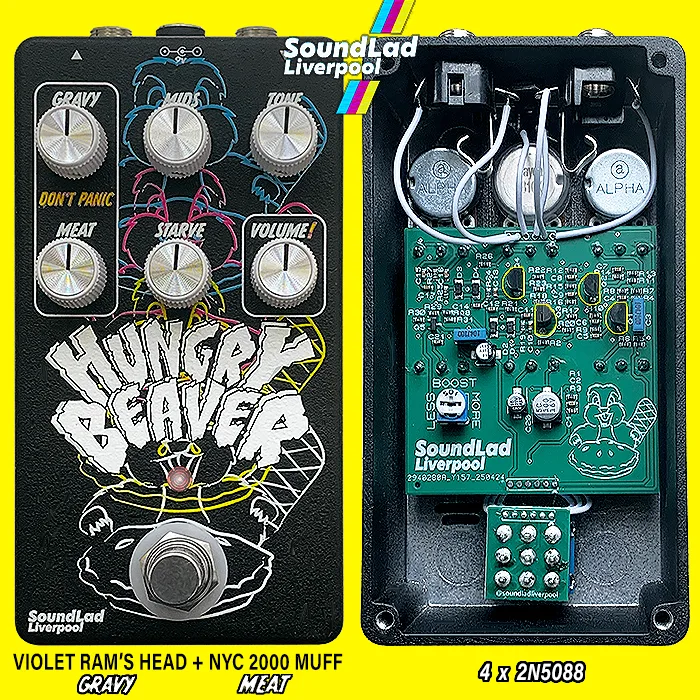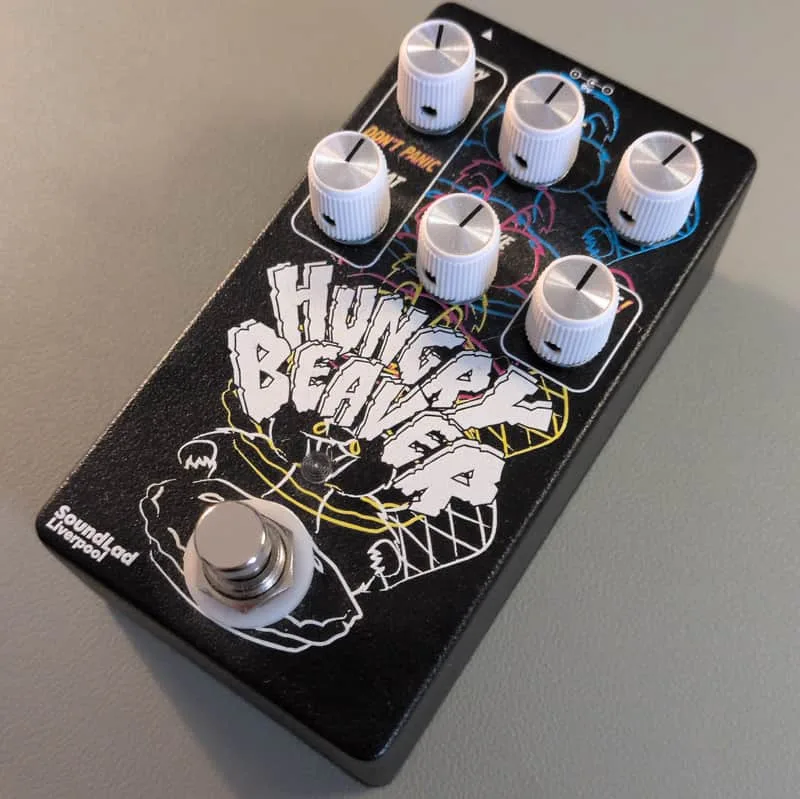



The SoundLad Liverpool Hungry Beaver is a fuzz pedal with a boost, hand-built in the UK by SoundLad Liverpool to Marc Dunn's own design. It is not a straight Big Muff copy: MusicRadar's reviewer described it as "a Muff-influenced design that's been pulled through a voltage starved" boostable circuit, built to "slam the front end of an amp harder than you could ever think possible"1.
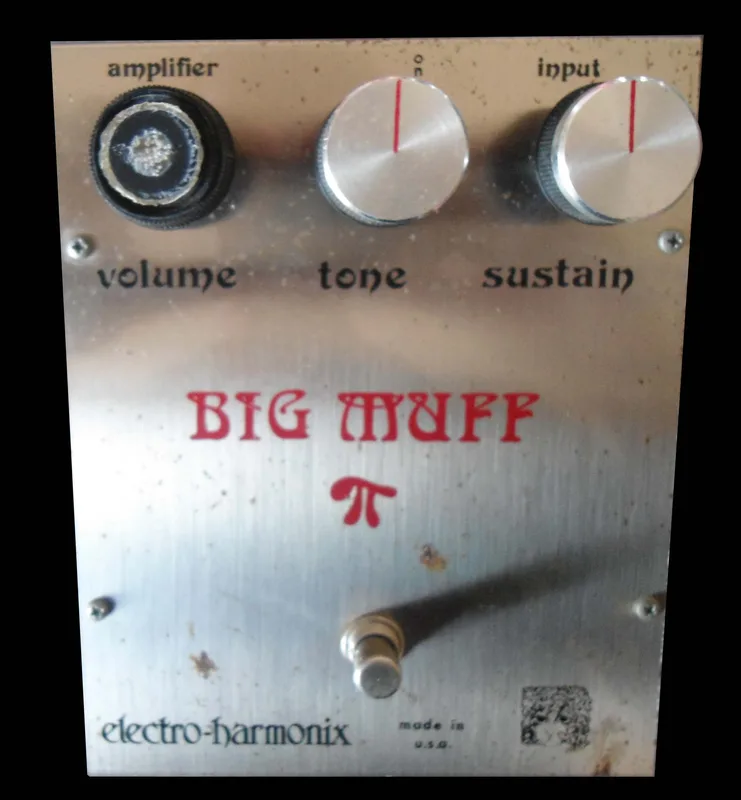
Guitar Pedal X called it the "Multi-Muff", because instead of one Muff voice it carries two: a Gravy gain circuit based on a 1973 Violet Ram's Head Muff, and a Meat gain circuit based on the NYC 2000 Muff, plus a Big Muff dual-filter tone stack and a Starve control that starves the circuit's voltage for gated, dying-battery fuzz character2.
Two Muffs in one box: how the controls work
The Hungry Beaver's control set splits the Big Muff legacy into separate knobs, which is what separates it from a straight clone12.
| Control | What it does |
|---|---|
| Gravy (Gain 1) | Mids-focused gain, based on a 1973 Violet Ram's Head Muff2 |
| Meat (Gain 2) | Thick and chunky gain, based on the NYC 2000 Muff2 |
| Tone | Big Muff dual-filter tone stack2 |
| Starve | Voltage-starve control; Meat adjusts the fuzz level when Starve is dialed in1 |
MusicRadar's reviewer characterized the two voices by their Muff ancestry: "Meat is thick and chunky like a modern Russian/New York sound whereas Gravy is less so with more mids, like a classic"1. That gives you a scooped, thick fuzz at one end and a more mid-forward, cutting fuzz at the other, with the Tone control sweeping a wide EQ range. The reviewer's verdict on that range: "Versatile with a very wide EQ sweep"1.
An internal Boost trimmer sits inside the pedal, and it changes how the Starve control behaves. Guitar Pedal X's reviewers explained: "Crank Meat and Gravy right up, turn the internal Boost to max and the second half of the 'starve dial' starts to be useable too!"2. In other words, the deepest starve settings, where the fuzz gates and collapses, only become practical with the gain controls and internal boost set high.
Is it a Big Muff clone?
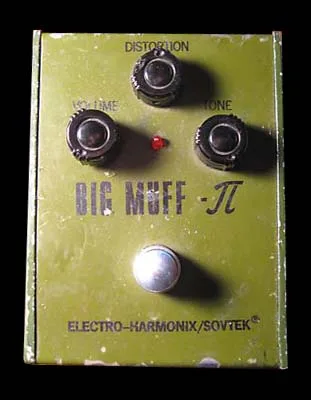
No, and both reviews are explicit about it. MusicRadar's reviewer wrote that "the Hungry Beaver isn't a mere Big Muff clone, more a Muff-influenced design that's been pulled through a voltage starved" boostable circuit1. Guitar Pedal X framed it as an evolution: for the MK2, the builder "combining Violet Ram's Head and NYC 2000 flavour" into what the site called a killer expanded-range Big Muff3.
So the family resemblance is real, but the Hungry Beaver adds what a stock Muff does not have: two selectable Muff voicings in one circuit, a voltage-starve control, and an internal boost. If you want a straight reproduction of one specific Muff, this is not that pedal; if you want a Muff-flavored fuzz with more range, that is the pitch both reviewers responded to123.
Price and versions
The pedal has gone through a few versions, and the pricing has shifted with them423.
| Version | Price | Date |
|---|---|---|
| Original | £99 (UK) | December 20224 |
| Multi-Muff | £129 | June 20252 |
| MK2 Multi-Muff (Violet Ram's Head x NYC 2000) | £129 / $169 | December 20253 |
When component costs rose, the builder did not pass the increase on to the price of the pedal itself. Instead, machined aluminum knobs became the standard fit at the previous £99 price, with the original knobs available for £20 extra1. MusicRadar called the result "a very fair price for a hand-built UK pedal"1, and Guitar Pedal X judged the Multi-Muff "superb value at just [£129]"2.
The £99 and £129 prices are UK prices as stated by the reviews. The only US dollar figure given is $169 for the MK2 in December 202531.
Power and connections
The Hungry Beaver runs on a 9V power supply drawing 4mA, with input, output and power sockets on the enclosure, and true bypass switching1. A 4mA draw is low enough that the pedal places almost no demand on a shared or daisy-chained supply, and true bypass means it leaves your dry signal alone when switched off.
Who makes it
SoundLad Liverpool is the maker, and the Hungry Beaver is Marc Dunn's own hand-built design1. MusicRadar first reviewed his fuzz pedal in 2022, later writing "we reviewed his first fuzz pedal in 2022, and we never forgot it"4, and the pedal earned a place in Guitar Pedal X's roundup of the best new fuzz pedals of 20254.
Videos
SoundLad Liverpool
SoundLad Liverpool
SoundLad Liverpool
Questions
Is the Hungry Beaver a Big Muff clone?
No. MusicRadar's reviewer called it a Muff-influenced design rather than a clone, pulled through a voltage-starved, boostable circuit. Its two gain controls are based on two different Muffs: Gravy on a 1973 Violet Ram's Head and Meat on the NYC 2000 Muff.
Is the SoundLad Hungry Beaver true bypass?
Yes. MusicRadar's review lists the pedal as true bypass, so with the effect switched off your signal passes through without buffering.
How much does the Hungry Beaver cost?
The MK2 Multi-Muff was listed at £129 / $169 in December 2025. Earlier versions were £99 in the UK, with machined aluminium knobs as standard and the original knobs available for £20 extra.
What power supply does the Hungry Beaver use?
A 9V DC power supply, drawing only 4mA according to MusicRadar's review. That low current draw makes it easy to run alongside other pedals on a shared supply.
Who makes the Hungry Beaver?
SoundLad Liverpool, a UK builder. The pedal is Marc Dunn's own hand-built design, which MusicRadar noted was made to slam the front end of an amp harder than you could think possible.
Sources (4)
- SoundLad Liverpool Hungry Beaver Voltage Starved Power Fuzz / Boost pedal review, MusicRadar, 2022-08-15
- Guitar Pedal X, Guitar Pedal X, 2025-06-06
- Guitar Pedal X, Guitar Pedal X, 2025-12-08
- Our 11 favourite effects pedals of 2022, MusicRadar, 2022-12-22