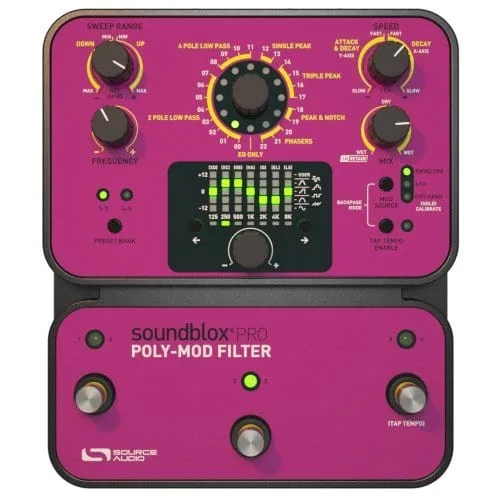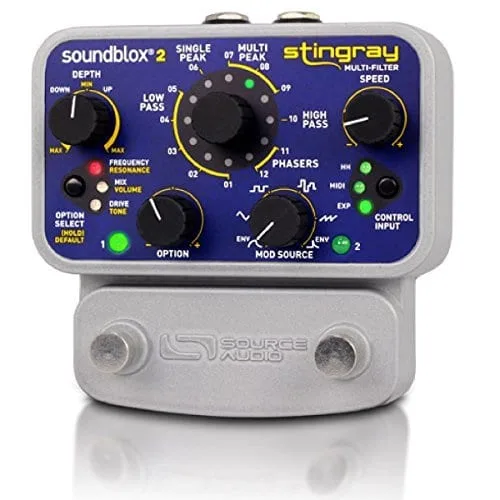

The Source Audio Soundblox 2 Stingray Multi-Filter is a digital filter pedal released by Source Audio on October 16, 20141. It puts 12 filter effects in one compact stompbox, covering low pass, high pass, band pass, single peak, multi-peak, notch and phaser types12, and each filter can be modulated four ways: by an envelope follower that tracks your picking, by an LFO with tap tempo, by the Hot Hand motion sensor ring, or by Source Audio's Dual Expression Pedal2. Premier Guitar described its range as "a wealth of completely original tones, everything from basic wahs to ambient oscillating vocal sounds and beyond"1.
What it is and what it does
The Stingray is a DSP-based multi-filter: instead of one fixed wah or envelope circuit, the EFFECT knob selects the filter type, and the rest of the knobs shape how that filter moves3. Source Audio houses it in the same compact, rugged cast aluminum Soundblox 2 enclosure used across the line23. The signal path runs through the company's proprietary 56-bit SA601 Digital Signal Processor with 24-bit converters23, and the manual lists a 115dB DNR audio path with a 56-bit digital data path3.
In Normal Mode the EFFECT knob offers 12 filters3:
| Position | Normal Mode filter | |
|---|---|---|
| 01 | 2-pole low-pass filter | |
| 02 | 4-pole low-pass filter | |
| 03 | Two parallel low-pass filters | |
| 04 | Three parallel low-pass filters | |
| 05 | Notch > low-pass filters | |
| 06 | Peak filter | |
| 07 | Low-pass > two peak filters | |
| 08 | Triple peak filter A | |
| 09 | Triple peak filter B | |
| 10 | High-pass filter | |
| 11 | Phaser, dual notch | |
| 12 | Phaser, triple notch | 3 |
A global Extended Mode setting expands this to 24 filters, adding designs like a 6-pole low-pass, a 4-pole low-pass with offset peaks, band-pass, triple peak filters C and D, and single and dual notch combinations3. Extended Mode is a global setting rather than something saved per preset3.
The pedal also carries a Drive function, which MusicRadar's launch coverage said "can be used to generate everything from subtle overdrive to full-on fuzz"2. The manual describes the distortion circuit as a soft clipper with an even, smooth characteristic and a warm spectrum at lower DRIVE settings, becoming more aggressive with sharper edges and more harmonics at higher settings3.
Controls and how to modulate the filter
The front panel works as a set of knobs plus an OPTION SELECT button that cycles through six parameters controlled by the OPTION knob, with the selected parameter shown by a green or red LED3. Frequency and resonance are among those parameters3.
| Control | What it does |
|---|---|
| EFFECT knob (A) | Selects the filter type3 |
| OPTION knob (C) | Adjusts the parameter chosen by the OPTION SELECT button3 |
| OPTION SELECT button (F) | Cycles through six parameters; green or red LED shows the selection3 |
| FREQUENCY (green LED) | Sets the frequency center point of the filter's modulation range, low to high clockwise3 |
| MOD SOURCE knob (E) | Selects the modulation source, with a gradual blend between selections3 |
| CONTROL INPUT button (G) | Selects the external controller type: OFF, HH, MIDI, or EXP3 |
The MOD SOURCE knob chooses between the envelopes and four LFO waveforms: sine, square, random sample and hold, and sawtooth3. The LFO's modulation speed can be synced with the pedal's tap tempo function12. The manual notes that the Random Sample and Hold source uses a randomized staircase waveform that "recreates the chaotic filter sounds found in some vintage analog synthesizers"3.
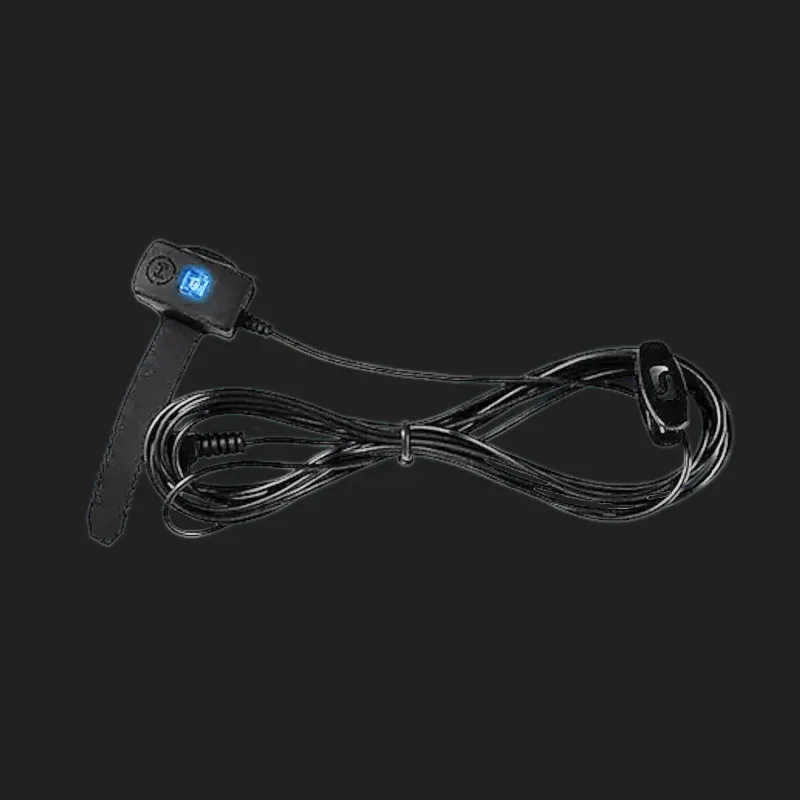
External control comes through the multi-function input, which accepts digital or analog signals and interfaces with the SA115 Hot Hand Wireless Controller, the SA111 Hot Hand Wired Sensor, the SA161 Dual Expression Pedal, and the SA164 Soundblox HUB3. In EXP mode, the Dual Expression Pedal controls filter modulation and can also be assigned to any other knob parameter3.
Hot Hand itself is Source Audio's motion control system: a two-axis accelerometer you wear like a ring, which lets you smoothly control pedal parameters by moving your hand4. For players comparing control options, an expression pedal gives conventional foot control of the same parameters.
Presets, MIDI and the Soundblox HUB
On its own, the Stingray stores two user presets, each recalled by its own dedicated footswitch32. Like every Soundblox 2 pedal, it is compatible with the Soundblox Hub v1: connecting it to the Hub alongside up to four other Soundblox 2 pedals taps into the pedal's full MIDI capabilities1. Through the HUB, MIDI gives access to control parameters and up to 128 user presets2. The Hub itself offers USB, 5-pin MIDI, and Multi-Function ports5.
The two on-pedal presets are what you get without the HUB. The 128-preset figure applies only when the pedal is connected to the Soundblox HUB for MIDI access32.
Power, bypass and connections
The Stingray runs on 9V DC with a negative tip power jack, drawing 140mA, or up to 180mA with the Hot Hand Wireless Adapter attached3. A 9V DC power supply is included2. Bypass is Source Audio's Universal Bypass, selectable between analog buffered and relay-based true bypass32. Audio connections are a mono GUITAR IN for guitar, bass, or other instruments and a GUITAR OUT to your amp or next pedal, with optional MULTI-FUNCTION IN and OUT jacks3. The manual lists a maximum input level of 2.0 Vrms (+6 dBV), 1 MOhm input impedance, and 1 kOhm output impedance3.
In the USA, Source Audio covers the pedal with a two-year warranty from the date of purchase by the original purchaser at an authorized dealer, and the warranty does not extend to batteries3. It can be transferred to a later owner within the warranty period, provided Source Audio receives the registration information, proof of the transfer within thirty days, and a photocopy of the original sales receipt3.
Where it came from
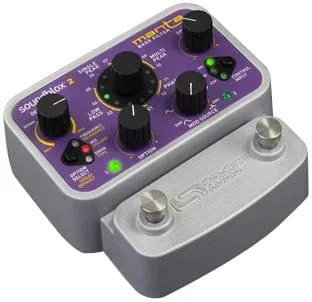
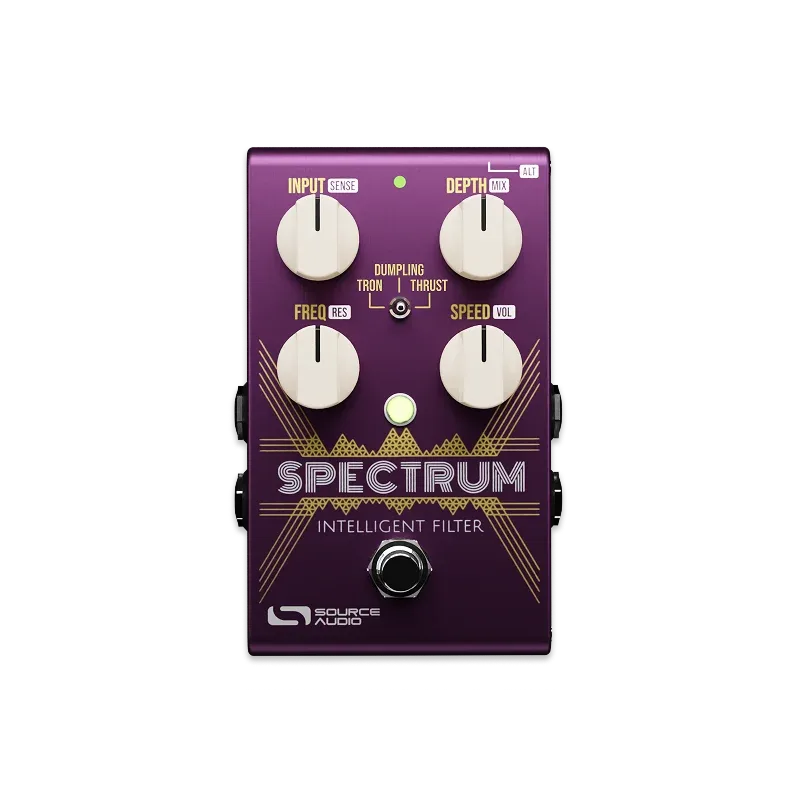
The Stingray was released on October 16, 2014 as part of Source Audio's Soundblox 2 line, whose pedals share precision 56-bit signal processing and a multi-function input that supports MIDI, expression pedal, or Hot Hand control671. Its closest sibling is the Soundblox 2 Manta Bass Filter, which offers twenty-four filter types for shaping the final tonal spectrum89. Source Audio later revisited the filter concept with the Spectrum Intelligent Filter.
Videos
ProGuitarShopDemos
Questions
Does the Stingray come with a power supply?
Yes. MusicRadar's launch coverage lists a 9V DC power supply as included with the pedal. The manual specifies a 9V DC power jack with a negative tip, drawing 140mA, or up to 180mA when the Hot Hand Wireless Adapter is connected.
Can I control the Stingray with an expression pedal?
Yes. The pedal has an EXP mode for use with the SA161 Source Audio Dual Expression Pedal. The expression pedal controls filter modulation and can also be assigned to control any other knob parameter. The CONTROL INPUT button selects which external controller type is active: OFF, HH, MIDI, or EXP.
Can the Stingray be used with a bass?
Yes. The manual describes the GUITAR IN jack as accepting a guitar, bass, or other instrument via a mono instrument cable. Source Audio also makes a bass-focused sibling, the Soundblox 2 Manta Bass Filter, which shares the same 12 filter effects and adds eight on-board distortion types.
How many presets can the Stingray store?
On the pedal itself, two user presets, each recalled by its own dedicated footswitch. Connected to the Soundblox HUB, the pedal gains full MIDI access to control parameters and can save up to 128 user presets.
What is the Hot Hand on the Stingray?
Hot Hand is Source Audio's motion control system: a two-axis accelerometer worn like a ring that lets you smoothly control pedal parameters by moving your hand. The Stingray's multi-function input interfaces with the SA115 Hot Hand Wireless Controller and the SA111 Hot Hand Wired Sensor.
Does the Stingray work with the Soundblox Hub?
Yes. Like all Soundblox 2 pedals, the Stingray is compatible with the Soundblox Hub v1. Connecting it to the Hub, along with up to four other Soundblox 2 pedals, unlocks the pedal's full MIDI capabilities, including saving up to 128 user presets.
Sources (9)
- Source Audio Launches Soundblox 2 Stingray Filter, Premier Guitar, 2014-10-16
- Source Audio releases Soundblox 2 Stingray multi-filter pedal, MusicRadar, 2014-10-22
- Source Audio SoundBlox 2 Stingray Multi-Filter User Manual PDF, Source Audio LLC
- SOURCE AUDIO Soundblox 2 OFD Bass microModeler Pedal SA228 B&H, B&H Photo Video
- Source Audio Releases the Soundblox Hub Manager, Guitar Interactive Magazine, 2014-08-13
- NAMM 2012: Source Audio to release Soundblox 2 line of guitar, bass effects, MusicRadar, 2012-01-15
- Source Audio Unveils Soundblox 2 Series at NAMM, No Treble, 2012-01-28
- NAMM 2014: Source Audio Introduces SoundBlox 2 Manta Bass Filter, Guitar Interactive Magazine, 2014-01-16
- Source Audio Launches Soundblox 2 Manta Bass Filter, Premier Guitar, 2014-01-15