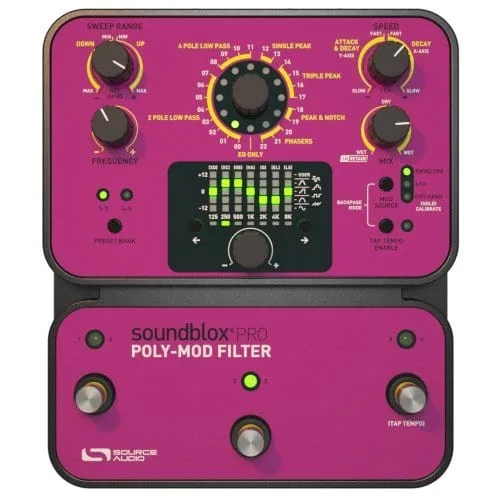


The Source Audio Soundblox Pro Poly-Mod Filter is a filter pedal for guitar and keyboard that puts 23 filter effects in one box, from 2 and 4 Pole Low Pass variations to Single Peak, Triple Peak, Peak & Notch and phaser sounds1. Announced by Source Audio in January 2013, it builds on the company's earlier Soundblox Pro Bass Envelope Filter, carrying what Source Audio described as "all the power and functionality of our award winning Soundblox Pro Bass Envelope Filter" in a package aimed at players of both instruments1.
Where a simple envelope filter or wah gives you one motion and one sound, the Poly-Mod Filter lets you choose the filter type and then choose how it moves: with your picking dynamics, with an LFO, with an expression pedal, or with Source Audio's Hot Hand motion controller1.
23 filter effects for guitar and keyboard
The pedal's 23 filter effects include multiple variations on 2 and 4 Pole Low Pass, Single Peak, Triple Peak, Peak & Notch, and phasers1. For a player, that range covers the familiar territory: low pass filters sweep from bright to dark like a slowly closing tone control, peak filters emphasize a narrow band for vocal-like quack, and notch filters cut a band out for hollow, comb-filtered textures.
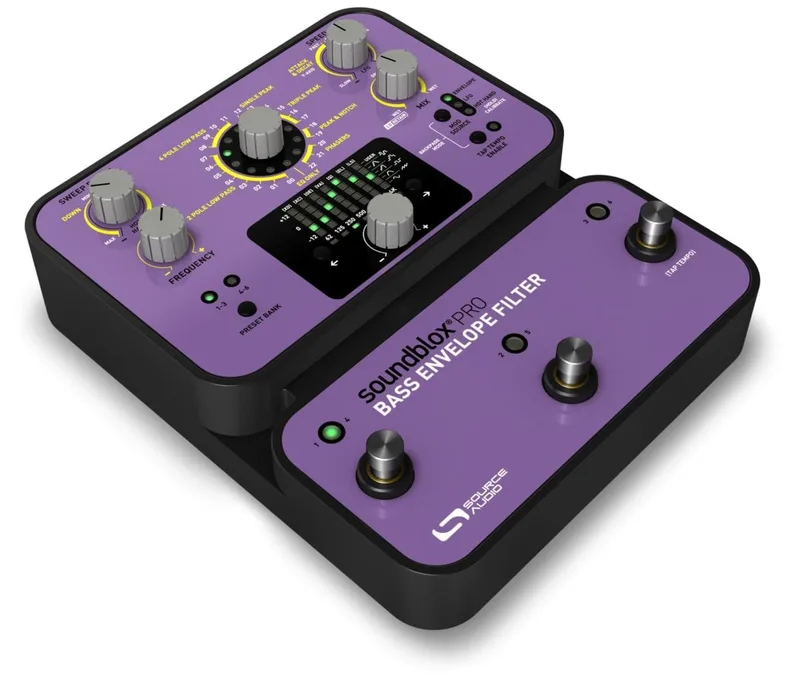
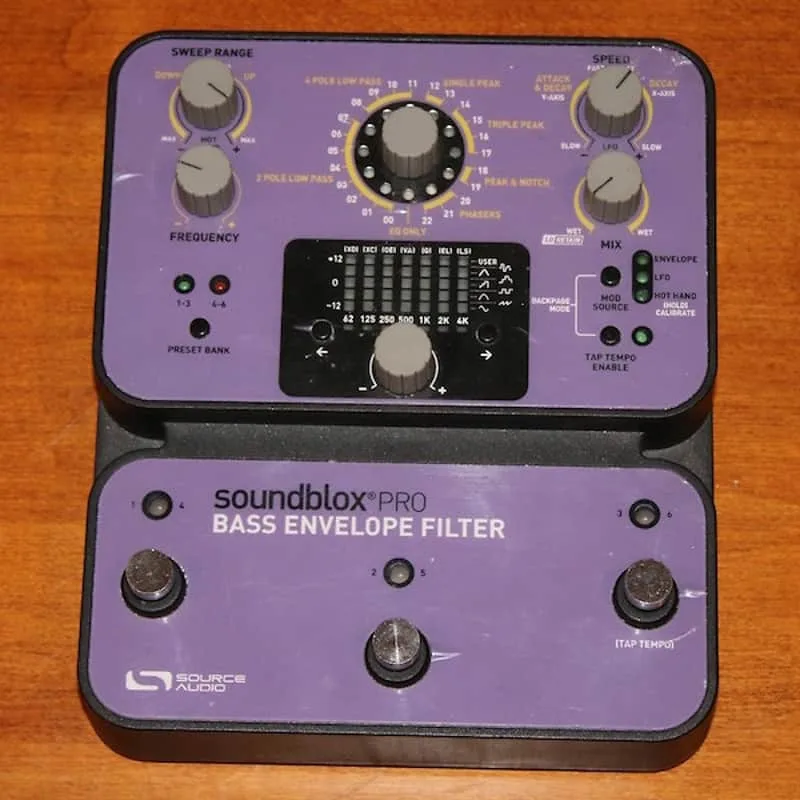
The family resemblance is direct. The Soundblox Pro Bass Envelope Filter, announced in July 2011, offered 22 filter sounds drawn from the same categories: 2 Pole Low Pass, 4 Pole Low Pass, Single Peak, Triple Peak, Peak & Notch, and phasers1. The Poly-Mod Filter adds one more effect and, more importantly, opens the modulation sources beyond the envelope follower that gives an envelope filter its name.
| Pedal | Filter effects | Announced | Target instruments |
|---|---|---|---|
| Soundblox Pro Bass Envelope Filter | 22 | July 20112 | Bass |
| Soundblox Pro Poly-Mod Filter | 23 | January 20131 | Guitar and keyboard |
The controls, presets and modulation sources
Each of the 23 filters can be driven four ways1:
- Envelope follower: the filter responds to your picking attack, the classic auto-wah behavior
- Variable wave shape LFO: the filter sweeps automatically, with a Low Frequency Oscillator whose shape you can vary, and tap tempo speed control1
- Expression pedal: an expression input allows control of a wide variety of pedal parameters1
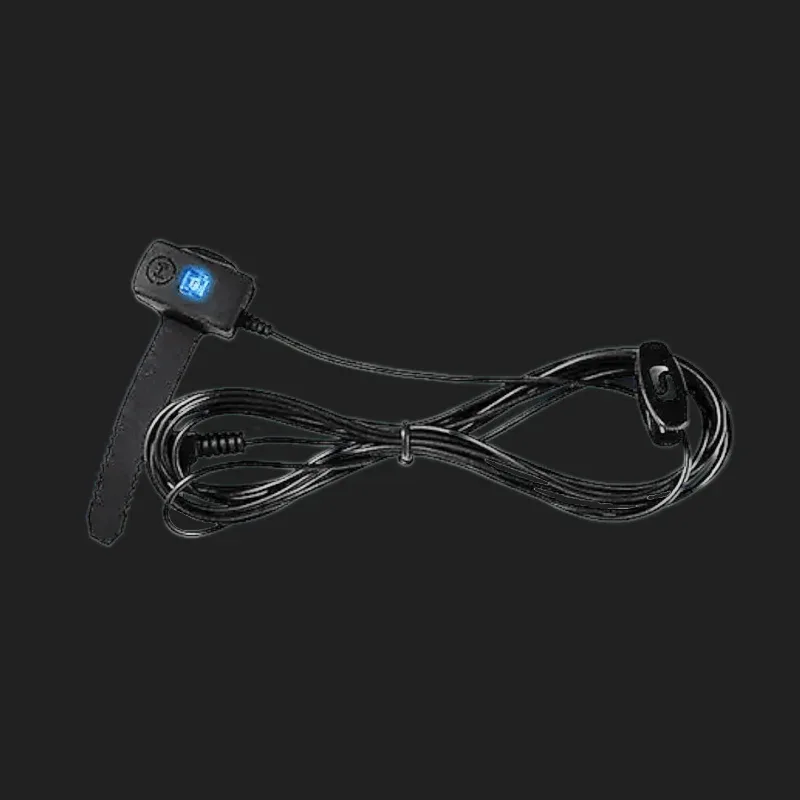
- Hot Hand: Source Audio's motion-sensing effect controllers, which the Soundblox Pro line supports3
The adjustable parameters include positive and negative filter sweeps (whether the filter opens or closes as the control source rises), sweep range, attack and decay speed, frequency range, LFO rate with tap tempo, and Q, the control that sets how sharp or resonant the filter's peak is1.
Presets are handled with three footswitches and two preset banks holding six user presets, so you can jump between configured sounds on a gig without bending down1. Each preset can carry its own tone shaping: the pedal includes what Source Audio calls an "Ultra-precise 7-band equalizer for in-depth tone control saved per preset"1. That per-preset EQ means a peak filter preset can be voiced differently from a low pass preset without redoing your amp settings.
A MIDI input also allows external access to presets and parameters1, so the pedal fits into a larger MIDI pedalboard setup where a controller switches sounds across several units at once.
Analog dry path, digital engine
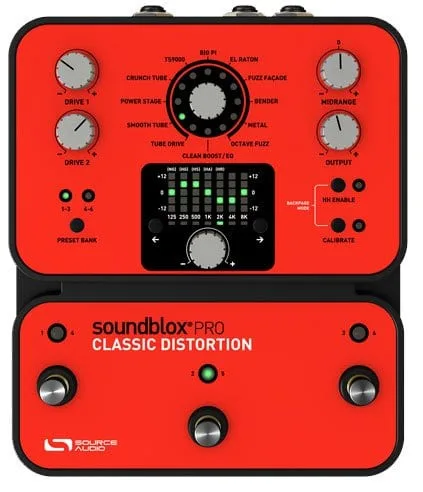
The Poly-Mod Filter is a digital pedal at heart, built on Source Audio's proprietary 56-bit SA601 digital signal processor with 24-bit converters1. That same SA601 engine and 24-bit converter design appears across the Soundblox Pro line; Premier Guitar's review of the Soundblox Pro Classic Distortion noted the identical DSP and converter specification in that pedal4.
The bypass, though, is analog. Source Audio describes an "Active Analog Bypass" in which the bypass path is fully routed around the DSP, with an active input to ensure zero signal degradation1. In practice that means your dry tone does not pass through the converters when the effect is off.
Where it came from
The Poly-Mod Filter carries the Soundblox Pro series' emphasis on extended control. A tap tempo speed control sets the speed of the LFO, and an expression input allows for control of a wide variety of pedal parameters1.
The pedal's signal routing and physical design follow the rest of its series. Its Active Analog Bypass is fully routed around the DSP, with an active input to ensure zero signal degradation1. A 9V DC power supply is included, and the enclosure measures 7 in./17.8 cm long (not including I/O jacks), 6 in./15.25 cm wide and 2 in./5 cm high including the knobs1.
Videos
Premier Guitar
sourceaudioeffects
Questions
Does the Soundblox Pro Poly-Mod Filter have MIDI?
Yes. The pedal has a MIDI input that allows external access to its presets and parameters, so you can switch sounds and change settings from a MIDI controller rather than tapping footswitches on the pedal itself.
Does the Poly-Mod Filter work with the Hot Hand?
Yes. Each of its 23 filter effects can be controlled by a Hot Hand effect controller, Source Audio's motion-sensing ring or strap controller, alongside the envelope follower, the LFO and an expression pedal.
Is the Soundblox Pro Poly-Mod Filter analog or digital?
It is digital. Source Audio built it around its proprietary 56-bit SA601 digital signal processor with 24-bit converters. The bypass, however, is an active analog design routed fully around the DSP so the dry signal is untouched when the effect is off.
How is the Poly-Mod Filter different from the Soundblox Pro Bass Envelope Filter?
The Poly-Mod Filter carries all the power and functionality of the Soundblox Pro Bass Envelope Filter and adds modulation sources beyond the envelope follower, including a variable wave shape LFO, expression pedal control and Hot Hand. It also offers 23 filter effects rather than the Bass Envelope Filter's 22.
Sources (4)
- Source Audio's New Soundblox 2 and Pro Poly-Mod Filter, Premier Guitar, 2013-01-22
- Source Audio Introduces the Soundblox Pro Bass Envelope Filter, No Treble, 2011-07-21
- Source Audio Unveils Soundblox Pro Pedals at NAMM 2010, Premier Guitar, 2010-01-06
- Source Audio Soundblox Pro Distortion Pedal Review, Premier Guitar, 2010-05-18