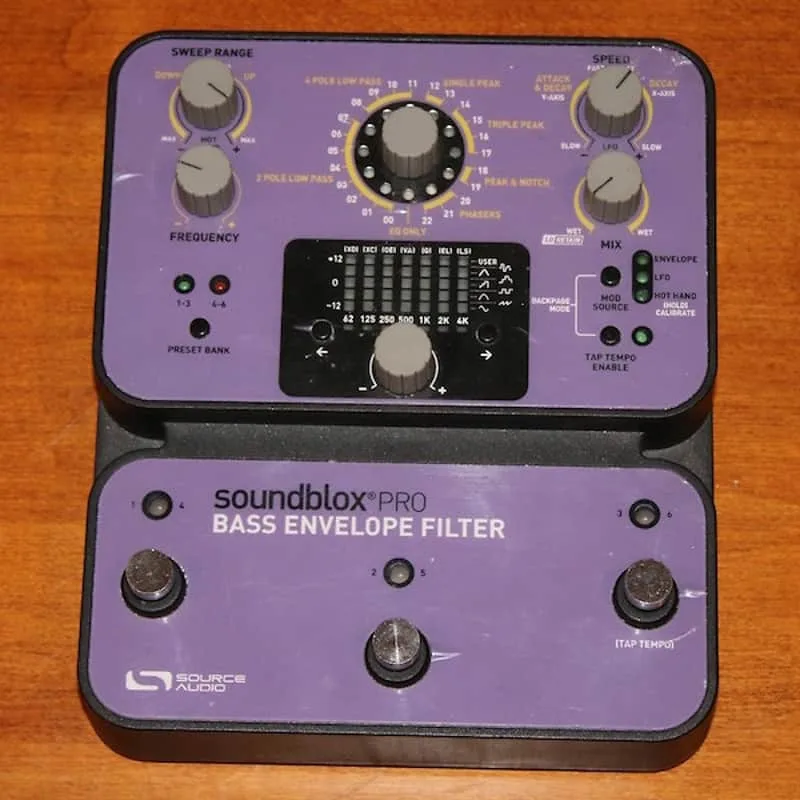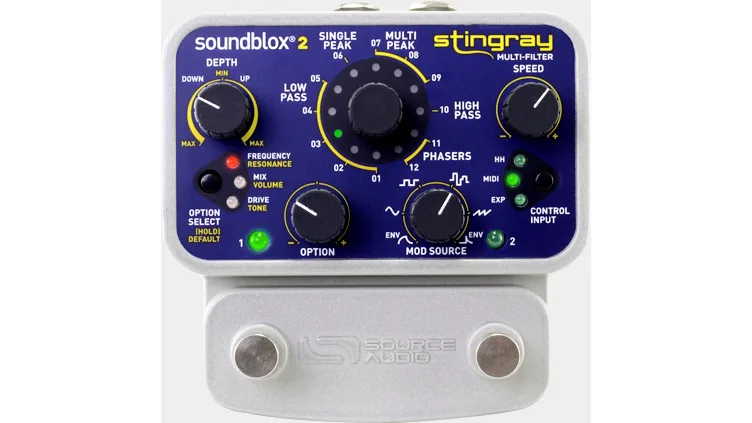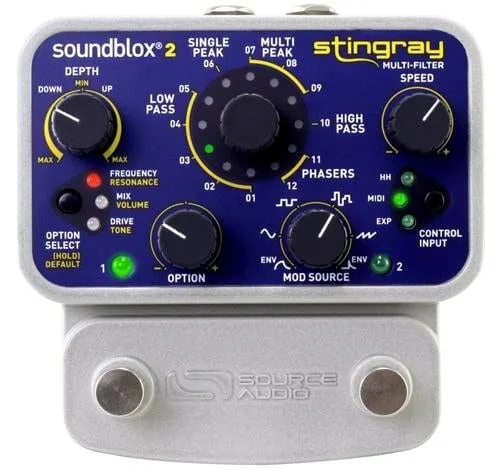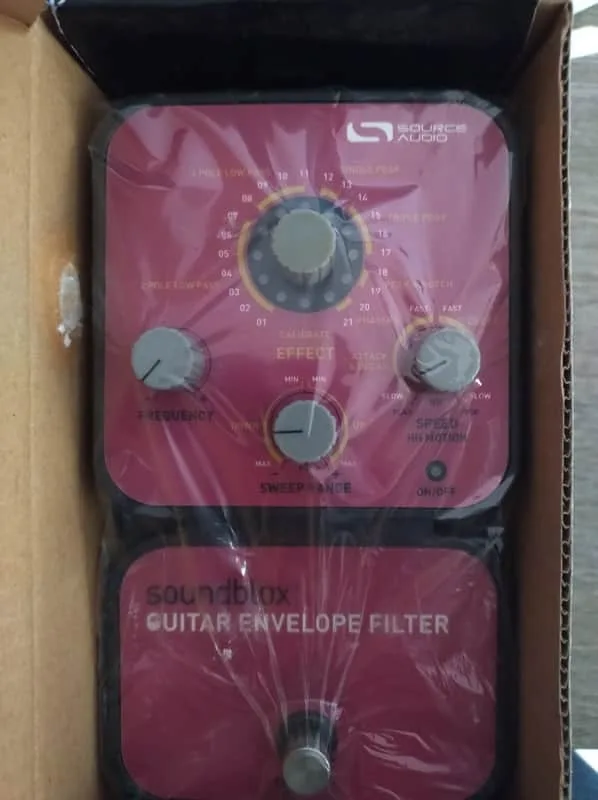


The Source Audio Soundblox Guitar Envelope Filter is a digital envelope filter stompbox announced by Source Audio in April 2011. An envelope filter, also known as an auto wah, sweeps a filter across your tone in response to how hard you play, so the effect follows your picking dynamics instead of a footswitch. Source Audio says the pedal "packs the power and flexibility of a rack-mounted unit into a user-friendly stompbox"1.
The pedal comes loaded with 21 individual envelope filter effects, and Source Audio describes its range as running "from traditional auto wah sweeps to more dramatic vocal simulations"1. It was designed in the mold of the company's earlier Soundblox Bass Envelope Filter, which shipped in 201012.
What it does and how it is controlled
The pedal's three-knob control panel adjusts the center point of the frequency sweep, the depth and direction of the moving filter, and the attack and decay times1. In practical terms, that means you set where in the frequency range the filter sits, how far and which way it travels, and how quickly it responds to your picking.
One behavior worth knowing about: the filter resets on any gap in the signal. As MusicRadar's launch report put it, "even the slightest gap in the incoming signal will reset the filter position, providing a full sweep range for every note"1. For a player, that means each note you attack starts the sweep from the beginning rather than picking up where the last note left off, which keeps the effect consistent across fast passages.
The 21 filter effects
The effects are organized into filter categories, each shaping the sweep differently1:
| Filter category | What it is |
|---|---|
| 2 Pole Low Pass | A gentler low-pass sweep |
| 4 Pole Low Pass | A steeper low-pass sweep |
| Single Peak | One resonant peak moving through the band |
| Triple Peak | Three resonant peaks in the sweep |
| Peak & Notch | A peak and a notch moving together |
| Phaser | Phaser-style filtering |
The same six-category structure appeared on the bass version, whose 21 presets break down as seven 2-pole low-pass filters, four high-pass filters, two single-peak filters, four triple-peak filters, two peak-and-notch filters, and two phase filters3.
Digital engine
The Guitar Envelope Filter runs on Source Audio's proprietary 56-bit digital signal processor with 24-bit converters1. The same DSP architecture appears across the Soundblox filter line: the Pro Bass Envelope Filter used the company's SA601 processor with the same 24-bit converters4, and Premier Guitar's reviewer of the bass version noted that "thanks to the 56-bit digital signal processor and 24-bit converters, the Soundblox BEF always sounded crystal clear"3.
Where it came from
The pedal's family tree starts with the Soundblox Bass Envelope Filter, announced in October 2010 as the newest addition to Source Audio's expanding line of bass effects2. No Treble reported it as available now at release5. For a limited time at launch, a wired Hot Hand motion controller was included with the bass pedal2.
The Guitar Envelope Filter followed in April 2011, packed with 21 individual envelope filter effects1, and Source Audio exhibited it at Summer NAMM in Nashville that July1. It carried a three-knob control panel providing adjustability to the center point of the frequency sweep, the depth and direction of the moving filter, and the attack and decay times1, with an MSRP of $169 and a street price of $1191.
What reviewers said
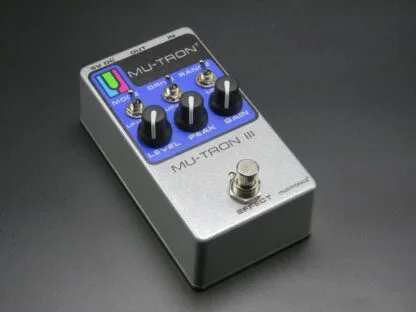
Published reaction to the family has been positive. Premier Guitar's review of the bass version found that "the device packs in so many easy-to-use presets, a flexible control set, the Hot Hand expression controller, and a real feel for what made analog envelope filters like the Mu-Tron so special"3. The same review noted the plastic enclosure "eschews vintage pedal styling clichés for a tech-influenced look"3.
In the original 2010 launch materials, Kevin Walker said Source Audio "has revolutionized the bass envelope filter as we know it today and resurrected the bass guitar," adding that it replaced a keyboard for sounds he once needed a keyboard for2.
"Source Audio has revolutionized the bass envelope filter as we know it today and resurrected the bass guitar."
Videos
sourceaudioeffects
gearmanndude
musictoyznetwork rasch
Questions
Is the Source Audio Soundblox Guitar Envelope Filter analog or digital?
It is digital. The pedal uses Source Audio's proprietary 56-bit digital signal processor with 24-bit converters, which the company says delivers crystal clear sound. The design follows the same DSP approach as the earlier Soundblox Bass Envelope Filter.
What filter modes does the Soundblox Guitar Envelope Filter have?
It offers 21 individual envelope filter effects organized into categories: 2 and 4 Pole Low Pass, Single Peak, Triple Peak, Peak & Notch, and Phaser. Source Audio says the range covers everything from traditional auto wah sweeps to more dramatic vocal simulations.
How many presets does the Soundblox Guitar Envelope Filter have?
The pedal comes packed with 21 individual envelope filter effects. The related Soundblox Bass Envelope Filter also carries 21 presets, while the later Pro Bass version added 6 user presets in two banks selectable via 3 footswitches.
What does the filter reset on signal gap do?
Even the slightest gap in the incoming signal resets the filter position, so every note gets a full sweep range. This means each attack triggers the envelope from the start of its sweep rather than continuing from wherever the previous note left the filter.
Is there a bass version of the Soundblox envelope filter?
Yes. Source Audio released the Soundblox Bass Envelope Filter in 2010, before the guitar version, and the Guitar Envelope Filter was designed in its mold. A Pro Bass version followed in 2011 with more presets, an EQ and MIDI.
Sources (5)
- Source Audio launches Soundblox Guitar Envelope Filter, MusicRadar, 2011-04-20
- Source Audio Unveils Soundblox Bass Envelope Filter, Premier Guitar, 2010-10-19
- Soundblox Bass Envelope Filter Pedal: In-Depth Review, Premier Guitar, 2011-03-15
- Source Audio Introduces the Soundblox Pro Bass Envelope Filter, No Treble, 2011-07-21
- Gear Watch: Source Audio Soundblox Bass Envelope Filter, No Treble (www.notreble.com), 2010-10-20