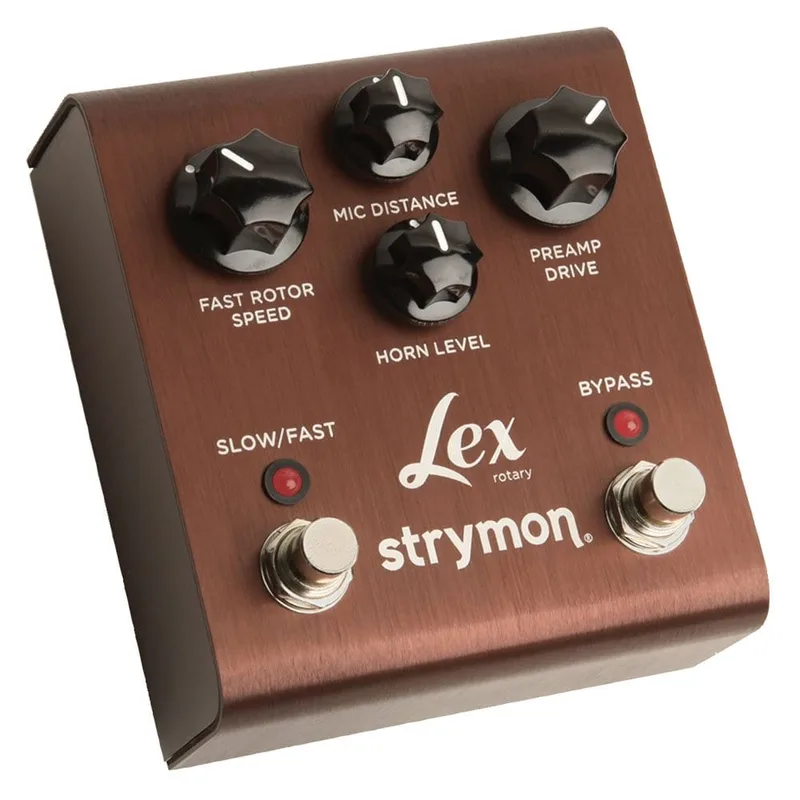


The Strymon Lex is a digital rotary speaker pedal: a stompbox that recreates a Leslie-style rotating speaker system, the kind long associated with organ players and adopted by guitarists for its swirling, three-dimensional modulation. Strymon describes it as "a studio-class pedal that faithfully recreates the classic, unmistakable sound of the most sought-after rotating speaker system," modeling the low-frequency bass rotor, the rotating treble horn, the tube-driven amplifier, and the microphone placement around them, along with the interactions between those elements1. The name is a play on the source: Strymon notes the "rotary" speaker is a Leslie2.
The pedal was announced on January 6, 20113 and sold out shortly after release, with Strymon reporting it was building more units to meet demand4. The original Lex is now discontinued; the current version is the Lex V2, a second-generation pedal that Strymon says keeps the same rotary sounds and adds significant new features, including stereo in and out, full MIDI, and a new ARM DSP chip5. This page covers both generations; see also the Strymon Lex Rotary and Lex V2 pages, and the wider field of speaker simulation pedals.
What the Lex does
Strymon's goal with Lex, in the maker's own words, was "to create the most realistic sounding, flexible rotating speaker effect ever fit within a pedal"5. The pedal reproduces the complete rotating speaker system: the bass rotor that handles low frequencies, the treble horn that spins above it, and the internal tube-driven amplifier whose grit "creat[es] additional harmonics that spin around the room"5. The signal path is digital, running 32-bit floating point processing on an ARM DSP chip through ultra low noise 24-bit 96kHz converters, with a premium analog JFET input circuit in front of the conversion5.
What that means for a player is the full rotary experience in a pedalboard-friendly box: the chorusing as the horn and bass rotor speed up and slow down, the ramp behavior of a real mechanical speaker, and the option to stop the rotors entirely. Holding the Slow/Fast switch engages a brake function that winds the rotary down and stops it, with the horn and drum positioned at an optimal brake angle at rest; releasing the switch sets it spinning again5.
The controls and the hidden knobs
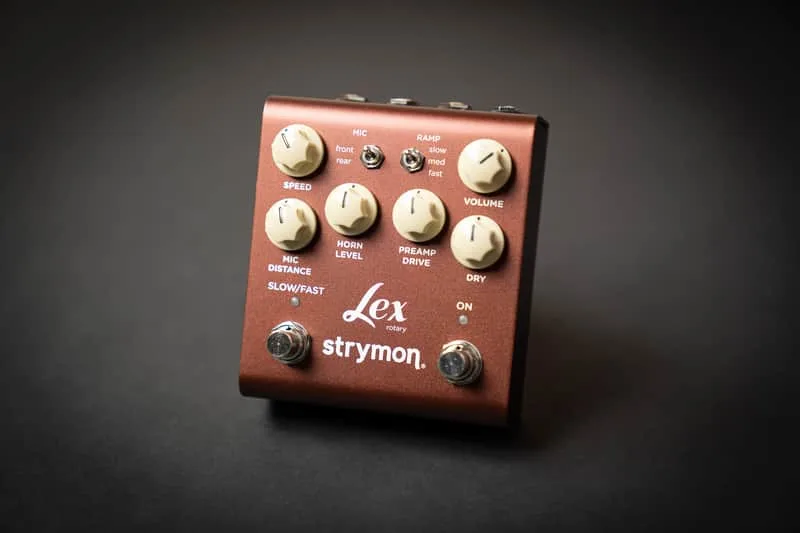
The Lex V2 carries the four knobs from the original, Speed, Preamp Drive, Mic Distance and Horn Level, plus a Volume knob6. Two footswitches handle On/Off and Slow/Fast rotor speed5.
| Control | What it does |
|---|---|
| Speed | Selects rotor speed |
| Preamp Drive | Drives the modeled tube amplifier |
| Mic Distance | Varies the distance of the stereo mics from the horn rotor and the single mic on the woofer rotor; left for a more pronounced effect, right for more ambience5 |
| Horn Level | Controls the output level of the high frequency rotating horn5 |
| Volume | +/-6dB boost or cut when engaged, 12 o'clock is unity gain; also accesses the Cab Filter Live Edit function5 |
| Dry | Adds dry input signal to the effect; off at minimum, blended 50/50 at maximum5 |
| Ramp | Controls how quickly the rotors transition between speeds; the low-frequency rotor accelerates more slowly than the horn5 |
Several functions live behind knob-and-footswitch combinations rather than on the panel. The Volume knob doubles as the entry point to the Cab Filter Live Edit setting, which tailors the speaker cab filter response for use with audio interfaces, mixers or full-range speakers5. A Bi-Amp Live Edit setting splits the output, sending only the horn signal to the left output and the woofer signal to the right, for running the two rotors into separate amplifiers5.
The input level is also configurable. Holding the On footswitch while powering up enters Input Level setup; you turn the Speed knob to choose between Instrument mode (green, the default, set for guitar or bass level) and Line mode (red, set for keyboards or synthesizers, adding 10dB of headroom), then press either footswitch to store it7. Strymon notes the line level mode suits bass guitars with active pickups, synthesizers, keyboards and effects loops5.
Power, MIDI and connections
The Lex V2 runs on 9V DC, center negative, with a 300mA minimum rating; the power supply is not included5. That is a step up from the original Lex's 250mA minimum on the same 9V center negative standard1, so an older supply sized for the first generation may not have headroom for the V2.
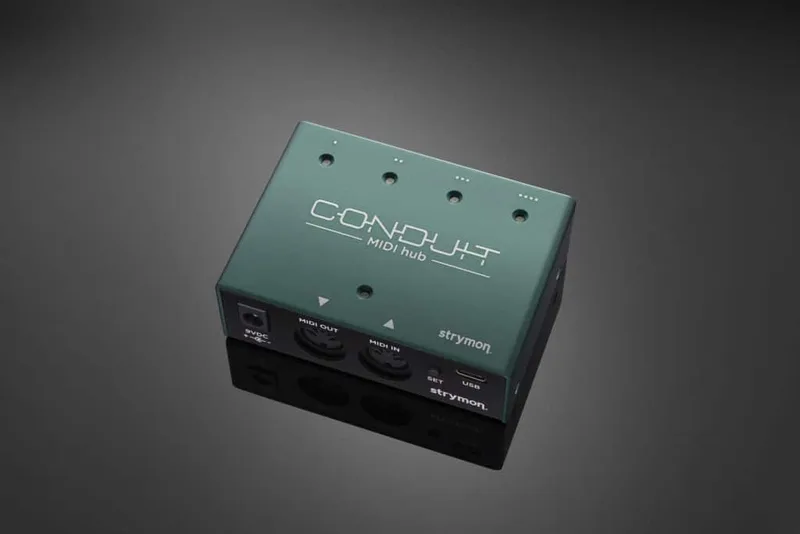
The EXP/MIDI jack is a multifunction communication jack. It accepts a standard TRS expression pedal for continuous control over the knobs, or it can be configured for MIDI and accessories such as the Strymon Conduit, MultiSwitch Plus and MiniSwitch5. Configuration is done by holding the Slow/Fast footswitch while powering up; Expression Pedal mode (green LED, the default) allows continuous control over any knob with a TRS expression pedal8.
Full MIDI implementation means you can control just about every switch, knob and setting remotely via the EXP/MIDI jack or the USB-C connection, and rotor speed can be synchronized via MIDI Clock Sync5. There are 300 MIDI preset locations for loading and saving settings5. MIDI defaults to channel 1, and the presets map across three banks: Bank 0 holds presets 0 to 127, Bank 1 holds 128 to 255, and Bank 2 holds 256 to 299. Program Change 0 recalls the Favorite setting, Program Changes 1 to 3 correspond to MultiSwitch Plus footswitches 1 to 3, and Program Change 127 is manual mode9. MIDI input can come from a Strymon Conduit MIDI Hub, a compatible 5-pin MIDI to 1/4" TRS interface, or a USB connection to a host device such as a computer9.
The USB-C jack on the back handles both MIDI communication and firmware updates. Updating is a simple process10:
- Download and install Strymon's Update software.
- Connect the powered pedal to your computer with a USB-C cable.
- Click "Check for Updates", then "Install Update"; the software detects the pedal automatically.
- The program shows "Your device is up to date" when finished.
A November 2023 firmware update for the Lex V2 addressed minor issues and added requested features11.
Mono input, TRS stereo and the V2 update
The Lex's input story has three chapters. The original pedal, manufactured before May 2012, had a high impedance mono input with stereo output12. In June 2012 Strymon introduced an updated design with an internal jumper allowing selectable TRS stereo input; it shipped in mono configuration from the factory, and using the stereo input required a TRS stereo input adapter12. Strymon states plainly that the earlier mono-input units cannot be converted: "There isn't any way to convert your Lex mono input to Lex (TRS stereo) specs or upgrade to the silent type switches," because the designs are different and parts are not interchangeable13.
The Lex V2 makes stereo a panel-level feature. A single TRS input jack with a rear-panel Mono/Stereo switch lets you select mono or stereo input, keeping the compact enclosure, and a TRS adapter cable is required for a stereo input signal5. Both outputs are low impedance: use Out L for mono output, or Out L and Out R together for stereo5. Premier Guitar's coverage of the updated line noted the full stereo inputs and outputs, the rear-panel Mono/Stereo switch, the TRS MIDI jack for bidirectional MIDI communication, and the new ARM processor that consumes less energy than previous iterations14.
If you own an original Lex, the V2 features cannot be added to it. Strymon confirms it is not possible to add the new functionality to older Lex pedals because the electronic and mechanical designs are different and the hardware is not interchangeable15.
Who uses it
Stanton Edward, touring with The Wallflowers as of June 2014, listed the Lex in his signal path in a Strymon pedalboard feature16. Strymon's own rotary demos with keyboardist Peter Dyer were created entirely with Lex, with the maker noting "All rotary sounds are created by Lex"17.
Versions and editions
| Version | Dates | Key differences |
|---|---|---|
| Original Lex (mono input) | Announced January 6, 2011; built before May 2012312 | Mono input, stereo output, 250mA minimum, internal bypass jumper options31218 |
| Updated Lex (TRS stereo) | June 2012 onward12 | Internal jumper for selectable TRS stereo input, ships in mono12 |
| Lex V2 | Current production5 | TRS input with rear Mono/Stereo switch, relay true bypass, full MIDI, 300 presets, USB-C, 300mA minimum, $349.005 |
The original measured 4.5" deep by 4" wide by 1.75" tall19; the V2 is slightly taller at 2.4", in an anodized brown aluminum chassis where the original used a mahogany anodized finish51. Both were built in the USA51. The V2's street price of $349.00 was also reported by Premier Guitar when the updated line launched14.
Videos
Premier Guitar
strymon
strymon
Questions
Is the Strymon Lex discontinued?
The original Lex is discontinued. Strymon's page for the first-generation pedal carries a discontinued notice, and the mono-input version built before May 2012 is explicitly described as discontinued.
Is the Strymon Lex true bypass?
Yes. From the factory the Lex ships in True Bypass mode, with a Buffered Bypass option you can select instead. You change the mode by holding a footswitch while powering up, turning the Volume knob until the ON LED shows green for True Bypass or red for Buffered Bypass, then pressing either footswitch to store it.
How many presets does the Strymon Lex store?
Up to 300 presets are available via MIDI. They are organized as three banks: MIDI Bank 0 holds presets 0 to 127, Bank 1 holds 128 to 255, and Bank 2 holds 256 to 299. Program Change 0 recalls the Favorite setting, and Program Change 127 is manual, knob-based mode.
Can the Lex take a stereo input?
The Lex V2 can. It has a single TRS input jack with a rear-panel switch for mono or stereo, and a TRS adapter cable is required for a stereo input signal. The original mono-input Lex built before May 2012 cannot be converted to TRS stereo specs, since the designs differ and parts are not interchangeable.
Is the Strymon Lex v2 true bypass?
Yes. The Lex V2 uses electromechanical relay switched true bypass by default, which Strymon describes as passing a 100 percent untouched, unprocessed signal when the pedal is bypassed. A premium quality buffered bypass is also available as an alternative mode.
How much current does the Strymon Lex v2 need?
The Lex V2 requires a 9V DC center-negative power supply rated at 300mA minimum, and the supply is not included. That is higher than the original Lex's 250mA minimum, so it is worth checking that an existing power supply can deliver enough current.
Sources (19)
- Lex Brochure, Strymon (www.strymon.net), 2023-12-05
- Putting the finishing touches on Lex..., Strymon, 2011-01-10
- Coming soon. The Strymon Lex. Stay tuned., Strymon, 2011-01-06
- Lex Rotary, Strymon, 2011-03-30
- Lex V2 Rotary Modulation, Strymon (www.strymon.net), 2026-08-12
- Strymon Lex V2 Rotary, Delicious Audio, 2022-08-03
- How do I set the Input Level on Lex?, Strymon
- How do I configure the EXP/ MIDI jack on Lex?, Strymon
- How do I control Lex with MIDI?, Strymon, 2022-06-28
- How can I update the firmware on Lex v2?, Strymon, 2026-07-09
- New Firmware Is Here!, Strymon, 2023-11-10
- How do I enable the TRS stereo input on Lex?, Strymon, 2022-05-07
- Can my Lex mono input be modded with silent switches and converted to Lex (TRS stereo)?, Strymon, 2021-07-19
- Strymon Announces Updated Line of Six Popular Pedals, Premier Guitar, 2022-06-28
- Can I send in my old pedal to get the V2 features added?, Strymon
- Pedalboard Feature: Stanton Edward, Strymon, 2014-06-25
- Lex Rotary keyboard demo with Peter Dyer, Strymon, 2013-03-18
- Lex Rotary, Strymon, 2011-01-11
- What are the dimensions of my pedal?, Strymon, 2021-07-20
 Steve Lukather