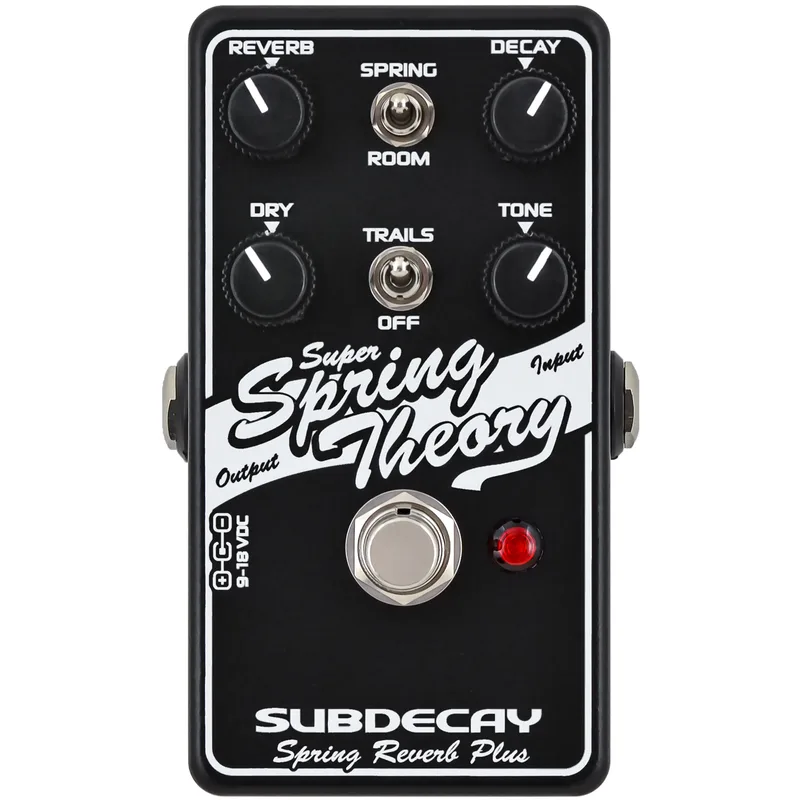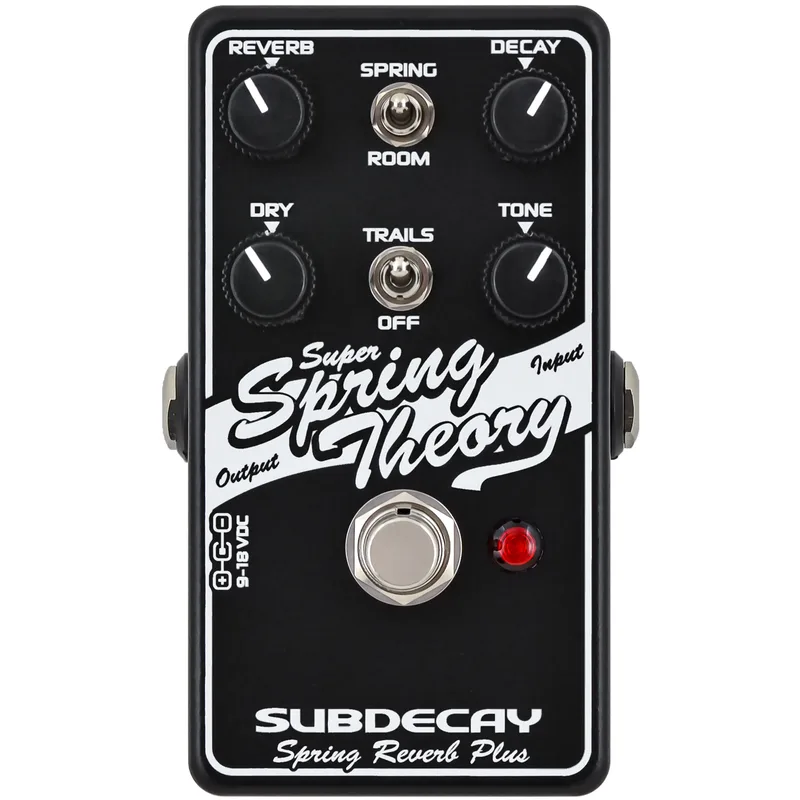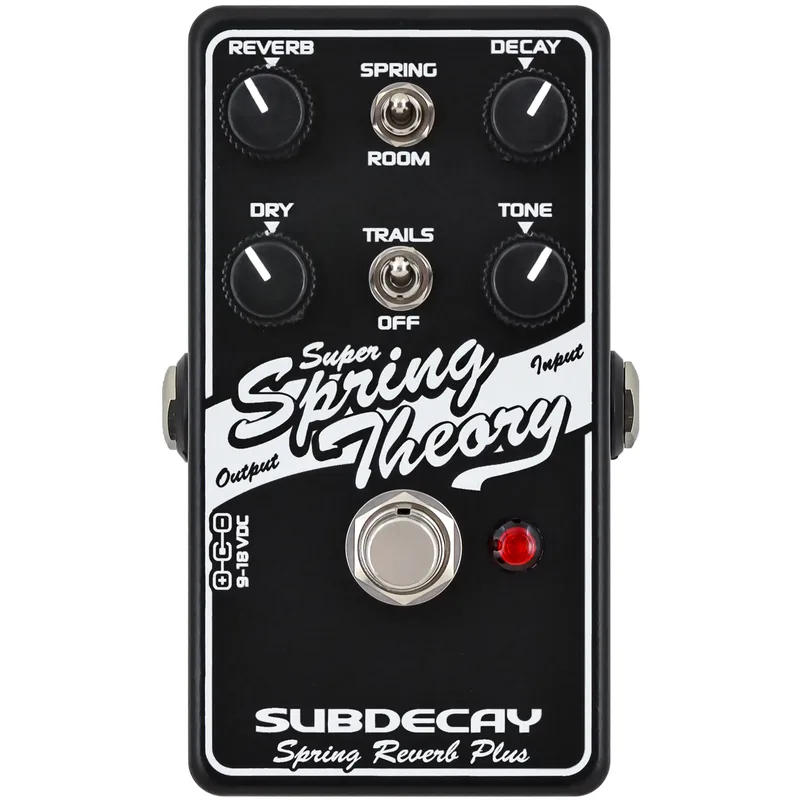


The Subdecay Spring Theory is a spring reverb pedal that Subdecay released in 2011 with the stated goal of building the most realistic spring reverb simulation it could. Subdecay says it sounds and feels like a real tube driven blackface reverb, reacting dynamically to the attack of every note, with springs that chirp and resonate. It was the company's first digital pedal, and it is no longer in production: Subdecay's product page directs players to its successor, the Super Spring Theory1.
Alongside the spring mode, the pedal carries a room setting that Subdecay describes as simulating anything from a small space to a 10 mile wide cavern with ceramic tile on every surface. Premier Guitar's reviewer Brook Hoover characterized the original as "a two-knob stomp with the stated aim (despite its spring/room mode toggle) of replicating classic blackface reverb"23.
What it does: spring and room reverb
The Spring Theory offers two reverb settings selected by a toggle: spring and room. In spring mode, Subdecay's claim is a faithful copy of a tube driven blackface spring tank, the reverb type built into classic Fender blackface amps. The company says the pedal reacts dynamically to how hard you pick, and that the simulated springs chirp and resonate the way real ones do3.
The room setting is the second voice. Subdecay's own description of its range runs from a small space to a 10 mile wide cavern lined with ceramic tile, which is to say it covers everything from a tight ambience to very long, reflective washes3.
The pedal's development story explains where the spring sound came from. Designer Brian Marshall wrote that he took apart the spring tanks from three different amps, dampened each spring and recorded each one individually, and that a programmer named Tom wrote about 50 different iterations of the algorithm over a five month span, each with minor improvements5.
"So I ended up taking apart the spring tanks in three different amps, dampening each spring and recording each one individually."
The controls
The control set is minimal: two knobs and a mode toggle.
| Control | What it does |
|---|---|
| Depth | Controls the reverb length. Near the middle gives realistic lush sounds; turned right gives "unrealistic everlasting reverbs"3 |
| Reverb | Sets the effect volume3 |
| Spring/Room toggle | Selects between the spring reverb and room reverb settings2 |
That is the whole interface: a two-knob stomp with a spring/room mode toggle and a depth control. The Super Spring Theory later adds a tone control, separate controls for the reverb and dry signal levels, and a decay knob216.
Power and specifications
The Spring Theory runs on a regulated 9V DC to 18V DC adapter with a negative center 2.1mm barrel style plug, and draws less than 100mA. There is no battery option; Subdecay states it can be powered by AC adapter only3.
No battery compartment. The pedal needs a wall adapter or a pedalboard power supply with a center negative 2.1mm output, and it accepts anything from 9V to 18V DC.
Other specifications from Subdecay3:
- Input impedance: 1M
- Output impedance: 1K
- Weight: 12 oz
- Dimensions: the specifications table lists 4.375 × 2.375 × 2.25 in, while the notes section of the same page lists 4.4″ × 2.3″ × 1.0″, so the two figures on the maker's page disagree
- Die-cast metal enclosure
- Three-year limited warranty
Spring Theory versus Super Spring Theory
The Super Spring Theory is the direct successor, and it expands the original's control set considerably. It keeps the spring/room switch and the reverb knob, but adds a decay knob that Subdecay says lets you dampen the springs for shorter reverb or stretch into long psychedelic resonating trails, plus a tone control for timbre, separate dry and reverb level controls, and an internal reverb send trimmer that works like the dwell control on an outboard tank62. In room mode, its decay knob ranges from a broom closet to a cavern with reverb trails over three minutes long1. JFET amplifiers handle the send and recovery of the reverb signal, which Subdecay says adds tube like dynamics1.
The bypass behavior also differs: the Spring Theory is true bypass, while the Super Spring Theory offers a trails option when bypassed so the reverb tail rings out after you switch off1.
Premier Guitar's reviewer Brook Hoover, writing in a spring reverb pedal roundup, found the Super Spring Theory delivered "some of the most authentic-sounding spring-reverb tones available in pedal form" along with great room sounds and versatile trails-mode switching2.
"Some of the most authentic-sounding spring-reverb tones available in pedal form. Great room sounds. Versatile"
There was also a limited run of the Super Spring Theory Burlwood, a cosmetically distinct version with the same spring and room reverb inside; Subdecay says literally only 3 burlwood finished units exist, and no more will be made7.
Both the Spring Theory and the Super Spring Theory are discontinued. Subdecay listed the Super Spring Theory as out of stock under its discontinued category as of November 20241, so either pedal is now a secondhand find.
Videos
ProGuitarShopDemos
Subdecay
Subdecay
Questions
Is the Subdecay Spring Theory true bypass?
Yes. Subdecay built the Spring Theory with 3PDT switches for true bypass switching, so when the pedal is off the signal passes through without active circuitry in the path. The later Super Spring Theory instead offers a trails option when bypassed, letting the reverb tail continue after you switch the effect off.
Can the Spring Theory run on a battery?
No. Subdecay states the pedal can be powered by AC adapter only and there is no battery option. It takes a regulated 9V DC to 18V DC adapter with a negative center 2.1mm barrel plug, so you need a power supply or a pedalboard power brick rather than a battery.
Is the Spring Theory analog or digital?
It is digital. Subdecay describes the Spring Theory as its first foray into DSP, with an algorithm developed over about five months and roughly fifty iterations. The later Super Spring Theory is built around a Spin Semiconductor FV-1 programmable DSP chip, though RockBoard's PedalPedia entry lists that pedal's circuit type as analog.
Is the Subdecay Spring Theory discontinued?
Yes. Subdecay states the Spring Theory is no longer in production and points players to the Super Spring Theory as its replacement. The Super Spring Theory itself was listed as out of stock under the discontinued category on Subdecay's site as of November 2024, so both pedals are now hard to find new.
What is the difference between the Spring Theory and the Super Spring Theory?
The Spring Theory is a two-knob pedal with a spring/room toggle, a depth knob for reverb length and a reverb knob for effect volume. The Super Spring Theory keeps the spring/room switch and reverb knob but adds a decay knob, a tone control, separate dry and reverb level controls, an internal send trimmer, and a trails option when bypassed.
Sources (7)
- Super Spring Theory, Subdecay, 2024-11-27
- “Spring-Reverb” Pedal Review Roundup, Premier Guitar, 2015-02-13
- Spring Theory, Subdecay, 2016-11-05
- Subdecay Spring Theory, Delicious Audio, 2018-03-04
- Spring Theory: the beginning., Subdecay, 2012-11-26
- Super Spring Theory by Subdecay, RockBoard PedalPedia, 2026
- Super Spring Theory, Subdecay, 2016-12-27