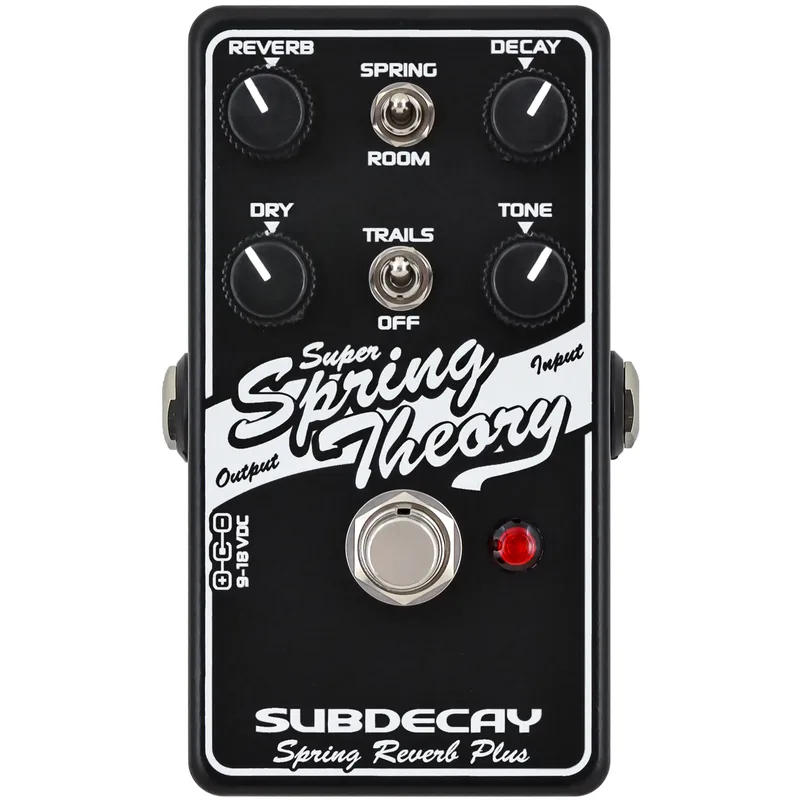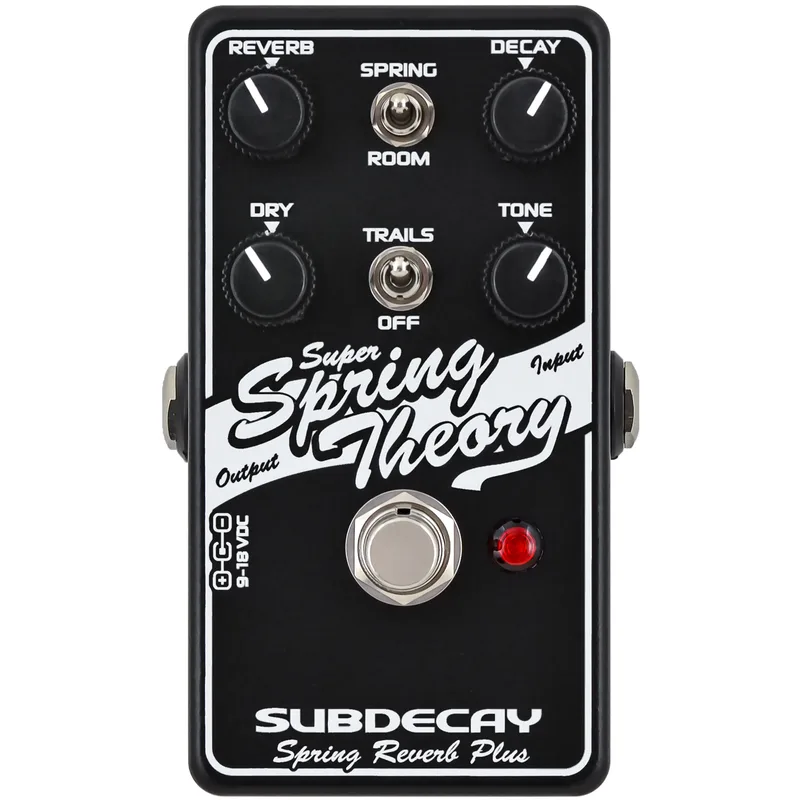


The Subdecay Super Spring Theory is a reverb pedal that emulates a tube driven spring tank, made by Subdecay, the Oregon effects builder. Instead of putting a physical spring tank in the box, Subdecay analyzed the design, sound and physics of real spring tanks to capture the nuances of tube driven spring reverb1. Alongside the spring sound it carries a second mode, Room, whose decay knob ranges from a broom closet to a cavern with reverb trails over three minutes long2.
The pedal is discontinued: Subdecay's product page lists it under the discontinued category2. It succeeded the earlier Subdecay Spring Theory, which is also no longer in production3.
An analog spring reverb with a Room mode
The Super Spring Theory is a hybrid design. Its clean signal path is all analog, and JFET amplifiers carry out the send and recovery of the reverb signal, which RockBoard's PedalPedia says gives "even more tube like dynamics"1. The reverb itself is digital: Premier Guitar's reviewer Brook Hoover found that "at the heart of the Super Spring Theory is a Spin Semiconductor FV-1 programmable DSP chip"4. RockBoard's PedalPedia listing classifies the circuit type as analog1, which reflects the analog dry path rather than the reverb engine.
The spring mode is the pedal's core. Subdecay describes the original Spring Theory as sounding and feeling "like a real tube driven black face reverb" that "reacts dynamically to the attack of every note" as the springs chirp and resonate3. The Room mode is the second setting: the decay knob alters the perceived dimensions from a small space to a huge tiled one, with trails that can run past three minutes2.
In Premier Guitar's spring reverb pedal roundup, the reviewer's verdict on the Super Spring Theory was4:
"Some of the most authentic-sounding spring-reverb tones available in pedal form. Great room sounds. Versatile trails-mode switchability."4
The controls
The Super Spring Theory keeps the spring/room switch and reverb knob from the original Spring Theory4 and adds more shaping on top. The controls and what they do:
| Control | What it does |
|---|---|
| Reverb | Sets the reverb (effect) level; retained from the Spring Theory43 |
| Dry level | Separate control for the dry signal level2 |
| Decay | Dampens the springs for shorter reverb, or produces long psychedelic resonating trails21 |
| Tone | Dials in the timbre of the effect1 |
| Spring/Room switch | Selects between spring reverb and room reverb modes4 |
| Internal reverb send trimmer | Two purposes: turns down for hotter input signals, and does essentially what the dwell control does on an outboard reverb tank1 |
The decay knob is where the pedal goes beyond a real spring tank. As RockBoard's PedalPedia puts it, unlike a real spring tank, the decay knob lets you "dampen the springs for shorter reverb or bend the laws of physics resulting in long psychedelic resonating trails"1.
The original Spring Theory was simpler: a two-knob stomp with a spring/room mode toggle, where the depth knob controlled reverb length and the reverb knob set effect volume43.
From the Spring Theory to the Super Spring Theory
Subdecay set out in 2011 "to create the most realistic spring reverb simulation ever," and the Spring Theory was born2. The Super Spring Theory is a variant of that pedal, carrying the spring reverb concept forward2.
The Super Spring Theory followed as a variant of the Spring Theory2. At its heart is a Spin Semiconductor FV-1 programmable DSP chip4, while JFET amplifiers carry out the send and recovery of the reverb signal2.
There was also a limited edition: the Super Spring Theory Burlwood, a burlwood-finished version with the same spring and room reverb inside. Subdecay states that "literally only 3 Burlwood finished Spring Theories exist," and no more will be made5.
Subdecay has posted demo videos of the pedal over the years, including one of Brandon playing the Super Spring Theory set to spring reverb mode6. Dennis Kayzer has also used it in a review video, putting it toward less traditional verb sounds2.
Power and bypass
The Super Spring Theory runs on 9V DC with a center negative plug and draws 100mA1. The original Spring Theory took a regulated 9VDC to 18VDC adapter with a negative center 2.1mm barrel plug, with no battery option3.
The 100mA current draw is higher than many analog pedals, so plan a power supply with headroom rather than a low-current output.
Where the original Spring Theory used 3PDT switches for true bypass3, the Super Spring Theory offers a trails option when bypassed, letting the reverb tail ring out after you switch it off2.
Videos
ProGuitarShopDemos
Subdecay
Ryan Kiesshauer
Questions
Is the Subdecay Super Spring Theory analog or digital?
It is a hybrid. The clean signal path is all analog, with JFET amplifiers handling the send and recovery of the reverb signal, but the reverb itself is generated by a Spin Semiconductor FV-1 programmable DSP chip. RockBoard's PedalPedia listing classifies the circuit type as analog.
Does the Super Spring Theory have a real spring tank inside?
No. Subdecay built it by analyzing the design, sound and physics of real spring tanks to capture the nuances of tube driven spring reverb. The original Spring Theory algorithm came from taking apart the spring tanks in three different amps and recording each dampened spring individually.
What power supply does the Super Spring Theory need?
It runs on 9V DC with a center negative plug, drawing about 100mA. The original Spring Theory took a regulated 9VDC to 18VDC adapter with a negative center 2.1mm barrel plug and had no battery option.
Does the Super Spring Theory have trails when bypassed?
Yes. Subdecay lists a trails option when bypassed, so the reverb tail continues after you switch the pedal off. The original Spring Theory used 3PDT switches for true bypass switching instead.
Is the Subdecay Super Spring Theory discontinued?
Yes. The original Spring Theory is also no longer in production, and the limited edition Burlwood version, of which only three were made, is discontinued as well.
Sources (6)
- Super Spring Theory by Subdecay, RockBoard PedalPedia, 2026
- Super Spring Theory, Subdecay, 2024-11-27
- Spring Theory, Subdecay, 2016-11-05
- “Spring-Reverb” Pedal Review Roundup, Premier Guitar, 2015-02-13
- Super Spring Theory, Subdecay, 2016-12-27
- Evolution of the (Super) Spring Theory reverb., Subdecay, 2016-03-01