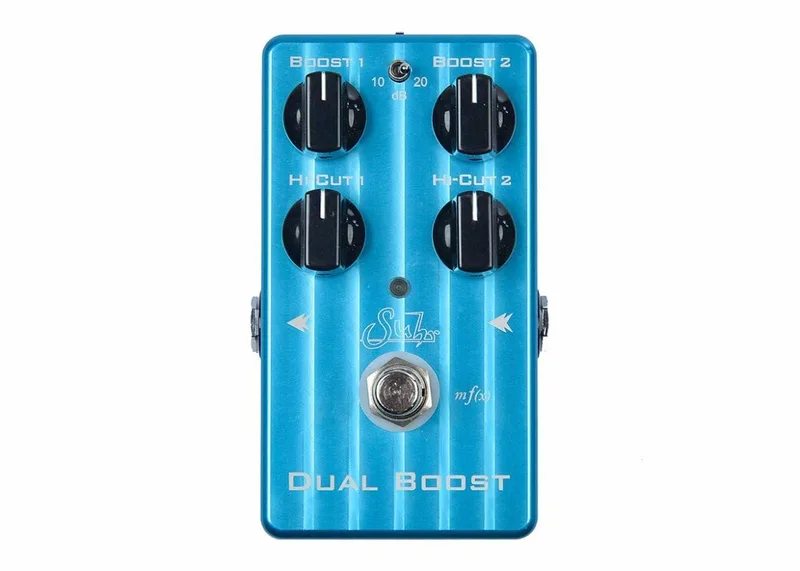


The Suhr Dual Boost is a dual-channel clean boost, buffer and line driver from Suhr, built as a compact, pedalboard-friendly pedal. Suhr describes it as "a versatile, dual-mode, transparent clean boost, housed within a compact, pedalboard friendly enclosure"1. The idea is simple: instead of one boost setting, you get two fully independent channels, each with its own Boost and Hi-Cut controls, so you can set up one level for a solo push and another for driving an amp harder, and move between them with a footswitch.
The pedal was announced on February 9, 2016, with a $200 MSRP at launch23. The current version carries an identical circuit and tone to the original Dual Boost circuit, according to Suhr's product page, at a list price of $249.00 USD45.
Two clean boosts in one pedal
A boost pedal in general does one job: raise the level of your signal without adding distortion of its own. The Dual Boost splits that job into two channels you can dial in separately. Each channel has an independent Boost knob and an independent Hi-Cut knob, and a global Boost Range switch sets the ceiling for both channels at either +10 dB or +20 dB46.
Suhr's manual describes what each range is for. At the 10 dB range, the pedal "compliments the interaction between your guitar and amplifier, enhancing playability while retaining dynamics." At higher settings it can push a clean amp into overdrive, or add saturation and sustain to an amp that is already overdriven6. The Hi-Cut control shapes how the boost sits: Suhr says it can make the boost transparent or impart coloration, depending on where you set it6.
Because the two channels are independent, a practical setup is one channel set mild for a level lift and the second set harder to slam the front of the amp. The input jack connects to the output of your instrument or another effects device, and the output jack feeds the input of an amplifier or the next effect in the chain1.
The controls: Boost, Hi-Cut and the range switch
The control set is deliberately small. Per the 2024 manual and Suhr's product page, the front panel amounts to742:
| Control | What it does |
|---|---|
| Boost 1 | Clean volume boost for channel 1, up to the range switch ceiling14 |
| Hi-Cut 1 | Rolls off high frequencies on channel 1, from transparent to colored46 |
| Boost 2 | Clean volume boost for channel 2, up to the range switch ceiling1 |
| Hi-Cut 2 | Rolls off high frequencies on channel 24 |
| Boost Range switch | Global mini toggle that sets the boost range to +10 dB or +20 dB47 |
| Footswitch | Engages the pedal; hold to switch between the two mf(x) modes1 |
The Boost knobs give "a clean boost in volume up to +20dB," with the actual ceiling set by the range switch1. Gearnews described the layout at launch in the same terms: "There's just a control for 'Boost', another for 'Hi-Cut' for each level of boost" plus "a mini toggle switch to select the mode" and "a switch for the amount of boost that you can set to either 10 or 20 dB"7.
mf(x) switching and remote control
The Dual Boost uses a switching system Suhr calls mf(x), a proprietary footswitch technology that lets you select between the pedal's two distinct settings during a performance. Holding down the footswitch moves between the modes1. The two modes are color-coded:
- Green (Boost 1 & Hi-Cut 1): channel 1 volume boost and Hi-Cut settings1
- Red (Boost 2 & Hi-Cut 2): channel 2 volume boost and Hi-Cut settings1
For players with larger boards or switching systems, the pedal also has an FX Link connector, a 1/8" mono jack with a maximum voltage of 3.3Vdc. Shorting shield to tip activates Boost 1, and shorting shield to ring activates Boost 24. That makes the Dual Boost usable from a remote switching setup rather than only from its own footswitch.
Bypass and power
The bypass is assignable between buffered and true bypass, handled by a relay1. That choice matters in a real chain: true bypass keeps the pedal out of the signal path entirely when off, while buffered mode keeps a buffer active, which can help over long cable runs. Since you can assign it, the pedal can fill either role, and Suhr also lists it as a buffer and line driver outright1.
Power comes from a single 9-volt battery or a 9V regulated power supply with a center negative 2.1mm x 5.5mm connector4. The operating range is 4.5V to 9V, with 9V the normal supply, and the manual lists a maximum of 10Vdc, so higher-voltage supplies are off the table46. Current draw is 21mA max4.
The Dual Boost runs on a 9Vdc regulated, center-negative supply with a 2.1mm x 5.5mm connector, drawing up to 21mA4. There is no battery option, so it needs a pedalboard power supply or adapter to run.
Where it came from and what reviewers said
Suhr announced the Dual Boost on February 9, 2016, in a press release that Premier Guitar carried, describing a dual-mode clean boost with independent Boost and Hi-Cut controls per mode, a global Boost Range switch, mf(x) switching, and a $200 MSRP23. Gearnews covered the announcement the same day, noting the 10 or 20 dB range switch, the buffered or true bypass operation, and a UK RRP at the time of £1557.
Gearnews' writer Jef was positive about the pedal's demo and its size:
"Their online demo sounds good to me and I think its compact size will make it very popular with gigging guitarists"7
Jef, Gearnews, February 9, 20167
The current production version uses what Suhr says is an identical circuit and tone to the original Dual Boost circuit, at a list price of $249.00 USD45. Suhr backs it with a lifetime warranty on workmanship, with electronic components covered for five years, for USA customers1.
Videos
Martin Cliffe
tim boehlert
Questions
Is the Suhr Dual Boost true bypass or buffered?
Both. The bypass is assignable between buffered and true bypass, switched by a relay, so you can set it either way depending on where the pedal sits in your signal chain and how long your cable runs are.
How much boost does the Suhr Dual Boost give?
Up to +20 dB of clean volume boost. A global Boost Range switch on the pedal sets the maximum to either +10 dB or +20 dB, and that range applies to both channels.
Can the Suhr Dual Boost run at 18V?
No. The operating voltage is 4.5V to 9V, with 9V the normal supply, and the manual lists a maximum of 10Vdc. It runs from a single 9-volt battery or a 9V regulated, center negative power supply.
Can the Suhr Dual Boost be switched remotely?
Yes. An 1/8 inch mono FX Link connector lets you activate the boosts remotely: shorting shield to tip activates Boost 1, and shorting shield to ring activates Boost 2. Maximum voltage on this input is 3.3Vdc.
Sources (7)
- DualBoost_UserGuide_070524.pdf, Suhr (JS Technologies, Inc.), 2024-07-05
- Suhr Unveils the Dual Boost, Premier Guitar, 2016-02-09
- ThorpyFx Heavy Water review, Guitar World, 2020-05-07
- Dual Boost, Suhr (www.suhr.com)
- Shiba Drive Legacy Edition, Suhr.com
- DualBoost_UserGuide_042816_FINAL.pdf, Suhr (JS Technologies, Inc.), 2016-04-28
- Suhr Dual Boost, gearnews.com, 2016-02-09