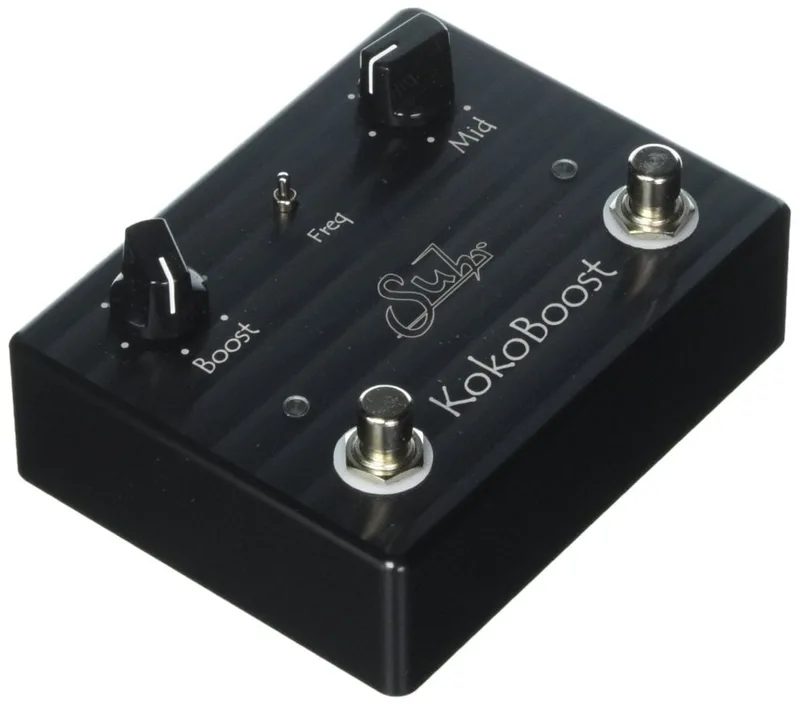


The Suhr Koko Boost is a boost pedal that combines two boosts in one box: a transparent clean boost and a selectable midrange boost12. Suhr positions it as a pedalboard-friendly Clean/Mid Boost that expands the range of pushed and overdriven tones from your amplifier and pedal setup3. The clean boost side can push the front end of a tube amp into natural overdrive at higher settings13, while the mid boost side lets you pick which part of the midrange gets lifted, which is the classic trick for making a solo cut through a band mix.
The pedal comes out of a lineage of Suhr boost pedals. The current Koko Boost carries what Suhr describes as the identical circuit and tone of the original Koko circuit, in a smaller pedal size, and the earlier Koko Boost Reloaded circuit is discontinued45. The standard Koko Boost and the Koko Boost Legacy Edition are both listed at $249.00516.
Two boosts in one pedal
The Koko Boost has two independent boost modes, clean and mid3. Suhr's mf(x) multi-function scheme color-codes them: green is the transparent clean boost, and red is the frequency-selectable mid boost with a Q control3. Two footswitches give instant access to each mode, so you can stomp from a flat volume lift to a midrange push without bending down12.
The clean Boost control varies from 0dB, unity gain, to +20dB of gain51. Suhr says turning it to higher settings will efficiently push the front end of your amplifier and create a broad range of natural overdriven tones1. The manual's sample settings describe the range: a clean boost setting pushes the front of a clean amplifier into a mild crunch, and a heavy clean boost setting transforms a slightly overdriven amplifier into a hi-gain, hard rock machine3.
The mid boost side is where the Koko differs from a plain boost pedal. The Mid control adjusts the output of the selected mid frequency, and that mid content is added to the clean boosted signal rather than replacing it13. A Mid Q control adjusts how much emphasis is applied to the selected frequency, letting you focus the bump narrowly or spread it out3.
The controls
| Control | What it does |
|---|---|
| Boost | Overall output of the boost circuit, 0dB (unity gain) to +20dB of gain1 |
| Mid | Output of the selected mid frequency, added to the clean boosted signal1 |
| Mid Q | Amount of emphasis applied to the frequency chosen by the Freq switch3 |
| Freq switch (3-way) | Chooses the midrange voicing, active when the mid boost is engaged1 |
The three-position Freq switch is active only when the mid boost is engaged, and each position is a different midrange voicing1:
- Left (Mids): Full and Smooth, tuned to bring out the guitar's natural midrange characteristics1
- Middle (High Mids): Clear and articulate, voiced to cut through a mix for solo playing1
- Right (Low Mids): Fat and Creamy, excellent for thickening up rhythm and lead tones1
Power, connections and the buffer
Power comes from a 9V DC regulated, center negative supply with a 2.1mm x 5.5mm connector, or from an internal 9V battery with an estimated 50 to 75 hours of continuous use5. The operating voltage range is 4.5V to 18V, nominal 9V, with a maximum of 18V DC, and the pedal draws about 15mA53. It has reverse battery protection and over-voltage protection5. Connecting a cable to the input jack powers the pedal up, so unplugging it conserves battery life3.
The input jack takes your instrument or the output of another effect, and the output jack feeds an amplifier or the next effect in the chain3. Input impedance is 1M Ohm and output impedance is 600 Ohm5.
Koko Boost employs true bypass switching via a relay, which removes the effect from the signal chain when off3. There is also a switchable buffer: an internal switch lets you choose whether the pedal is true bypass or acts as a high quality buffer when switched off2. Suhr describes the buffer as high quality and transparent sounding1. That choice matters on a long pedalboard, where a buffered pedal left in the chain can preserve high end that true bypass switching can lose through cable capacitance.
FX Link remote switching
The FX Link connector, a 1/8" stereo jack, allows the pedal's switching function to be controlled from an external switch, pedalboard loop switcher, or other custom interface57. It has two modes3:
- Green (default): for remote on/off control from an external switching system. Tip is On/Off (Normal) latching, ring is On/Off (Mid) latching3
- Orange: remotely toggles between the two mf(x) modes with a single momentary footswitch3
An internal FX Link switch sets the power-up state: right powers the pedal up in the ON state, center allows remote switching via the FX Link jack, and left powers it up in bypass3. On the jack itself, shield to tip activates the normal boost and shield to ring activates the mid boost, with a maximum FX Link voltage of 3.3V DC5.
From the original Koko to the smaller pedal
The Koko line goes back to the original big-box Koko Boost, which gearnews described in 2016 as a clean boost, alongside Suhr's original Riot distortion pedal8. The current Koko Boost carries the identical circuit and tone of the original Koko circuit in a smaller pedal size45.
The Koko Boost Reloaded sat between them. It kept the dual clean and mid boost modes and added 6dB more gain than the original Koko, which Suhr said gave increased harmonics and sustain7. Where the current pedal has two footswitches, the Reloaded used one: you hold it down to change modes, with the LED lighting green or red9. Suhr's product page states the Reloaded circuit is discontinued5.
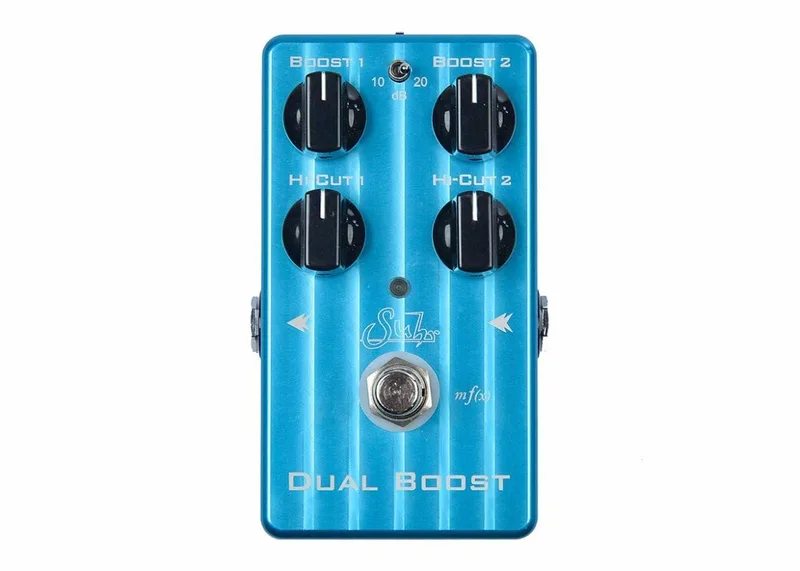
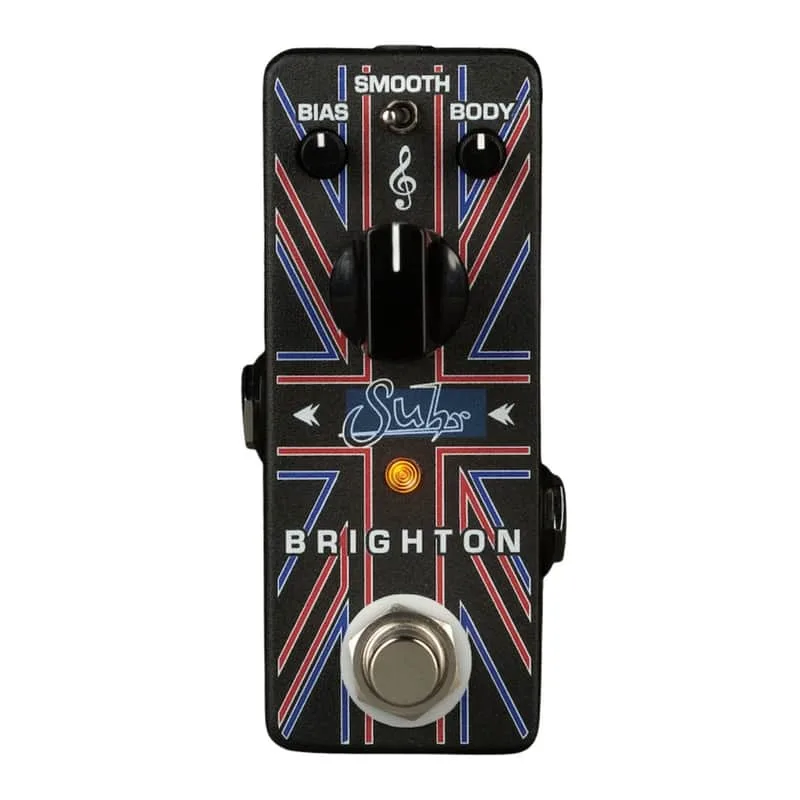
Suhr has since expanded its boost range with pedals like the Dual Boost and the Brighton Treble Booster, but the Koko remains the company's clean-plus-mid boost design.
What reviewers said
A 2014 Pedal of the Day review of the original Koko Boost praised its transparency:
"I have used a several different OD/clean boost and this one is by far the most transparent one I've ever heard."
The same reviewer noted a touch of bottom end enhancement as the boost passed 1 o'clock, though he found it pleasant to the ears10. On the mid boost, he found some extreme settings could sound too excessive on their own, but sat perfectly in a band mix10.
MusicRadar's Trevor Curwen, reviewing the Reloaded, found the clean boost "really transparent" and said the 26dB on tap should be enough for all conventional boosting needs9. He found the dual modes useful for dialing in the boost you're after9.
Warranty
JS Technologies warrants the pedal for the lifetime of the initial retail purchaser against defects in workmanship, with electronic components such as capacitors, resistors, filters, transformers, jacks and pots covered for 5 years2.
Videos
Suhr Custom
Suhr Custom
Suhr Custom
Questions
Is the Suhr Koko Boost true bypass?
Yes. The Koko Boost uses true bypass switching via a relay, which removes the effect from the signal chain when it is off. It also has a switchable internal buffer, so you can set it to act as a high quality buffer when switched off instead, using an internal switch.
Can the Suhr Koko Boost run on a battery?
Yes. The pedal runs on a 9V battery with an estimated battery life of 50 to 75 hours of continuous use, or on a 9V DC regulated, center negative power supply. Unplugging the input cable conserves battery life, since connecting a cable to the input jack powers the pedal up.
What is the difference between the Koko Boost and the Koko Boost Reloaded?
The Reloaded added 6dB more gain than the original Koko, for increased harmonics and sustain, and used a single footswitch: you hold it down to change between clean and mid boost modes, with the LED lighting green or red. The current Koko Boost instead uses two footswitches for instant access to each mode. Suhr states the Reloaded circuit is discontinued.
Is the Suhr Koko Boost discontinued?
The standard Koko Boost is listed as out of stock on Suhr's product page as of late 2026. The Koko Boost Legacy Edition, which carries the identical circuit and tone of the original Koko circuit in a smaller pedal, is listed as in stock at $249.00.
Can I use both boosts on the Koko at the same time?
The two footswitches give instant access to each boost mode, clean and mid boost. The Mid control adjusts the output of the selected mid frequency that is added to the clean boosted signal, so the mid boost works on top of the boosted clean signal rather than as a fully separate alternative.
Is the Suhr Koko Boost Reloaded discontinued?
Yes. Suhr's product page states that the Koko Reloaded circuit is discontinued. The current Koko Boost carries the identical circuit and tone of the original Koko circuit in a smaller pedal size.
Sources (10)
- Koko Boost Legacy Edition, Suhr (www.suhr.com)
- Koko Boost Pedal Manual v6, Suhr (JS Technologies, Inc.), 2022
- KokoBoost_UserGuide_071024_Final.pdf, Suhr (JS Technologies, Inc.), 2024-07-10
- Koko Boost, Suhr.com
- Koko Boost, Suhr
- Shiba Drive Legacy Edition, Suhr.com
- KokoBoostReloaded_UserGuide_100114_Final.pdf, Suhr (media.suhr.com), 2022
- Suhr Dual Boost, gearnews.com, 2016-02-09
- Suhr Koko Boost Reloaded review, MusicRadar, 2018-08-25
- Suhr Koko Boost, Pedal of the Day (www.pedal-of-the-day.com), 2014-03-20