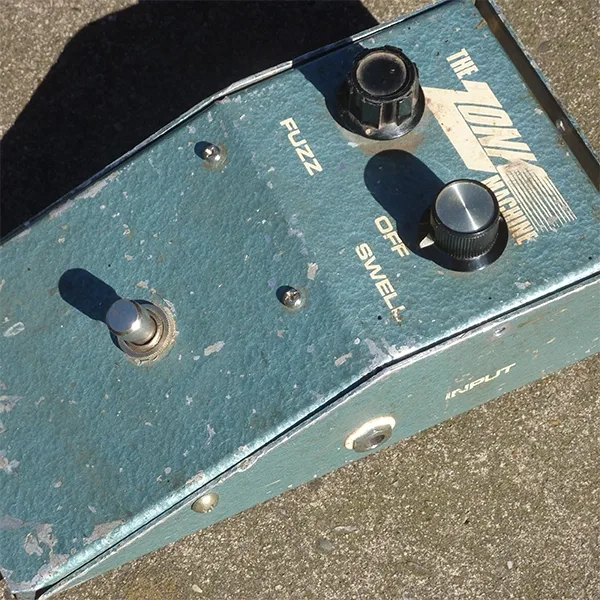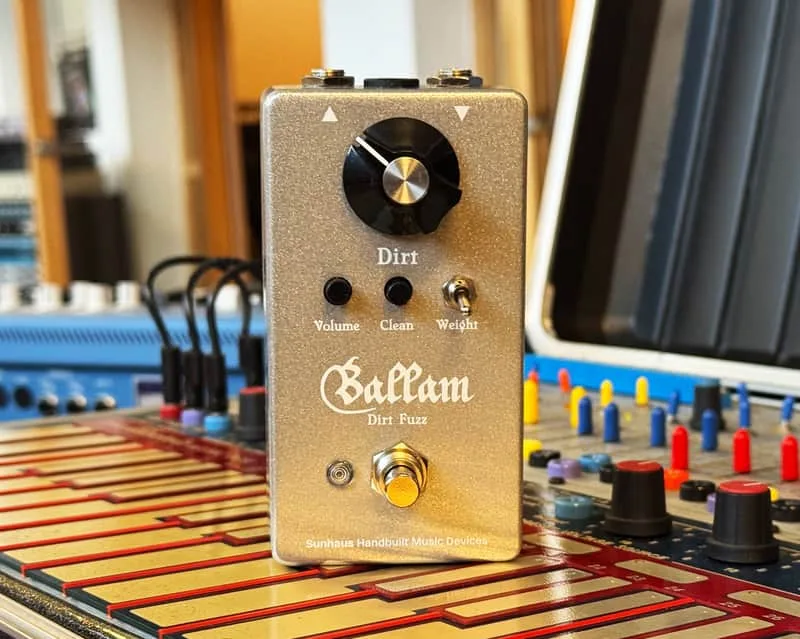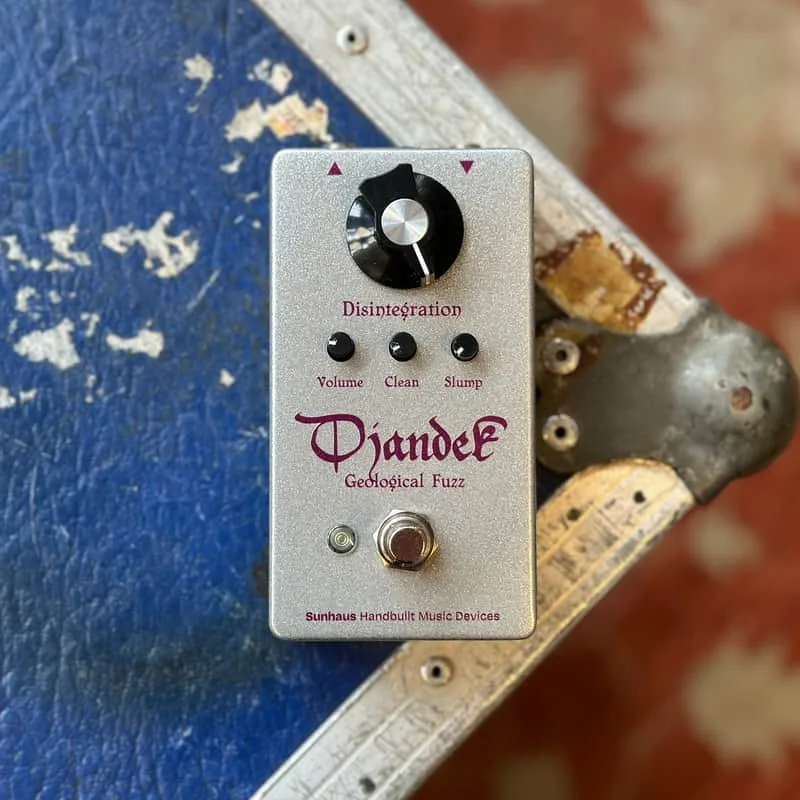


The Sunhaus Djandek Geological Fuzz is a fuzz pedal and the second release in Sunhaus' Colourway Series, a line of pedals built around distinct enclosure finishes. It appears in a Soft Pink colourway1. Guitar Pedal X describes it as massively evolved from a Zonk Machine, the 1960s British fuzz, with new controls that push the circuit toward what the reviewer calls sonic breakdown and disintegration12.
What it does
The Djandek's controls shape how the fuzz breaks up and falls apart rather than just how much gain there is1.
| Control | What it does |
|---|---|
| Disintegration Bias (labeled Bias: Starve > Full-On) | Runs from thick, full-bodied fuzz and drive sounds to starved, fractured decay1 |
| Slump Input Gain | Sets the input gain into the fuzz1 |
Guitar Pedal X's Stefan Karlsson describes the bias control's range this way: "You can go from thick and full-bodied Fuzz and Drive sounds, to starved and fractured decay."1
Karlsson's overall verdict on the series: "Both the Ballam and Djandek sound excellent - and have a wonderfully expansive range of tones and textures onboard."1 He calls the Djandek "a tweaker's delight," and notes that designer Marcus's second pedal is as equally textured as the first, but with a very different emphasis1.
The Zonk Machine connection
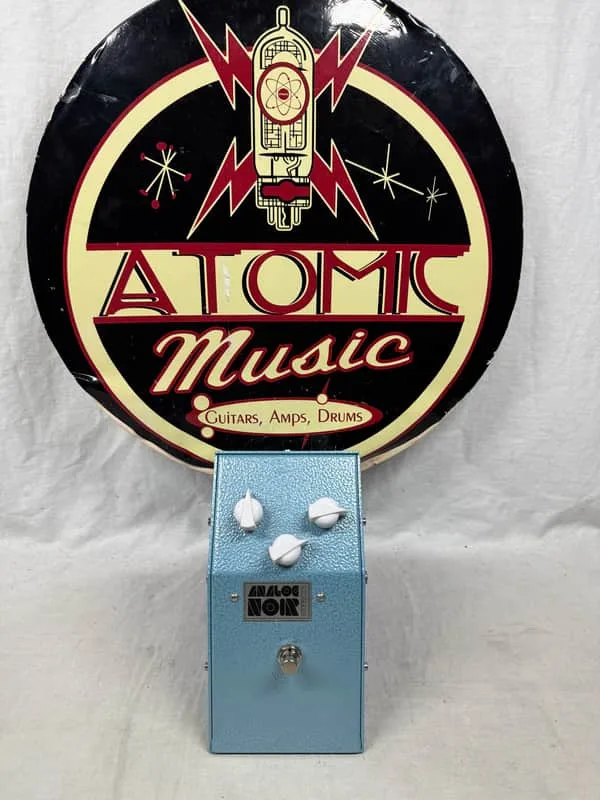
The circuit the Djandek starts from has its own history. The John Hornby Skewes Zonk Machine was a three-transistor fuzz that evolved over the two to three years it was in production3. Fuzzboxes.org notes that its circuit resembled Gibson's Maestro Fuzz-Tone but was much more similar to the Tone Bender MKI, likely its true inspiration3. TONEHOME calls it one of the more famous Tone Bender MKI influenced fuzz boxes4, and Guitar FX Layouts, profiling the original Hornby Skewes Zonk Machine I, describes it as an uber rare fuzz also based on the Tone Bender MKI5.
What the historical sources record about the original:
- Three-transistor circuit3
- Production spanned two to three years, with the circuit evolving over that time3
- Housed in folded aluminum with a teal hammered finish3
- Circuit resembled the Maestro Fuzz-Tone but was much more similar to the Tone Bender MKI3
- Described by tru-fi.com as having a colorful psychedelic design that, like many classic fuzz pedals from the 1960s, continues to influence contemporary pedal designs6
The Djandek is one such design: the Zonk Machine platform reworked with modern controls and a new finish1.
The Djandek is sold in Australia, from Found Sound and Pedal Empire when in stock2. Guitar Pedal X lists it at $305 AUD, which it roughly equates to $210 USD1; that figure dates from June 2026.
The Colourway Series
The Djandek follows the Sunhaus Ballam Dirt Fuzz, the first Colourway Series pedal, which Guitar Pedal X describes as an evolved low-gain take on a silicon MKII Tone Bender1. The two pedals share the series format, distinct colourways and evolved takes on classic fuzz circuits, but sit in different places:
| Ballam Dirt Fuzz | Djandek Geological Fuzz | |
|---|---|---|
| Position in series | First Colourway pedal1 | Second Colourway pedal1 |
| Circuit base | Silicon MKII Tone Bender, significantly evolved1 | Zonk Machine, massively evolved1 |
| Character | Low-gain, textured take on the Tone Bender lineage2 | Fuzz built around bias and disintegration1 |
Videos
Brett Kingman
Brett Kingman
Questions
What circuit is the Sunhaus Djandek based on?
Guitar Pedal X describes the Djandek as massively evolved from a Zonk Machine, the three-transistor British fuzz from the 1960s that was itself one of the more famous pedals influenced by the Tone Bender MKI. The Djandek takes that circuit as its starting point and reworks it with new controls, in the same way Sunhaus' first Colourway pedal, the Ballam, evolved a silicon MKII Tone Bender.
What does the Disintegration Bias control do?
The Disintegration Bias control is a bias control labelled Starve to Full-On Disintegration. Guitar Pedal X describes its range as taking you from thick and full-bodied Fuzz and Drive sounds to starved and fractured decay, so it shapes how the fuzz breaks up and falls apart rather than just how much gain there is.
How much is the Sunhaus Djandek in US dollars?
Guitar Pedal X lists the Djandek at $305 AUD, which it roughly equates to $210 USD, a figure it called a fair price. That is the Australian price as of June 2026; the pedal is sold in Australia, so US availability depends on stock and shipping.
Where can you buy the Sunhaus Djandek?
According to Guitar Pedal X, both Colourway Series pedals are available when in stock from Found Sound and Pedal Empire in Australia. As a small-run pedal, it may not be in stock at all times.
What is the Soft Pink version of the Djandek?
The Djandek appears in a Soft Pink colourway. The Colourway Series is built around distinct finishes, and Soft Pink is the enclosure colour for this second pedal in the series.
Sources (6)
- Guitar Pedal X, Guitar Pedal X, 2026-06-25
- Guitar Pedal X, Guitar Pedal X, 2026-06-25
- John Hornby Skewes Zonk Machine • Fuzzboxes, Fuzzboxes.org, 2021-05-14
- TONEHOME, TONEHOME - the World of Vintage Guitar Effect Pedals
- Guitar FX Layouts: Hornby Skewes Zonk Machine I, Guitar FX Layouts (tagboardeffects.blogspot.com), 2017-05-01
- Creation of Zonk Machine Fuzz, tru-fi.com