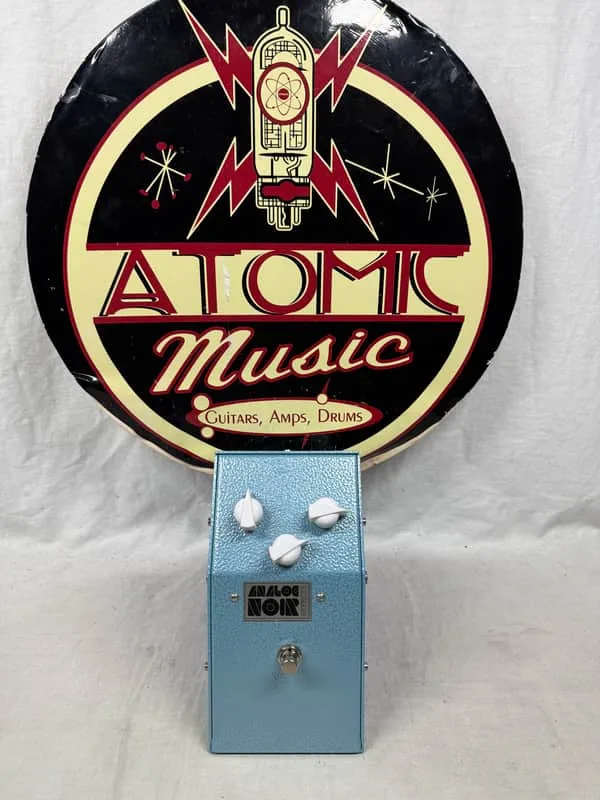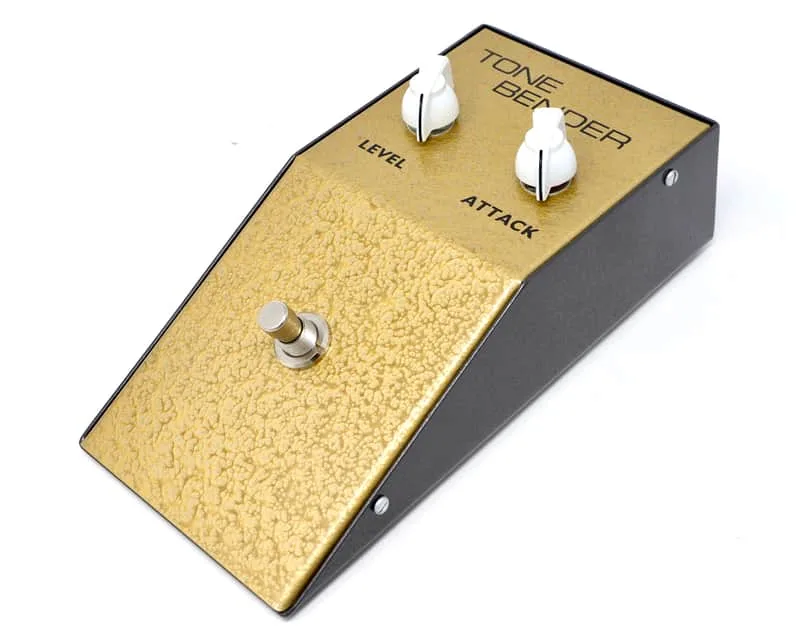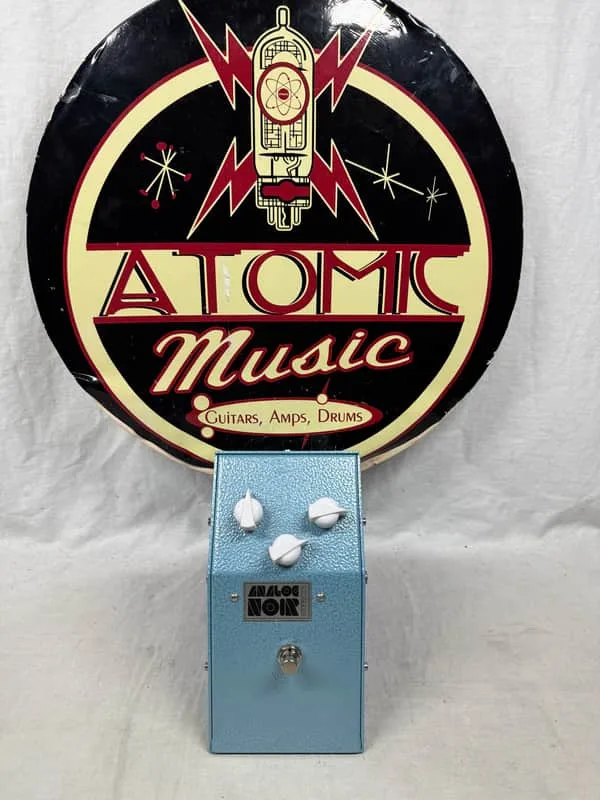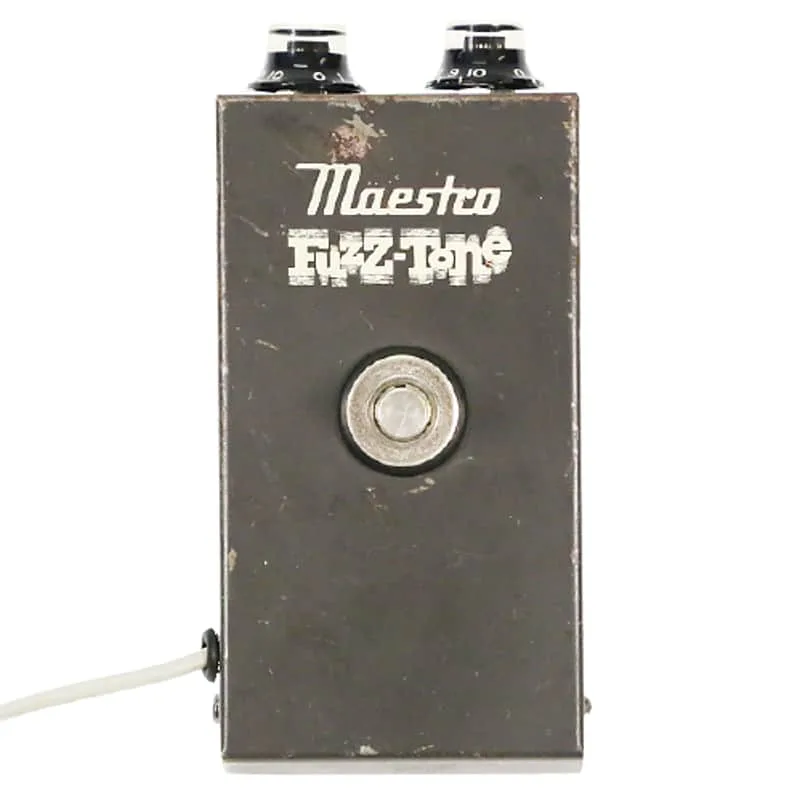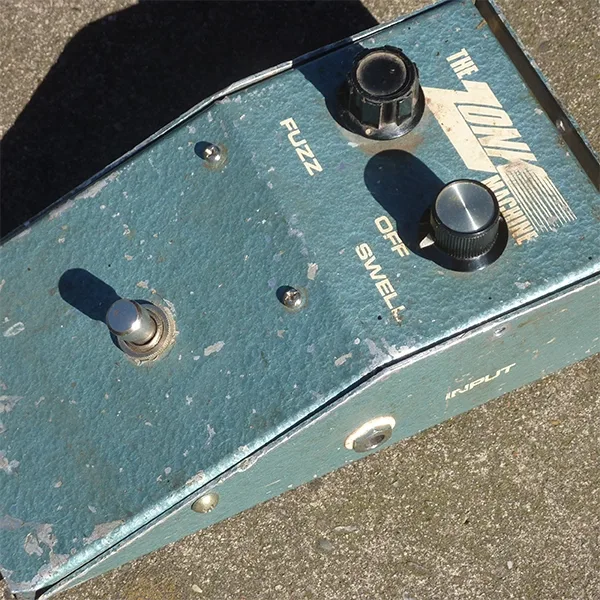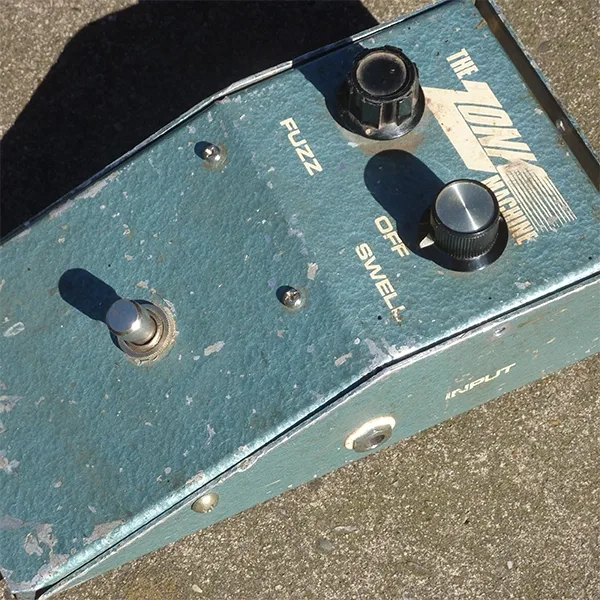


The John Hornby Skewes Zonk Machine is a British fuzz pedal made in Leeds, England, launched by the end of 1965 and built in very small numbers. Its circuit was almost identical to the Sola Sound Tone Bender MKI: three germanium transistors in a design tracing back to the Gibson Maestro Fuzz-Tone FZ-1 and the Tone Bender12. Where the MKI wore a golden wedge, the Zonk Machine was painted a fashionable baby blue, and stompboxes.co.uk calls it "the freakier, weirder looking cousin to the Tone Bender MKI," ultra bright and searing32.
A brighter, weirder cousin of the Tone Bender MKI
The Zonk Machine sits squarely in the first wave of British fuzz. The Maestro FZ-1 inspired Gary Hurst's Tone Bender, which was modified to produce more sustain than its American counterpart, and the Zonk followed as one of the more famous MKI-influenced fuzz boxes7. Fuzzboxes.org notes that its circuit resembled Gibson's Maestro Fuzz-Tone, but the model was much more similar to the Tone Bender, likely its true inspiration5.
What set it apart was its character. Vintage Guitar magazine describes Ramskirr's design as providing "more boost and a slight but pleasing oscillation" compared with the MKI2. Builders who have traced the circuit agree on its brightness: on the Guitar FX Layouts blog, Zach writes that "the Zonk is very bright," and suggests input capacitor values between .001uF and .01uF to tame it8. A verified PNP build documented on the blog used Q1: OC75 (~80 hfe), Q2: NKT275 'reissue' (~100 hfe), and Q3: OC75 (~80 hfe)8.
"The freakier, weirder looking cousin to the Tone Bender MKI, the John Hornby Skewes Zonk Machine."
The enclosure told the same story of a budget cousin. TONEHOME describes the Zonk as only made in small numbers before the pedal was updated with a more modern, easier to produce unit, and not as heavy duty or robust as the MKI4. One unit examined by stompboxes.co.uk was Veroboard loaded, described as the first such unit its author had seen3.
Who designed it, and who built it
John Hornby Skewes, the Leeds firm behind the pedal, approached Charlie Ramskirr of Wilsic Electronics in Doncaster to build its new fuzz box6. Skewes recalled in 2015 that the Zonk Machine was designed by Charlie Ramskir, though Fuzzboxes.org treats that recollection as unreliable5. Either way, the Wilsic connection is consistent across the histories: the pedal carried the Hornby Skewes name, and the building happened in Doncaster65.
The pedal ran on a 9 volt battery, like the Tone Bender5. Early examples had a battery clasp fastened to the main chassis, while later units had the clasp attached to the removable cover behind the controls5.
Versions of the Zonk Machine
Original Zonk Machines were built in at least three construction phases, and the parts changed along the way5:
| Version | Period | Construction |
|---|---|---|
| PCB version | c. 1966 to 1967 | Printed circuit board |
| Stripboard version | c. 1967 to 1968 | Stripboard |
| Tag board version | undated | Tag board |
Within the PCB version, earlier examples featured brown carbon composite resistors before Hornby Skewes started fitting yellow, likely Iskra, types5.
The pedal was then re-engineered as the Zonk Machine II in 1967, an extremely rare unit based on the Sola Sound MKI Tone Bender circuit9. Vintage Guitar reports that Skewes asked Wilsic Electronics to develop a less-expensive option2. Where the original Zonk is very bright, the Zonk II is more stable, smoother, and less dark sounding than the Zonk Machine I9. Both the I and II were built in original PNP and original NPN layouts89. The Zonk Machine I itself was made between 1965 and 1966 in Leeds8.
Why originals turn up in Canada
John Hornby Skewes was reported in Melody Maker in August 1966 to have been exporting fuzz boxes, and original Zonk Machines overwhelmingly resurface in Canada5. That export trail explains why so many surviving originals are found in North America rather than in the U.K.
The pedal's run ended in 1968. Fuzzboxes.org and the British Pedal Company both report that the Zonk Machine was discontinued after Ramskirr's death that year56. Vintage Guitar adds that the products had had their day, with more sophisticated products from the U.K., Italy, and the U.S. appearing on the market2. Production figures are small under every account: very few of the original units were produced between 1965 and 19686, with other histories giving the span as 1965 to 196618.
Players and reviewers
David Gilmour reportedly used a Zonk Machine during the early years of Pink Floyd, according to Tru-Fi's history of the pedal10. On That Pedal Show, in an interview with Guitar World, Mick Taylor named it his pick as the greatest fuzz pedal after the FZ-1:
"So it's actually the Zonk Machine for me."
MusicRadar, covering 2024's fuzz pedal releases, noted that the original Zonk Machine "was produced for a short period between 1965 and '66, yet became something of a legend in the world of fuzzboxes," famous for its bright fuzz12.
Reissues
The Zonk Machine's circuit has been revived more than once:
- JHS: two of its own versions, a Vintage Series pedal in the larger wedge-style enclosure and one in its Compact Series12.
- British Pedal Company: a Zonk Machine reissue made in England in 20134.
Videos
Acid Fuzz Pedals
Acid Fuzz Pedals
British Pedal Company
Questions
Is the Zonk Machine a Tone Bender copy?
Very nearly. The Zonk Machine was almost identical in circuitry to the Sola Sound Tone Bender MKI, with three germanium transistors in a design tracing back to the Maestro Fuzz-Tone FZ-1 and the Tone Bender. Its circuit resembled the Maestro Fuzz-Tone, but the Tone Bender MKI was likely its true inspiration.
Who designed the original Zonk Machine?
John Hornby Skewes developed the pedal and had it built by Charlie Ramskirr of Wilsic Electronics in Doncaster. Skewes recalled in 2015 that Ramskir designed it, though one history of the pedal treats that recollection as unreliable. Ramskirr's design gave the pedal more boost and a slight but pleasing oscillation.
When was the Zonk Machine made?
The Zonk Machine was launched by the end of 1965 and made in Leeds, England. Sources differ on the exact span: some say 1965 to 1966, others 1965 to 1968, and all agree very few units were produced. It was discontinued in 1968 after Ramskirr's death.
Why are original Zonk Machines found in Canada?
John Hornby Skewes was exporting fuzz boxes by August 1966, and original Zonk Machines overwhelmingly resurface in Canada, which points to that export market. That Canadian distribution is why so many surviving originals turn up there rather than in the U.K.
Does JHS make a Zonk Machine reissue?
Yes. JHS has two of its own versions out: a Vintage Series pedal in the larger wedge-style enclosure, and one in its Compact Series. The British Pedal Company also made a Zonk Machine reissue in England in 2013.
Sources (12)
- A Little History, www.stompboxes.co.uk, 2017
- Hornby Skewes Zonk Machines, Vintage Guitar magazine, 2016-02-12
- 1965, stompboxes.co.uk, 2025
- TONEHOME, TONEHOME - the World of Vintage Guitar Effect Pedals
- John Hornby Skewes Zonk Machine • Fuzzboxes, Fuzzboxes.org, 2021-05-14
- Zonk Machine History, British Pedal Company, 1965
- Skronk Machine, BLAMMO! Electronics
- Guitar FX Layouts: Hornby Skewes Zonk Machine I, Guitar FX Layouts (tagboardeffects.blogspot.com), 2017-05-01
- Guitar FX Layouts: Hornby Skewes Zonk Machine II, Guitar FX Layouts (tagboardeffects.blogspot.com), 2017-05-01
- Creation of Zonk Machine Fuzz, tru-fi.com
- That Pedal Show's Dan Steinhardt & Mick Taylor rate legendary pedals, Guitar World, 2022-10-31
- Bored of your 'board? Stomp this way for the must-have new guitar effects pedals of 2024, MusicRadar, 2024-03-28