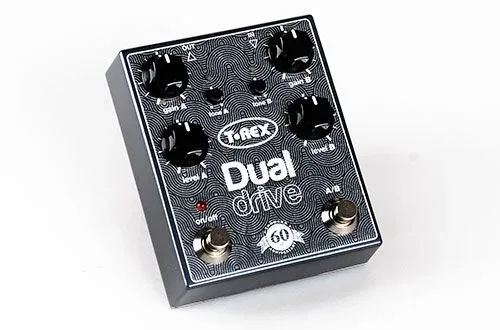


The T-Rex Dual Drive is a two-channel distortion pedal: T-Rex describes it as "two channels DISTORTION," carrying "two separate channels of vintage T-Rex gain" in one enclosure1. The idea is simple and useful on a gig: set up one drive tone and a second, different one, then switch between them with your feet instead of bending down to turn knobs. T-Rex describes the two sounds as "a nice edgy overdrive from Channel A" and "a thick warm distortion" from Channel B1.
Controls and channels
Each channel gets its own set of controls, so the two sounds are set up independently1:
| Control | What it does |
|---|---|
| On/off | Bypasses the pedal (True Bypass switching)1 |
| A/B switch | Selects between Channel A and Channel B1 |
| Gain A | Sets the amount of gain for Channel A1 |
| Gain B | Sets the gain for Channel B, which "picks up where Channel A leaves off"1 |
| Level A / Level B | Sets each channel's output level1 |
| Tone A / Tone B | "a pair of individually tuned tone controls, one for each channel," to shape the timbre of the overdrive and distortion1 |
Channel 2 also carries a built-in gain boost, which T-Rex says is there "for wider range of sounds"1. Because Channel B's gain range starts where Channel A's ends, the natural setup is Channel A as a lower-gain overdrive and Channel B as a heavier distortion voice.
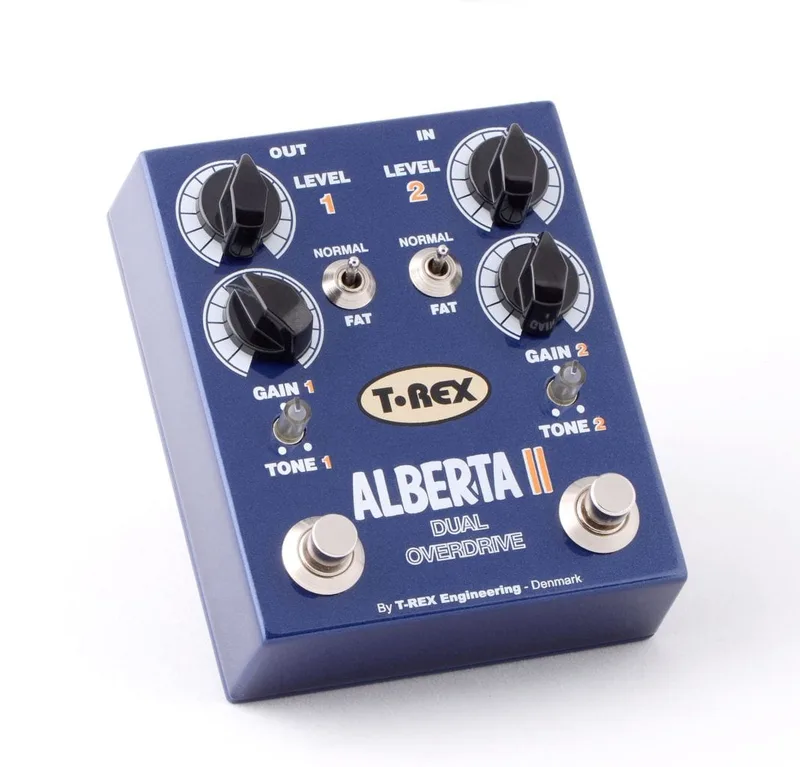
The two channels are separate voices selected by the A/B switch, not a stack. On the related Alberta II dual overdrive, Delicious Audio's reviewers noted that "it isn't possible to cascade one channel into the other, Stevie Ray Vaughan-style," while finding that the channels "are highly complementary, for a start. Set one up as your lead and the other up as your rhythm, and you can happily toggle between the two all night"2.
How it compares
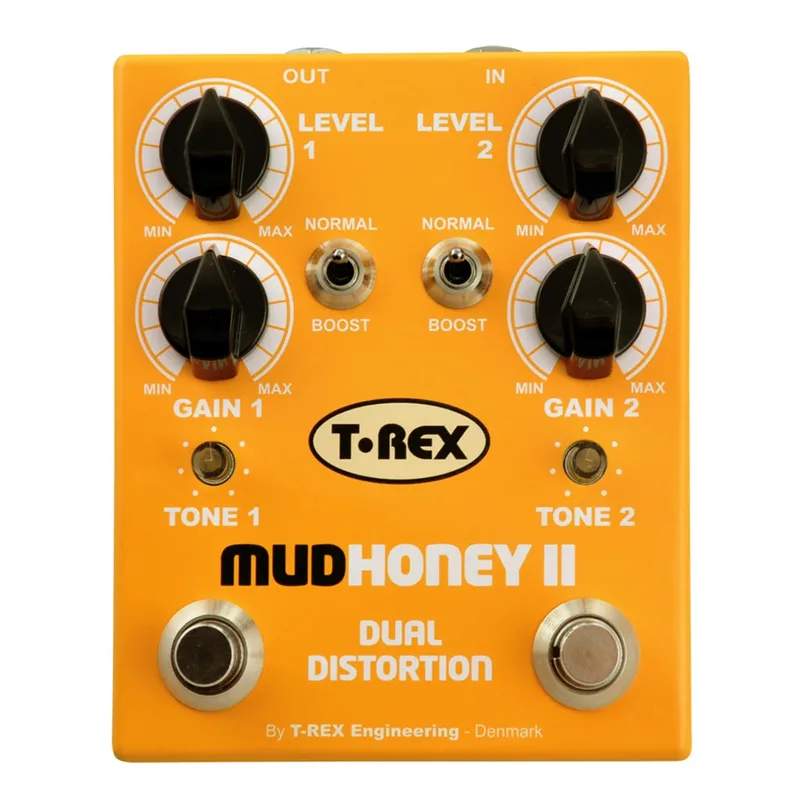
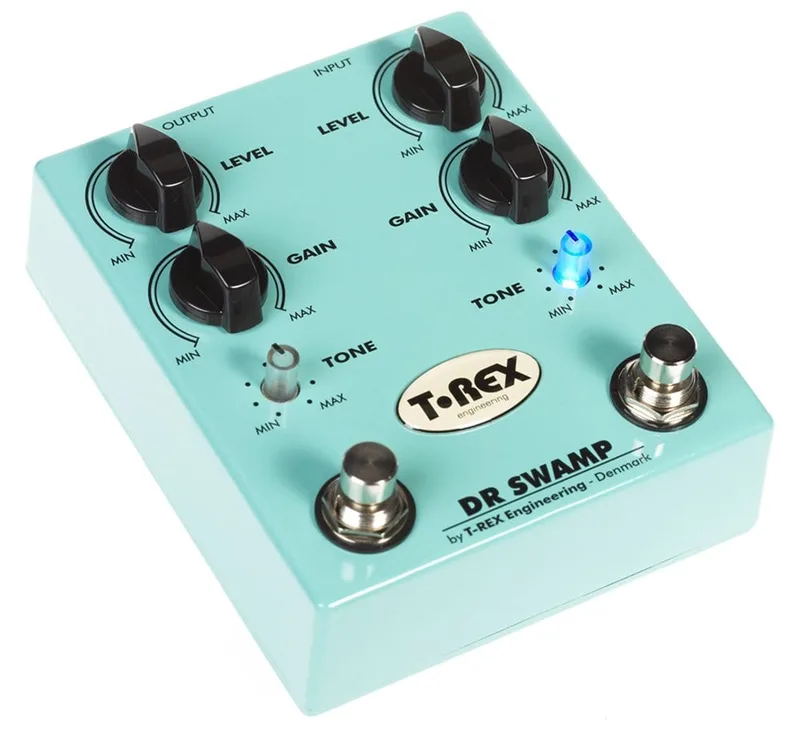
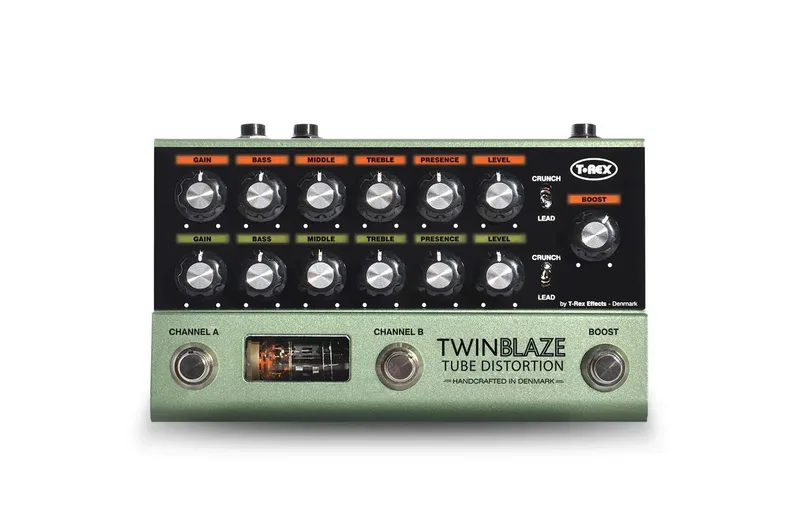
The dual-drive-in-one-box idea shows up elsewhere in the T-Rex range and beyond. T-Rex Mudhoney 2 is the Danish maker's dual distortion pedal from that same family of two-channel designs, and the T-Rex Dr. Swamp and T-Rex TwinBlaze cover other distortion territory in the lineup. Vintage Guitar magazine described the Alberta II, a two-channel overdrive from the same maker, as a pedal that "lets the user set two drive tones"3. A separate pedal also called the Dual Drive, from Magnetic Effects, is true bypass as well, according to Premier Guitar's press release4; it is a different product from a different maker, covered on its own page at Magnetic Effects Dual Drive.
Power and setup
The Dual Drive runs on a 9V DC supply, with T-Rex naming its own FuelTank as the reference supply, and draws 50 mA at 9V DC1. A 9V 6F22 battery can also power the pedal1. The external connections are an input jack, an output jack and the 9V DC jack1.
At 50 mA, the Dual Drive draws more current than many low-gain overdrives. On a daisy-chain supply shared with several pedals, the 50 mA draw needs to fit within the supply's budget, or the Dual Drive can have its own outlet on a pedalboard power supply.
For more on where this pedal sits, see Distortion Pedals and Overdrive Pedals.
Videos
EytschPi42
AmpsOnAir
Wall of Sound
Questions
Is the T-Rex Dual Drive true bypass?
Yes. T-Rex lists True Bypass switching on the Dual Drive's product page, so when the pedal is off, your guitar's signal passes through without loading the front of your amp. The same true bypass specification appears on the related Magnetic Effects Dual Drive, according to Premier Guitar's press release.
Can the T-Rex Dual Drive run on a battery?
Yes. T-Rex specifies a 9V battery, type 6F22, as the battery for the Dual Drive, alongside the 9V DC jack for an external power supply. If you use a battery, keep in mind the pedal draws 50 mA at 9V DC, which is more than some simple overdrives.
Can I use both channels of the T-Rex Dual Drive at once?
The Dual Drive gives you two separate channels with an A/B switch, and T-Rex describes Channel B as picking up where Channel A leaves off, with a built-in gain boost in Channel 2. On the related Alberta II, Delicious Audio's reviewers noted that the channels cannot be cascaded into one another, so the design is for switching between two tones rather than stacking them.
How much current does the T-Rex Dual Drive draw?
T-Rex lists the current draw at 50 mA at 9V DC. That is enough that a battery will not last indefinitely, and it is worth accounting for on a daisy-chain supply shared with several pedals.
What is the input impedance of the T-Rex Dual Drive?
T-Rex specifies the input impedance at 1 kHz as higher than 1 megohm, and the output impedance at 1 kHz as lower than 1 kilohm. A high input impedance like that keeps an unbuffered pickup from being loaded down when the pedal is on.
Sources (4)
- → T-REX EFFECTS ← Pedals for guitar and bass players!, T-Rex Effects
- Pedal Review: T-Rex Alberta II Dual Overdrive, Delicious Audio, 2013-10-14
- T-Rex Intros Alberta II Dual Overdrive, Fuel Tank Goliath, Vintage Guitar magazine, 2013-04-24
- Magnetic Effects Introduces the Dual Drive, Premier Guitar, 2020-01-28