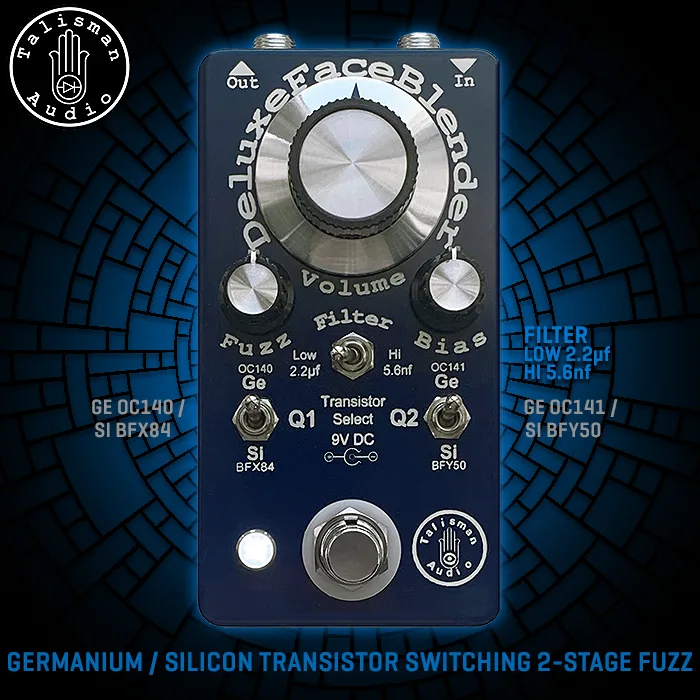
The Talisman Audio Deluxe Face Blender is a point-to-point wired, Fuzz Face style fuzz with germanium and silicon transistor switching at both gain stages, made by the small builder Talisman Audio. Alongside Volume, Fuzz/Gain, Filter and Bias controls, it carries separate Q1 and Q2 transistor select switches, so one pedal covers germanium, silicon and hybrid fuzz voicings. Guitar Pedal X's Stefan Karlsson reviewed it in August 2026 and priced it at £320, given as $430 in the same review12.
What it is and how it works
The circuit is a two-stage Fuzz Face style fuzz, built point-to-point rather than on a printed circuit board. Each stage has its own transistor select switch: Q1 chooses between a germanium OC140 and a silicon BFX84, and Q2 chooses between a germanium OC141 and a silicon BFY50. Because the silicon and germanium pairs are arranged so that Q1 silicon has higher hfe (gain) than Q2 silicon, while Q2 germanium has higher hfe than Q1 germanium, the four switch combinations give different gain arrangements: Q1 Si into Q2 Si is high into low gain, Q1 Si into Q2 Ge is high into high, Q1 Ge into Q2 Si is low into low, and Q1 Ge into Q2 Ge is low into high1.
The controls:
| Control | What it does |
|---|---|
| Volume | Output level |
| Fuzz / Gain | Amount of fuzz |
| Filter | Low 2.2 μF or Hi 5.6nF capacitor setting |
| Bias | Biases the transistors |
| Q1 Transistor Select | Ge OC140 or Si BFX84 |
| Q2 Transistor Select | Ge OC141 or Si BFY50 |
Beyond the switching, the build uses vintage capacitors including Philips Tropical Fish and Orange Drop, plus Alcap and Nichicon types, a 56uH inductor pickup simulator, and high quality Alpha pots1. The pedal comes in a deep blue enclosure1.
Talisman Audio's website is not up yet. As of August 2026 the pedal is bought by contacting Tom via the maker's Instagram page, instagram.com/talismanaudio1.
What reviewers said
The reviewer at Guitar Pedal X found the Deluxe Face Blender "a litter fatter, and a touch more potent" than the others, "with 2 relatively similar sets of Transistors" overall2. On the filter control, the reviewer's preference was for the Low 2.2 μF setting over the Hi 5.6 nf one, keeping it on Low all the time1.
On the filter switch, he found the Low setting far stronger: "while on this one the Low 2.2 μF setting is so much more potent than the Hi 5.6 nf one - that I just keep it on Low all the time"1. His preferred settings were Volume at noon, Fuzz and Bias at 3 o'clock, and the Filter on Low 2.2 μF1.
In a later roundup of transistor-switching two-stage fuzzes, he summed it up: "Overall the Deluxe Face Blender is a litter fatter, and a touch more potent - with 2 relatively similar sets of Transistors overall"2. Compared with the related Talisman Audio GP7, he found this one "phatter and more searing, a touch more full-on in every department than the GP7"1.
Tom of Talisman Audio, on the design: "Those old Mullard transistors really sing. Having independent bias trimmers for each transistor really helps to dial in the sweet spot"1.
Talisman Audio builds the Deluxe Face Blender with Point-to-Point construction, which the reviewer described as what "makes this circuit really special"2. Designer Tom of Talisman Audio said, "Those old Mullard transistors really sing. Having independent bias trimmers for each transistor really helps to dial in the sweet spot," adding that each one was biased by ear over several hours1.
Questions
Does the Talisman Audio Deluxe Face Blender use germanium or silicon transistors?
Both. Each of the two gain stages has its own transistor select switch, so you can choose germanium or silicon at Q1 and at Q2 independently. That gives four possible transistor pairings, from all-germanium to all-silicon, plus two hybrid combinations. Guitar Pedal X's reviewer described it as essentially a superior germanium, silicon, and hybrid Fuzz Face all in the same box.
What transistors can be selected in the Deluxe Face Blender?
Q1 selects between a germanium OC140 and a silicon BFX84. Q2 selects between a germanium OC141 and a silicon BFY50. The reviewer's own ranking of the four pairings put Ge OC140 with Si BFY50 first, then Ge OC140 with Ge OC141, then Si BFX84 with Ge OC141, and finally Si BFX84 with Si BFY50.
What voltage does the Deluxe Face Blender need?
It runs on 9V DC with center negative polarity and draws around 5mA, according to Guitar Pedal X's review. That low draw means it sits easily on any standard pedalboard power supply.
How much does the Deluxe Face Blender cost in the US?
Guitar Pedal X listed it at £320, which the same review gave as $430, as of August 2026. Sales currently run through the maker's Instagram page rather than a website.
Is the Deluxe Face Blender a Fuzz Face clone?
It is a Fuzz Face style fuzz, but it goes beyond a straight clone: it is built point-to-point and adds germanium and silicon transistor switching at both stages, a filter switch, and independent bias control. Guitar Pedal X called it essentially a superior germanium, silicon, and hybrid Fuzz Face all in one box.
How do I contact Talisman Audio?
Talisman Audio's website is not up yet, so as of August 2026 you contact Tom via the maker's Instagram page at instagram.com/talismanaudio, which is also where the Deluxe Face Blender is sold.
Sources (2)
- Guitar Pedal X, Guitar Pedal X, 2026-08-04
- Guitar Pedal X, Guitar Pedal X, 2026-08-14