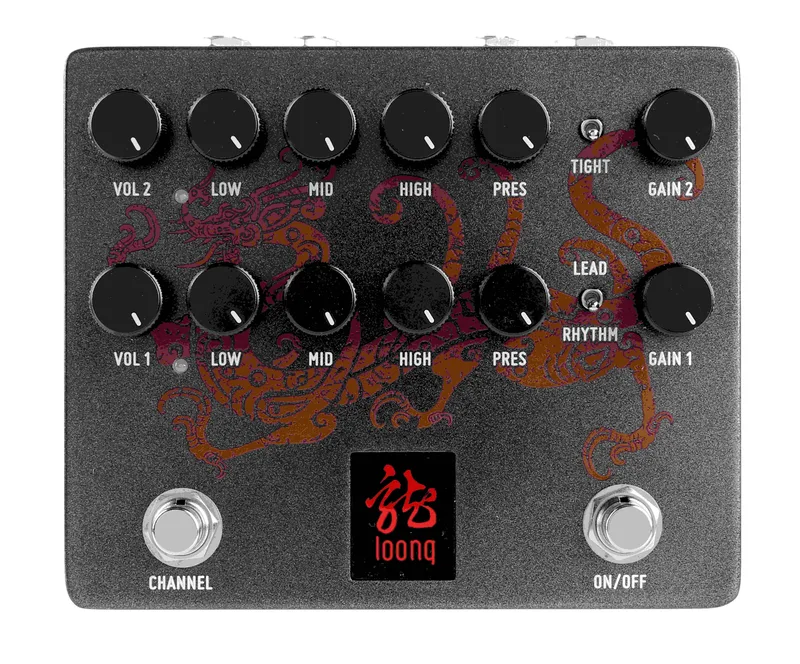
Because it is a preamp-style pedal rather than a simple distortion box, it is built to push an amp hard: the red channel reaches a maximum output of +12dB and the blue channel +13dB1. Internally, Tone City's own DC/DC voltage conversion technology raises the pedal's internal voltage to ±15V from a 9V supply, which the maker presents as the basis of the series12.
The two channels
The Loong's two channels are separate circuits with different clipping designs, and a dedicated footswitch switches between them13.
Red channel. Tone City describes this as the more modern voice: high-gain with impactful dynamics and a wide range of EQ adjustment, capable of an aggressive, heavy metal tone1. Its distortion is built on asymmetric clipping, and it carries an active three-band EQ plus a Presence adjustment12. A toggle switch moves it between two characters: up is a very thick, clean aggressive distortion mode, and down is a very tight, fuller aggressive mode1.
Blue channel. This channel uses symmetric clipping instead, and Tone City says it has less low-end gain and a more strengthened midrange gain than the red channel1. It has its own LEAD and RHYTHM modes: in LEAD mode the distortion is highly adaptable, covering styles from blues to rock, while RHYTHM mode reduces the distortion further for a crunchy tone1.
| Red channel | Blue channel | |
|---|---|---|
| Clipping | Asymmetric1 | Symmetric1 |
| Character | Modern high-gain, heavy metal capable1 | Less low gain, stronger midrange1 |
| EQ | Active 3-band plus Presence1 | Separate 3-band EQ1 |
| Modes | Thick/clean (up) vs tight/fuller (down) toggle1 | LEAD and RHYTHM modes1 |
| Max output | +12dB1 | +13dB1 |
Gearnews' Julian Schmauch described the two voices in similar terms: voice 1 "offers a tight switch to add more bass and goes more into high-gain sonics," while voice 2 "includes a lead/rhythm switch while offering more Marshall-y flavors"3.
Controls and switching
Each channel has its own three-band EQ, so the two voices can be dialed in independently rather than sharing one tone stack3. Beyond the EQ knobs, the controls break down as:
- A dedicated footswitch to switch between voice 1 and voice 23
- A toggle on the red channel selecting thick/clean or tight/fuller aggressive modes1
- A lead/rhythm switch on the blue channel13
- Presence adjustment on the red channel's EQ1
Power and connectivity
The Loong runs on a DC 9V adapter and draws 140mA1. There is no battery option in the maker's specification, and the 140mA draw is high for a compact pedal, so it needs a proper isolated or high-current supply rather than a small daisy chain.
The Loong's 140mA current draw is substantial for a single pedal. Plan a power supply with enough headroom; the maker specifies a DC 9V adapter only1.
Signal connections are straightforward: 1M input impedance, 10K output impedance, and a normal input level of -10dB1. Bypass is true bypass, so the signal passes unbuffered when the pedal is off1.
Where it came from
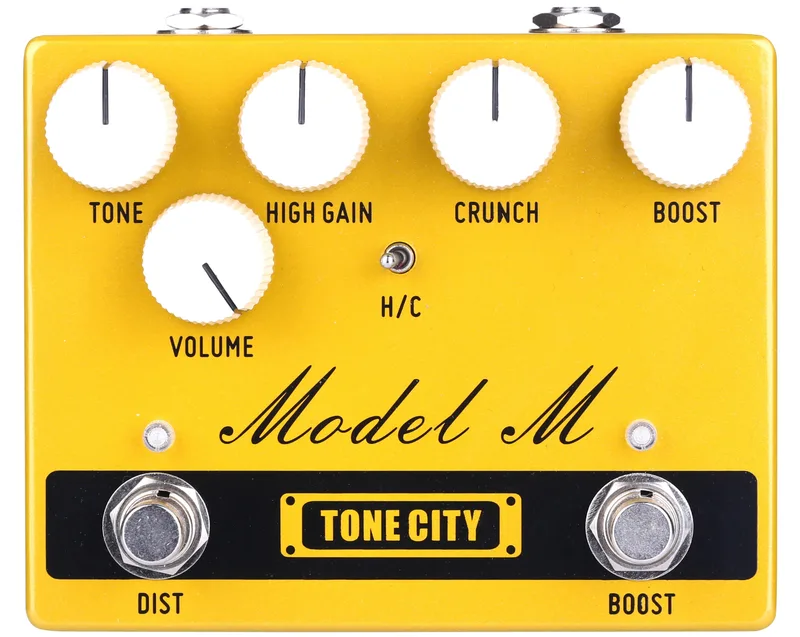
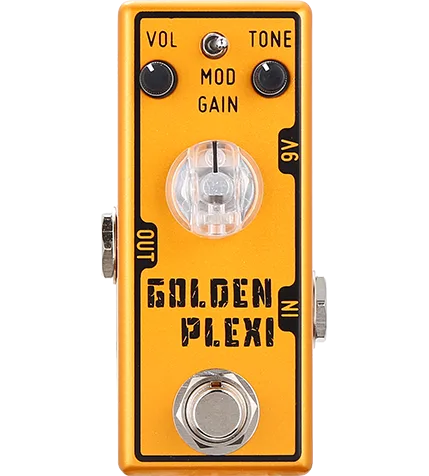
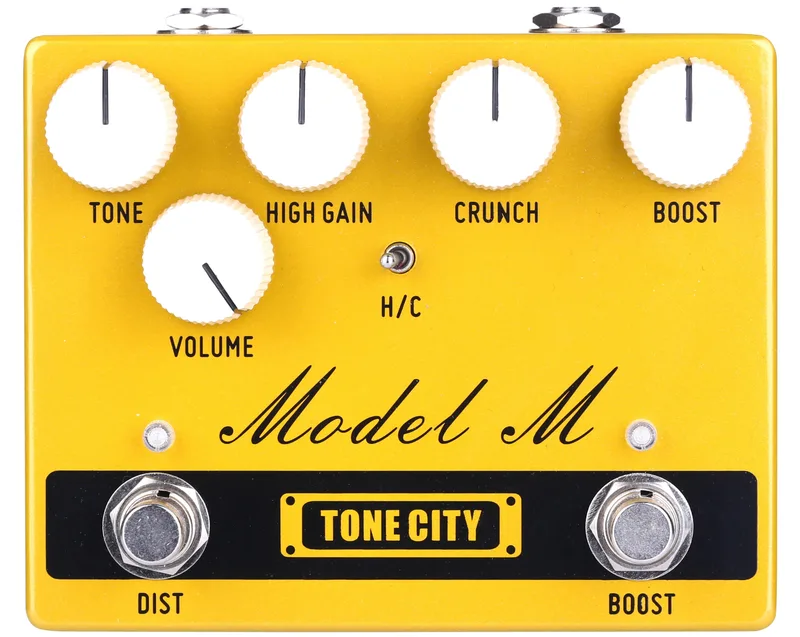
The maker's own references to Model M and Golden Plexi tones point to its earlier British-style distortion pedals, and Gearnews framed the Loong among Tone City's budget and mini versions of famous pedal designs13.
What reviewers said
Gearnews covered the Loong at its announcement, noting the $187.00 price alongside the UK and euro listings3. The reviewer's overall impression was positive about the line as a whole:
"This seems to be the case for the Loong and all the other pedals of this release. Can't go wrong with budget or mini versions famous pedals!"
Questions
Is the Tone City Loong true bypass?
Yes. Tone City lists the Loong as true bypass, so with the pedal off your signal passes through without buffering or coloration.
Can the Tone City Loong run on a battery?
No. The Loong runs on a DC 9V adapter only, drawing 140mA, which is well beyond what a battery or a small daisy chain is designed to supply comfortably.
What amp sounds is the Tone City Loong based on?
Tone City says the Loong delivers classic, distinguishable British amplifier distortion tones, and that players may find some of its Model M and Golden Plexi tones in it. Gearnews described its flavors as more Marshall-like.
What is the difference between the red and blue channels on the Loong?
The red channel is a more modern high-gain voice with asymmetric clipping, a tight/thick toggle and up to +12dB of output. The blue channel uses symmetric clipping, has less low-end gain and a stronger midrange, offers Lead and Rhythm modes, and reaches +13dB.
Sources (3)
- TONE CITY® 龍 LOONG -ULTIMATE Series Dual‑Channel High‑Gain Distortion Pre‑Amp Pedal-TONE CITY ▏Analog Pedals & Power supplies, Tone City Audio, 2026
- ULTIMATE-TONE CITY ▏Analog Pedals & Power supplies, Tone City Audio, 2026
- Tone City Releases 7 Distortion Pedals: Meet the Loong Preamp, New Legend Series, and more!, gearnews.com, 2026-09-18