

The Tone Electronix Animalizzer is a distortion and fuzz effect pedal for both guitar and bass, built by Tone Electronix (also known as TX Pedals), a one-man pedal builder from Portugal. Each unit is handmade, one by one, and the pedal first saw the light of day in 20171.
Its range is wide: Delicious Audio describes it as a distortion/fuzz pedal that can even sound like mild overdriven tones in some settings1, while Pedal of the Day found it ranges "from slightly dirty to balls-out distortion, with a vast myriad of options to play with and tones to discover"2. Guitar Pedal X calls it an extended-range MufferFuzzer covering boost, overdrive, distortion and multiple Big Muff-style fuzz voicings3.
What it is and what it does
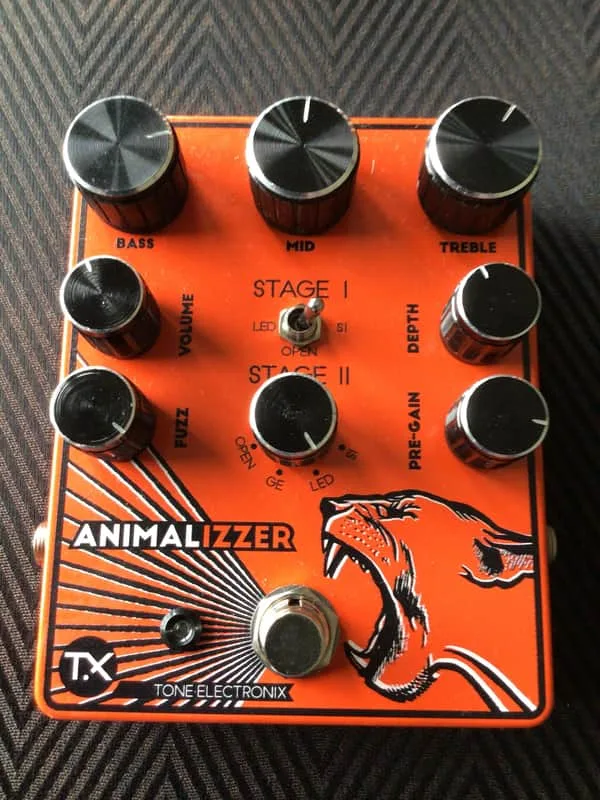
The Animalizzer is a multi-voice dirt pedal. Rather than one fixed clipping character, it gives you two clipping stages whose diodes you can switch, a boost section in front of them, and a three-band EQ after them. Gearnews summarized the signal flow as going from Boost (Pre-Gain, Depth, Fuzz), to Clipping Stage 1 (LED clip, Open, Silicon clip), then Clipping Stage 2 (Open, Germanium clip, LED clip, Silicon clip), and finally through the EQ section (Bass, Mid, Treble, Output volume)5.
Guitar Pedal X counts nine controls in total, including Volume, Fuzz, Pre-Gain, Depth and a three-band EQ, and notes that the diode choices minimally affect output while their combinations yield Muff, Rat-style and conventional drive textures3.
The controls and clipping switches
The three large Bass, Middle and Treble knobs sit on the top row of the pedal and shape the frequency response of the already-clipped signal5. Delicious Audio notes the mids knob is particularly effective for creating scooped or midrangey tones that cut through the mix, going from a really scooped "BMP-style" tone to very pronounced mids1.
| Control | What it does |
|---|---|
| Pre-Gain | Sets the level of the boost stage feeding the clipping stages5 |
| Depth | Shapes the boosted signal before clipping5 |
| Fuzz | Controls how much of the boosted/shaped signal hits the following clipping stages1 |
| Stage I | 3-position toggle: Si (symmetrical silicon diodes), LED diodes, or OPEN (natural transistor clipping)1 |
| Stage II | 4-position rotary: Si (asymmetric silicon), LED, Ge, or OPEN1 |
| Bass / Middle / Treble | Three-band EQ after the clipping stages5 |
| Volume | Final output level after the EQ stage1 |
The Stage II rotary switch offers four clipping options: Si, with silicon diodes arranged asymmetrically; LED; Ge, using pre-selected germanium diodes with "HI Voltage Forward" characteristics chosen for less impact on volume; and OPEN, which removes all Stage II clipping diodes, yielding midrange and a huge volume boost2.
On Stage I, the differences between the clipping options are more noticeable when both the Pre-Gain and Fuzz controls are above 75%1. Using the Stage I LED or OPEN positions gives increased bass response and headroom, which Delicious Audio calls great to try with bass guitar1.
The Stage II OPEN position removes all clipping diodes from that stage and produces a large volume boost, so it is worth easing off the Volume control before switching into it2.
Signal path
The circuit runs boost stage, then two clipping stages (Stage I and Stage II), then the EQ stage, and finally a Volume control before the output1. Delicious Audio describes the two clipping stages as the first offering LED plus Silicon options and the second offering Germanium, LED and Silicon1. Because the EQ sits after the clipping, the Bass, Middle and Treble knobs shape the distorted signal rather than the clean one going in1.
Big Muff roots, the MufferFuzzer name and V2
The Animalizzer is similar in a way to the well-known Big Muff circuit, which is where its original name, the MufferFuzzer, came from: like the Big Muff, it comprises two clipping stages1. MusicRadar introduced it as "The Animalizzer (née the MufferFuzzer)"6, and Premier Guitar's release notice listed it at €220 on the Tone Electronix site4. Gearnews reported a V2 offer price of €1905, and MusicRadar likewise noted a V2 special of €1906.
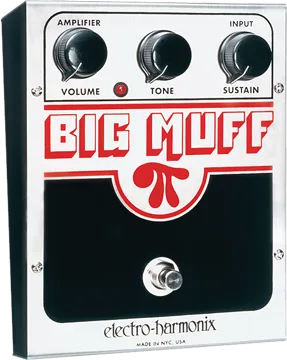
On That Pedal Show, Daniel Steinhardt and Mick Taylor named the Electro-Harmonix Big Muff among the cornerstones of classic fuzz, alongside the Tone Bender and Fuzz Face7, which is the lineage the Animalizzer extends. Guitar Pedal X's Stefan Karlsson went further, calling it:
"Not just one of the most versatile Big Muffs of all time, but one of the most versatile Multi-Gain and Multi-Fuzz pedals"8
The Animalizzer's fuzz side is built on Big Muff-style fuzz circuitry, which the maker describes as an extended-range MufferFuzzer covering Boost, Overdrive, Distortion and multiple Big Muff-style fuzz voicings3. The Big Muff itself is regarded as one of the cornerstones of classic fuzz, alongside the Tone Bender and Fuzz Face7. A reviewer called the MufferFuzzer "Not just one of the most versatile Big Muffs of all time, but one of the most versatile Multi-Gain and Multi-Fuzz pedals"8.
For bass players
Gearnews reported the pedal should work equally well for both guitar and bass5, and the Stage I LED and OPEN positions, with their increased bass response and headroom, are the settings Delicious Audio singles out for bass guitar1. Pedal of the Day found it does not get lost in the mix, which is one reason they call it "the BMP for BMP haters"2.
Videos
Tone.electroniX
Tone.electroniX
Eirik Stordrange
Questions
Is the Tone Electronix Animalizzer a Big Muff clone?
Not a straight clone. Its circuit is similar in a way to the Big Muff, with two clipping stages after a boost and before an EQ section, which is why it was originally called the MufferFuzzer. But the switchable clipping diodes, Pre-Gain and Depth controls and three-band EQ take it well past a stock Big Muff's range.
Can the Animalizzer be used with bass?
Yes. It was designed to work equally well for both guitar and bass, and the Stage I LED and OPEN clipping options give increased bass response and headroom, which Delicious Audio specifically recommends trying with bass guitar.
What did the Animalizzer used to be called?
It was originally called the MufferFuzzer, a name that came from its kinship with the Big Muff circuit. It first appeared in 2017 and was later renamed the Animalizzer.
What does the Stage II switch do on the Animalizzer?
Stage II is a 4-position rotary switch selecting the second clipping stage: Si (silicon diodes arranged asymmetrically), LED, Ge (pre-selected germanium diodes with high forward voltage), or OPEN, which removes all Stage II clipping diodes for a midrange-heavy sound and a huge volume boost.
How much current does the Animalizzer draw?
Its current draw is less than 5 mA, which makes it easy on a pedalboard power supply.
Where is the Animalizzer made?
In Portugal. Tone Electronix, also known as TX Pedals, is a one-man pedal builder there, and each Animalizzer is handmade one by one.
Sources (8)
- Tone Electronix Animalizzer Fuzz, Delicious Audio, 2022-12-08
- Tone.ElectroniX Animalizzer Distortion Fuzz, Pedal of the Day, 2021-03-15
- Guitar Pedal X, Guitar Pedal X, 2021-03-09
- Tone Electronix Releases the Animalizzer, Premier Guitar, 2020-12-15
- The Animalizzer, gearnews.com, 2020-12-16
- Answer the call of the wild with Tone Electronix's Animalizzer multi-drive and fuzz pedal, MusicRadar, 2020-12-15
- That Pedal Show, That Pedal Show, 2016-11-11
- Guitar Pedal X, Guitar Pedal X, 2026-08-28