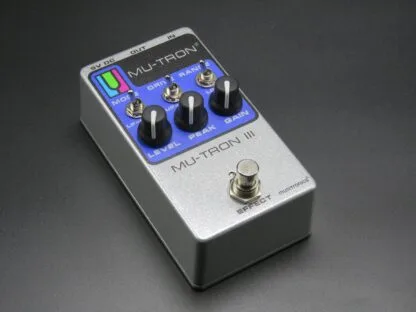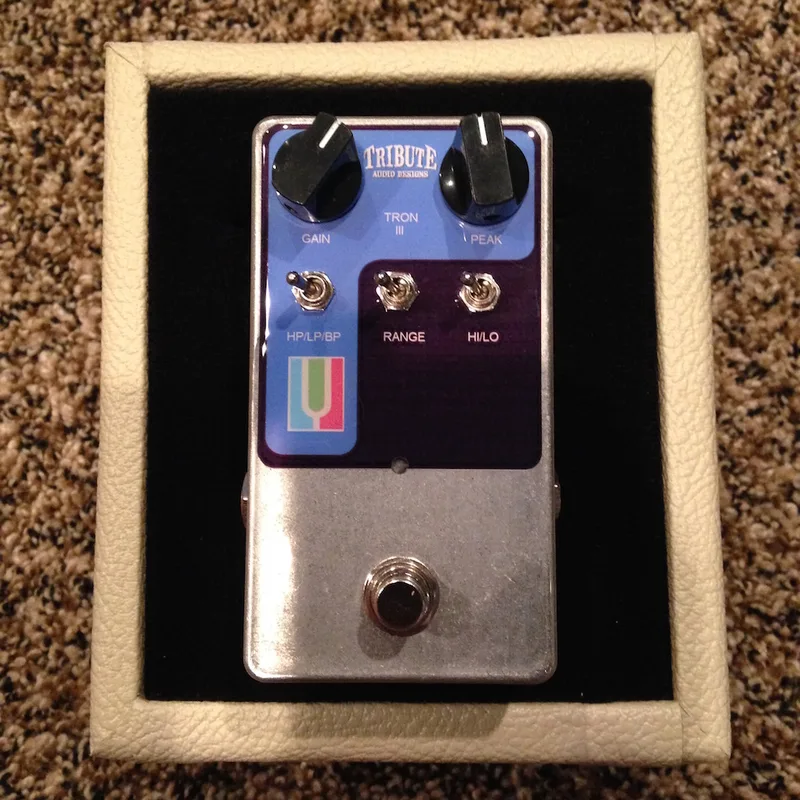

The Tron III is an envelope filter pedal from Tribute Audio Designs, a Canadian company. An envelope filter opens and closes a filter automatically in response to how hard you play, producing the auto-wah sounds associated with 1970s funk and beyond. The Tron III works in that tradition: Pedal of the Day's reviewer wrote that "You can truly coax Mu-Tron sounds out of this box," while noting it comes in a fraction of the footprint of the original unit, at about 1/4 of the size1.
The controls
The Tron III is controlled by one knob and three toggle switches, each shaping a different part of how the filter responds to your signal1.
| Control | What it does |
|---|---|
| Gain | Drives both the filter and the envelope portions of the circuit, adding more overdrive to your signal and more sensitivity to your playing dynamics1 |
| Peak | An intensity control that sets the top portion of the resonance of the filters1 |
| Hi/Lo toggle | Selects the type of filter sets being used1 |
| LP/HP/BP toggle | Selects the Lowpass, Highpass or Bandpass filter type1 |
| Range toggle | Goes between Upsweep and Downsweep1 |
The Gain control is worth understanding before you start turning it, because it does two jobs at once. Since it feeds both the filter and the envelope, raising it makes the pedal react more strongly to your picking and pushes the circuit into overdrive as it does. Players who want a cleaner filter response keep it low; players chasing a more aggressive, driven sweep push it up1.
The three toggles give the pedal its range. The LP/HP/BP switch picks the filter character: Lowpass, Highpass or Bandpass. The Hi/Lo switch selects between filter sets, and the Range switch sets whether the sweep moves up or down as your note decays1.
What reviewers said
Pedal of the Day reviewed the Tron III in June 2015. Its reviewer, Mike B, came away impressed with the sounds but flagged the learning curve:
"This is not a plug-and-play pedal, really, you need to invest some time to figure out how she's gonna play with your pickups..."1
That is a fair description of envelope filters generally: how the pedal tracks your signal depends on your instrument's output and everything around it on the board, so the Gain and Peak controls need to be set in context rather than copied from another rig1.
Availability
The Tron III is not a pedal you are likely to run across often. The same review notes that "there aren't many of these in existence," with the reviewer describing feeling lucky to have one arrive for evaluation1. Tribute Audio Designs is a small Canadian builder, and the pedal does not appear to be a mass-produced item1.
Videos
Pedal of the Day
Questions
Is the Tron III a copy of the Mu-Tron III?
It is not marketed as a copy, but it is built in the Mu-Tron III tradition: an envelope filter that tracks your playing dynamics. Pedal of the Day's reviewer wrote that you can truly coax Mu-Tron sounds out of the box, and noted it comes in a fraction of the footprint of the original unit.
Is the Tron III true bypass?
Yes. Pedal of the Day's 2015 review describes the Tron III as true bypass and standard 9V powered, so it can sit on a pedalboard and switch out of the signal path cleanly when off.
What voltage does the Tron III use?
The Tron III runs on a standard 9V power supply, according to Pedal of the Day's review. No current draw figure or battery option is documented for it.
What do the LP/HP/BP and Range toggles do?
The LP/HP/BP toggle selects the filter type: Lowpass, Highpass or Bandpass. The Range toggle goes between Upsweep and Downsweep, which sets the direction the filter sweeps as it responds to your picking.
Sources (1)
- Tribute Audio Designs Tron III Envelope Filter, Pedal of the Day, 2015-06-13