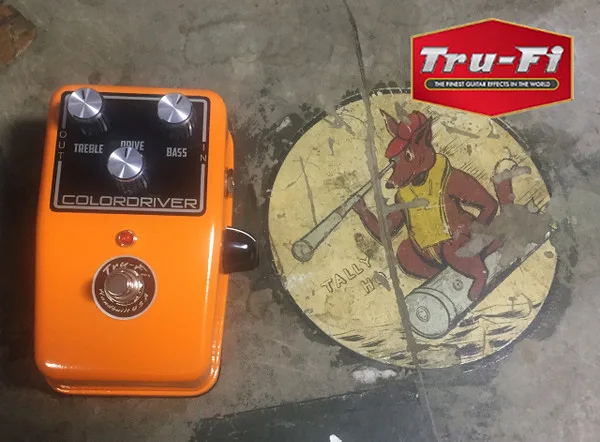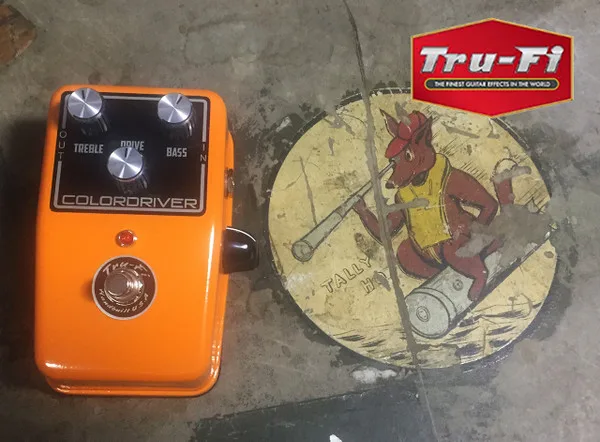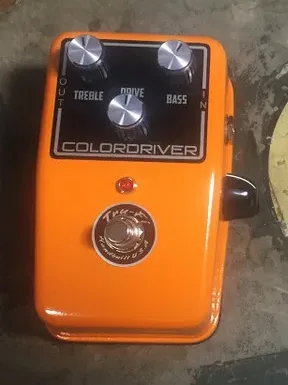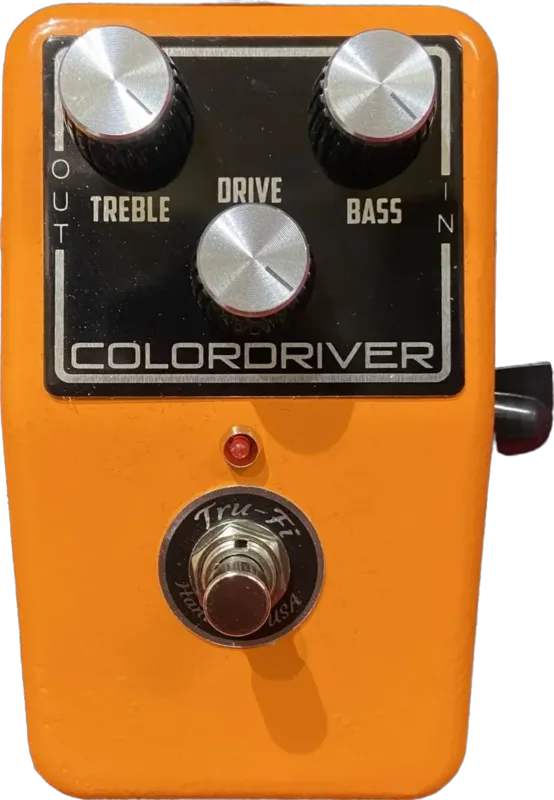


The Tru-Fi Mini '69 ColorDriver is a handbuilt, analog recreation of the 1969 Colorsound Power Boost circuit, squeezed into a smaller and more modern enclosure than Tru-Fi's vintage series. In 1969, Sola Sound, the London company behind the Tone Bender, released the Colorsound Power Boost, and Tru-Fi rebuilt that circuit with the same BC109 transistors as the original, made in Cumberland, Maine, USA1.
It works as an overdrive or a boost. Tru-Fi suggests using it as an always-on boost at the front of your chain so everything after it sounds better, or as an overdrive with the Drive control opened up1.
A Colorsound Power Boost in a smaller box
The original Power Boost ran on two 9V batteries at 18 volts and, in Tru-Fi's words, was "almost unusably loud." The Mini '69 gives you that circuit in a pedalboard-friendly box: 2/3 the size of Tru-Fi's vintage series, with the same Tru-Fi shaped enclosure and top-mounted jacks1.
The pedal sits alongside the full-size Tru-Fi Colordriver 9V version and 18 Volt version, which RockBoard's PedalPedia describes as a handmade recreation of the vintage Colorsound Power Booster / Overdriver circuit2. Tru-Fi notes that players who own the original Colordriver have found the smaller footprint of the '69 the perfect solution for tight boards1.
The controls
The control layout follows the original, with one addition the original never had1:
| Control | What it does |
|---|---|
| Treble | Top-end shaping |
| Bass | Low-end shaping |
| Drive | Sets the amount of overdrive |
| Master Volume | Side-mounted overall level control |
| 9V/18V toggle | Selects internal operating voltage |
Tru-Fi calls the Master Volume "the missing control the original desperately needed"1. On the full-size Colordriver, RockBoard describes the same setup: Gain, Treble, and Bass, plus a side-mounted master volume knob that lets you dial a boost, overdrive, or full-on fuzz/drive level2.
Power: 9V in, 9V or 18V inside
The Mini '69 takes a standard 9V center-negative power supply, and Tru-Fi states that all its mini pedals also run on a 9V battery1. Inside, a charge pump lets the circuit run at either 9V or 18V, selected by the toggle switch, so you can match the headroom of the original 18-volt design or run at the lower voltage1.
The original 1969 Power Boost ran on two 9V batteries at 18 volts, which Tru-Fi describes as almost unusably loud. The Mini '69's charge pump reproduces that 18V internal operation from a single 9V supply1.
On the full-size Colordriver, RockBoard lists 9V DC center-negative power with an internal battery clip or adapter, and notes the transistor choice varies with voltage: vintage-spec BC109 in the 9V version, BC184 in the 18V version2.
How it compares to the '71 ColorDriver
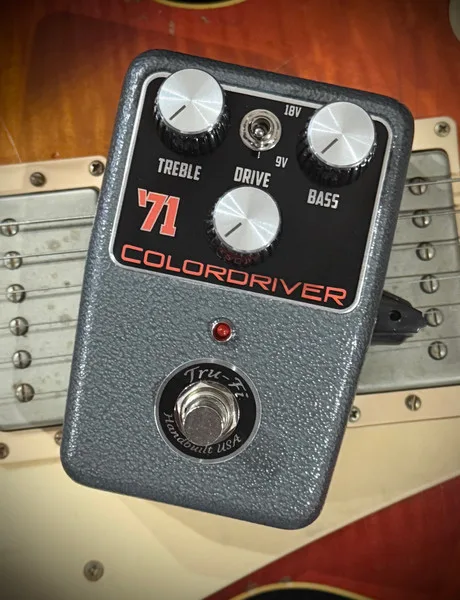
The Mini '69's sibling is the Tru-Fi Mini '71 ColorDriver. Tru-Fi draws the difference in character: "Where the '71 ColorDriver gets nasty and aggressive at full gain, the '69 stays warm, round, and musical"1. The maker also says the '69 runs smoother and warmer than the '71, cleans up beautifully with the guitar's volume knob, and stacks into other pedals1.
Guitar.com's reviewer Richard Purvis, reviewing the '71, noted the family differences: the '69 version is bright orange, has a tone described as "a bit smoother," and uses different silicon transistors, BC109 instead of BC18431.
Videos
gilmourish
Alberto Barrero
gearmanndude
Questions
What is the difference between the Tru-Fi '69 and '71 ColorDriver?
Tru-Fi describes the '71 ColorDriver as getting nasty and aggressive at full gain, while the '69 stays warm, round, and musical. The '69 runs smoother and warmer than its sibling, and Guitar.com's reviewer called its tone a bit smoother. The two also use different silicon transistors: BC109 in the '69, BC184 in the '71.
Does the Tru-Fi Mini '69 ColorDriver take a battery?
Yes. Tru-Fi states that all its mini pedals run on a 9V power supply or a 9V battery. The pedal also accepts a standard 9V center-negative adapter, and an internal charge pump lets it run at 9V or 18V internally via a toggle switch.
What transistors are in the Tru-Fi '69 ColorDriver?
The Mini '69 ColorDriver uses BC109 silicon transistors, the same type as the 1969 Colorsound Power Boost original. Tru-Fi builds it in Cumberland, Maine with these transistors. The '71 version uses BC184 transistors instead.
Does the Mini ColorDriver clean up with the guitar volume knob?
Yes. Tru-Fi says the '69 cleans up beautifully with the guitar's volume knob, describing it as a pure rock and roll machine that runs smoother and warmer than the '71 and stacks into other pedals in your chain.
Where is Tru-Fi made?
Tru-Fi pedals are handbuilt in Cumberland, Maine, USA. The Mini '69 ColorDriver is described by the maker as a handbuilt recreation of the original 1969 Colorsound Power Boost circuit, built in the same town with the same BC109 transistors as the original.
Sources (3)
- Tru-Fi '69 Colordriver Pedalboard Mini Version Guitar Pedal, Tru-Fi
- Colordriver by Tru-Fi Pedals, RockBoard PedalPedia, 2026
- Tru-Fi Mini ’71 Colordriver review, Guitar.com, 2026-02-23