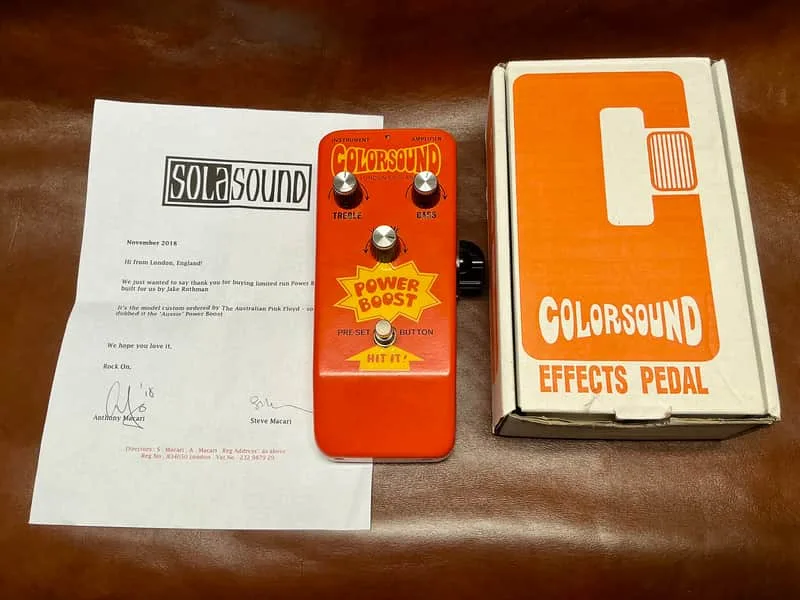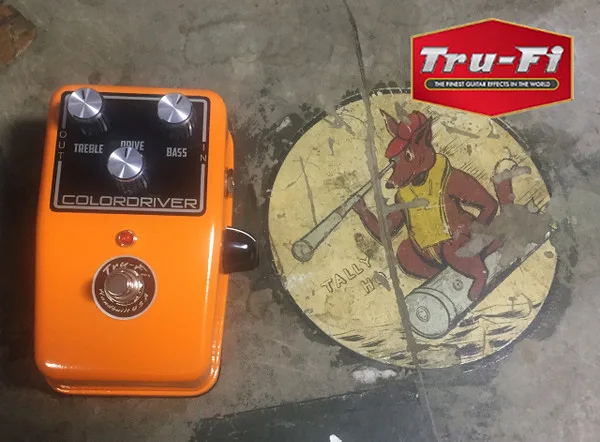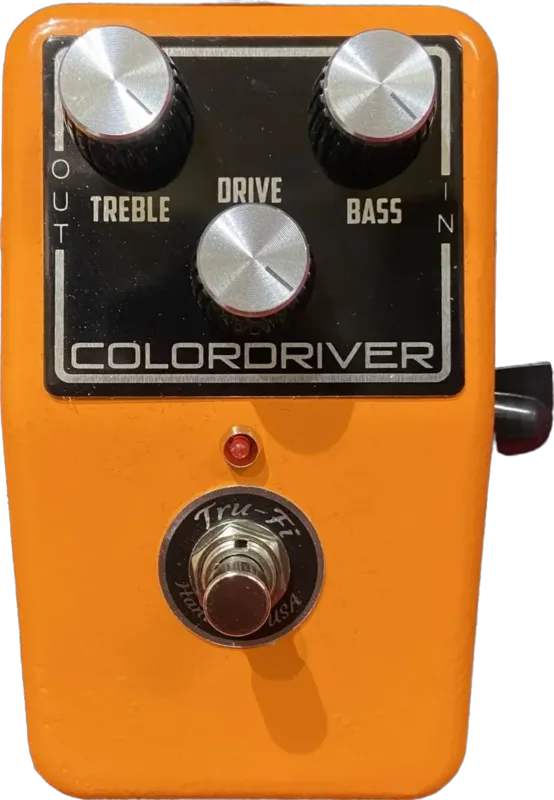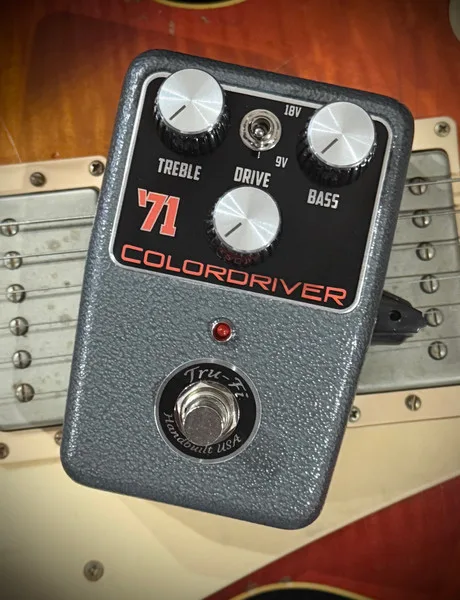

The Tru-Fi Mini '71 Colordriver is a handbuilt overdrive pedal that recreates the 1971 Sola Sound Colorsound Overdriver in a small, modern enclosure1. Tru-Fi describes it as raw, aggressive overdrive at full gain that melts into a smooth, musical boost when you back off the drive knob1. Guitar.com's reviewer, Richard Purvis, called it a tribute to both the Colorsound Power Boost and the Overdriver, keeping the vintage tones while adding modern practicality, and rated it 9/102.
The pedal sits in Tru-Fi's Mini series, which shrinks the company's full-size designs down by a third and moves the jack sockets to the top of the enclosure2. It is built in a Dark Gray enclosure and, as of Tru-Fi's product page, is built and ready to ship1.
A Colorsound Overdriver in a mini enclosure
In 1971, Sola Sound released the Colorsound Overdriver, the circuit this pedal is based on1. Tru-Fi's history of the pedal notes there have been different variations and reissues over the years, some with slight modifications to the circuit or enclosure design3. Aion FX documents the Overdriver as an updated version of the earlier Power Boost circuit, a third revision from 1972, and notes that a 1996 reissue added an output volume pot with a "minimum volume" resistor that stopped it going to zero45. The original came in a thin stamped gray metal case6, and TONEHOME notes that humbucker pickups will always push it into a slightly overdriven signal7.
Tru-Fi's version keeps the circuit's voice by using the same BC184 silicon transistors as the original1. Guitar.com notes the '71 version of the circuit used BC184s, where an earlier version used BC109s instead2.
The controls are:
| Control | What it does |
|---|---|
| Treble | Top-end tone shaping, part of the highly responsive tone controls12 |
| Bass | Low-end tone shaping1 |
| Drive | Gain; full on gives raw, aggressive overdrive, backing off gives a smooth boost1 |
| Master Volume | Side-mounted, sets output level, absent on the original circuit12 |
| 9V/18V toggle | Switches the internal operating voltage1 |
The master volume is the biggest practical change from the 1971 original. As Tru-Fi puts it1:
"The original had no volume control, which meant it was always screaming. We fixed that."1
Guitar.com's reviewer found the added volume knob lets you match the bypass level2.
Power: 9V or 18V
The pedal takes a standard 9V center-negative supply or a 9V battery, and an internal charge pump lets it run at 9V or 18V depending on the toggle position12. Tru-Fi describes the two modes as:
Guitar.com's buying guide frames the switch in historical terms: with the toggle up, "you get the 1969 Power Boost, which is simply the Overdriver running on 18v instead of 9v"8. The review itself notes the 18V setting sounds a little bit bigger and clearer than 9V1.
Tru-Fi offers the same circuit in other formats: the full-size Colordriver 9V version and Colordriver 18 Volt Version, plus the Mini '69 ColorDriver covering the earlier Power Boost era of the circuit.
What reviewers said
Guitar.com published a review by Richard Purvis on February 23, 2026, rating the pedal 9/102. On sound, he found it tonally uncoloured and crunchy below halfway on the drive dial, with colossal Fuzz Face sounds towards the top, and tone controls he described as highly responsive2. His verdict:
"Much more versatile than the average retro fuzz, and in the right setup it can take on the best of them for tone..."2
The review lists the price as $199/£199 and notes the pedal is brought to the UK by Joe's Pedals distribution2.
Videos
The Pedals Comparison
Questions
Can the Tru-Fi ColorDriver '71 Mini run on a 9V battery?
Yes. Tru-Fi states that all of its mini pedals run on a standard 9V power supply or a 9V battery, and Guitar.com's review confirms power comes from a standard 9V supply or battery. Either option feeds the pedal's internal charge pump, which produces the 18V mode when the toggle is switched up.
What does the 9V/18V switch do?
It flips the pedal between two internal voltages. At 9V Tru-Fi describes a compressed, gritty vintage growl; at 18V you get more headroom, clarity and punch. Guitar.com frames the 18V setting as the 1969 Power Boost, which is the Overdriver circuit running on 18V instead of 9V.
What polarity does the ColorDriver '71 Mini use?
It uses a standard 9V center-negative power input, as stated by Tru-Fi. The higher 18V setting is generated internally by a charge pump, so you still only need one ordinary 9V center-negative supply or a 9V battery.
Does the ColorDriver '71 Mini have a master volume?
Yes, and it is a feature the original 1971 circuit lacked. The master volume is side-mounted, and Tru-Fi notes the original had no volume control, which meant it was always screaming. Guitar.com's reviewer found the added knob useful for matching the bypass level.
Where is the Tru-Fi ColorDriver '71 Mini made?
Tru-Fi builds the ColorDriver '71 Mini by hand in Cumberland, Maine, USA. Guitar.com's review likewise describes it as an American-made tribute to the Colorsound Power Boost and Overdriver.
Which transistors does the ColorDriver '71 Mini use?
It uses BC184 silicon transistors, the same type Tru-Fi says gave the original Colorsound Overdriver its voice. Guitar.com notes the '71 version of the circuit used BC184s, where an earlier version used BC109s instead.
Sources (8)
- NEW Compact '71 Colordriver Overdrive Guitar Pedal in smaller and modern enclosure, tru-fi.com
- Tru-Fi Mini ’71 Colordriver review, Guitar.com, 2026-02-23
- The Colordriver Overdriver, Tru-Fi (tru-fi.com)
- Nucleus Vintage Boost / Colorsound Power Booster, Aion FX, 2020-07-03
- Plasma Vintage Drive / Colorsound Overdriver, Aion FX, 2020-07-03
- Colorsound vintage reissue effects pedals, Analog Man Vintage guitar effects (analogman.com), 2015
- TONEHOME, TONEHOME - the World of Vintage Guitar Effect Pedals
- Alternative rockers: 10 cool new dirt pedals you need in 2026, Guitar.com, 2026-04-22