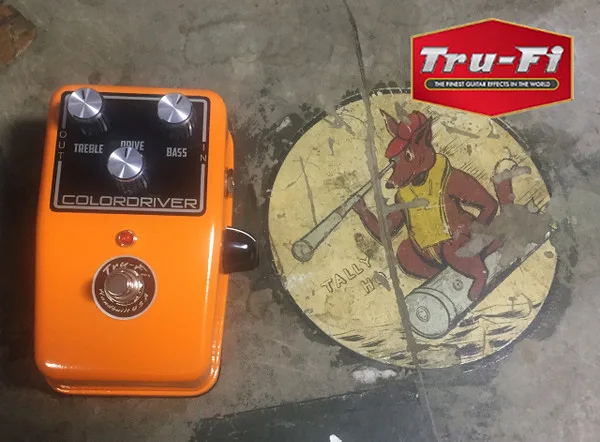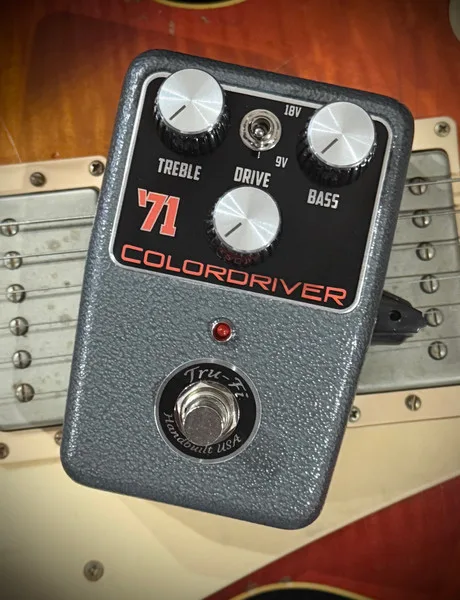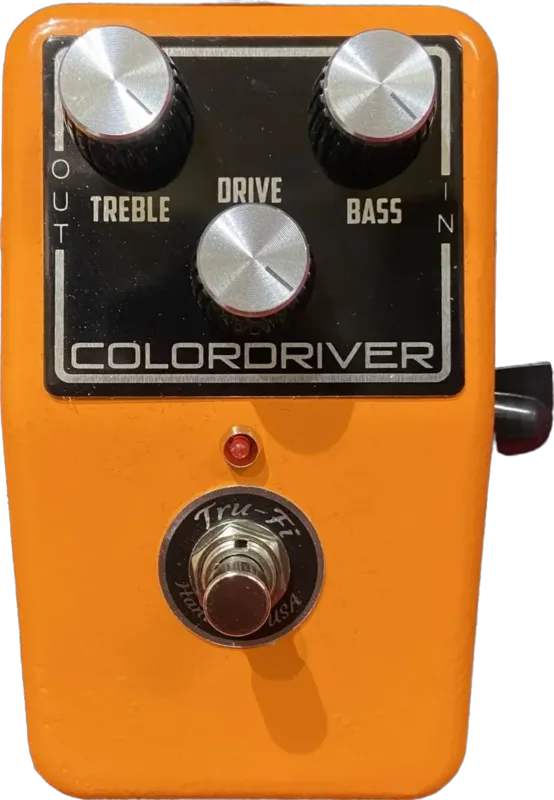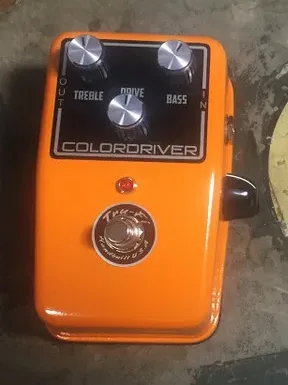


The Tru-Fi Colordriver is a handmade recreation of the vintage Colorsound Power Boost / Overdriver circuit, built to deliver classic British-style overdrive, boost, or fuzzy-drive tones1. Depending on settings and playing dynamics, it can push a clean amp harder, drive fuzz pedals, or work as a standalone overdrive/boost1. Tru-Fi builds it as a true Power Boost replica down to the correct vintage transistors, with one upgrade the original never had: a side-mounted master volume knob12.
A handmade Colorsound Power Booster recreation
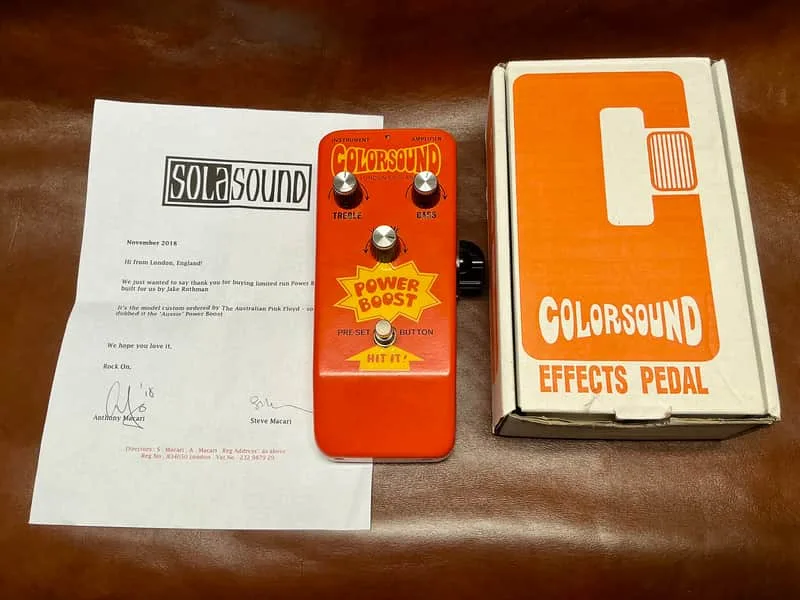
The Colordriver traces back to the Colorsound Power Boost, a clean, high-headroom booster designed to push the front end of guitar amplifiers, originally created around 1968 by Gary Hurst5. It was first sold in 1970 by the Macaris music store in London as a transistor-based boost/drive pedal with a two-band tonestack6. After the Power Boost was taken to a trade show in the United States and generated strong interest, per Macari's, it was renamed and revised as the Overdriver, with only minor component value tweaks to the same basic circuit76.
Tru-Fi's recreation follows that lineage closely. The 9V Colordriver is a hand-made recreation of the famous Colorsound 9 Volt Overdriver, which Tru-Fi notes was used by the likes of Jeff Beck and David Gilmour2. The 18V version is built to the original 18-volt Power Boost spec from 1969-703. Both are 100% handmade, with the 18V version using old school brown carbon resistors23.
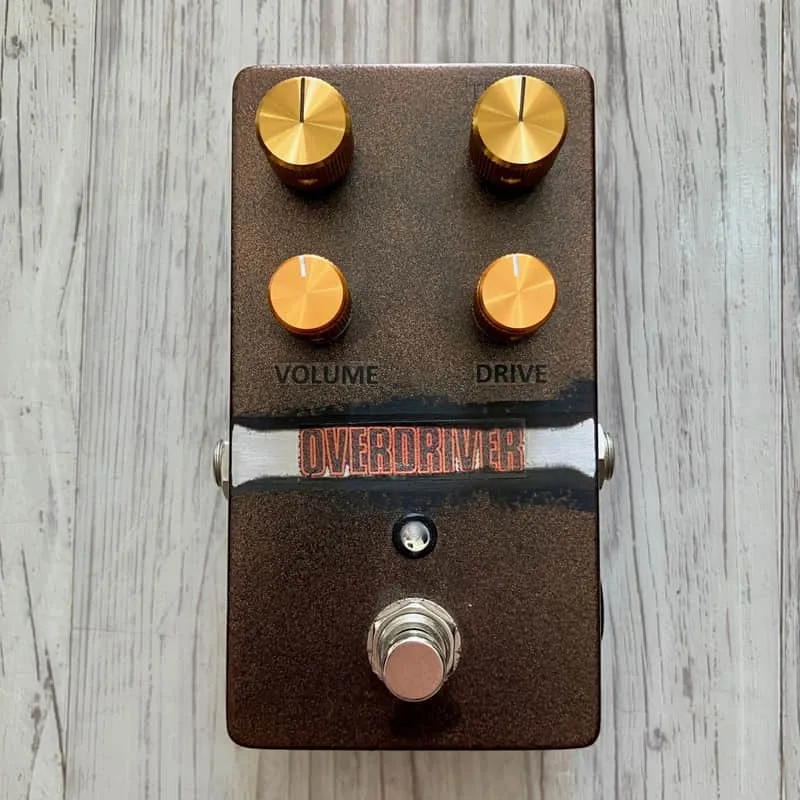
One thing the original sorely lacked was a true volume control: users set the gain knob and the output volume became enormous7. Tru-Fi adds a side-mounted master volume, mounted on the side just like the original's layout, so you can dial the output down to a boost, an overdrive, or a full-on fuzz/drive level12. A 1996 reissue Overdriver had incorporated an output volume pot, but it included a minimum-volume resistor that prevented it from going to zero7.
The controls
The control set follows the original Overdriver layout: drive, treble, and bass8. On the mini versions, Tru-Fi labels the gain knob Drive and adds the side-mounted Master Volume plus a 9V/18V toggle switch910.
| Control | What it does |
|---|---|
| Gain / Drive | Sets the amount of push, from clean boost through overdrive to fuzzy drive12 |
| Treble | Top-end shaping, part of the two-band tonestack2 |
| Bass | Low-end shaping, part of the two-band tonestack2 |
| Side Volume / Master Volume | Sets output level, mounted on the side like the original12 |
| 9V/18V toggle (mini versions) | Switches between the two circuit voltages910 |
On the original Overdriver, the bass and treble controls allowed a wide range of tonal options, including a full-on treble boost11. In his Guitar.com review of the Mini '71 Colordriver, Richard Purvis found the tone controls highly responsive, writing that "the combination of treble, bass and master volume knobs does allow for some extremely tweakable boosting with the gain s"12.
9V and 18V versions
The Colordriver comes in two circuit versions, matched to the two eras of the original pedal. The 9V version uses three vintage BC109 transistors, the same type as the 1969 original, while the 18V version uses three vintage BC184 transistors2310. Tru-Fi says the 18V "will give it a tad more headroom and transparency, plus this version used different transistors so the tone" is a bit different from the orange 9V Colordriver313.
| 9V version | 18V version | |
|---|---|---|
| Transistors | 3 vintage BC1092 | 3 vintage BC1843 |
| Based on | Colorsound 9 Volt Overdriver2 | Original 18V Power Boost, 1969-703 |
| Power in | 9V DC negative tip2 | 9V DC negative tip, raised to 18V internally3 |
| Battery | Internal 9V battery clip2 | Internal 9V battery clip1 |
The 18V version still plugs into a standard 9V supply: the voltage is increased inside the pedal to 18V, so you do not need an 18V power supply313. Tru-Fi stresses the negative-tip 9V DC polarity as key3.
The mini versions combine both characters in one pedal. The Mini '69 ColorDriver and the ColorDriver '71 Mini each carry a 9V/18V toggle switch, running on a standard 9V center-negative supply with a charge pump stepping the voltage up internally when 18V is selected910. Tru-Fi describes the difference in playing terms: "Run it at 9V for compressed, gritty vintage growl. Flip to 18V for more headroom, clarity, and punch."10. The '69 and '71 minis are siblings, with Tru-Fi noting that "Where the '71 ColorDriver gets nasty and aggressive at full gain, the '69 stays warm, round, and musical."9. The '71 uses BC184 silicon transistors and the '69 uses BC109, per Guitar.com12. The 18V version has also been available in a series of different colors, including a Clown Barf Sparkle finish13.
Reviews and demos
Delicious Audio covered the 18V Colordriver, confirming it as a true Power Boost replica done to the correct BC184 transistors, true bypass, with an LED and manual included13. Guitar.com's Richard Purvis reviewed the Mini '71 Colordriver, noting the toggle switch between the two voltages and finding "with 18v sounding that little bit bigger and clearer than 9v"12.
The Colordriver was featured on That Pedal Show in their look at outside-the-norm fuzzers, with the intro at 9:08, sounds from 10:48, and its use as a clean boost from 14:4514. In an earlier That Pedal Show video, Mick fielded a viewer question about "what happened to the color sound the power booster type pedal," discussing the Colordriver's lineage15.
RockBoard's PedalPedia also lists a demo by Gilmourish alongside the Delicious Audio review1.
Where it sits next to other Tru-Fi pedals
Tru-Fi builds the Colordriver alongside other vintage-circuit recreations, including the Tru-Fi Treble Boost Rangemaster and the Tru-Fi Newton overdrive. Where those follow other classic circuits, the Colordriver is the company's Power Boost/Overdriver line, covering boost, overdrive and fuzz territory in one box depending on where the gain and side volume are set1.
Videos
Alberto Barrero
gearmanndude
musictoyznetwork rasch
Questions
Is the Tru-Fi Colordriver true bypass?
Yes. Both the 9V and 18V versions use true bypass switching, so the pedal is out of the signal path completely when disengaged. The 18V version also includes an LED and a manual.
Is the Tru-Fi Colordriver analog?
Yes. It is an all-analog, discrete transistor circuit, handbuilt as a recreation of the original Colorsound Power Boost circuit. There is no digital processing anywhere in the signal path.
How much current does the Tru-Fi Colordriver draw?
The Colordriver draws about 10mA, which is light enough that it shares a power supply output with other low-current pedals without trouble. It runs on 9V DC with a center-negative, negative-tip connector.
Can the Tru-Fi Colordriver run on a battery?
Yes. The standard Colordriver versions have an internal 9V battery clip, and Tru-Fi states that all of its mini pedals run on either a 9V power supply or a 9V battery. The 18V version still takes a 9V supply or battery and raises the voltage internally.
What transistors does the Tru-Fi Colordriver use?
The 9V version uses three vintage BC109 transistors, matching the original Power Boost, while the 18V version uses three vintage BC184 transistors. Tru-Fi describes each as a true Power Boost replica down to the correct transistors.
Is the Tru-Fi Colordriver a Colorsound Power Booster clone?
It is a handmade recreation of the vintage Colorsound Power Booster / Overdriver circuit rather than a loose copy. Tru-Fi built it to the original circuit with the correct transistors, adding a side-mounted master volume the original lacked.
Sources (15)
- Colordriver by Tru-Fi Pedals, RockBoard PedalPedia, 2026
- Tru-Fi Colordriver 9V version, loved by guitar pedal fuzz lovers worldwide, used by Jeff Beck and David Gilmour in the 70s, Tru-Fi
- Tru-Fi Colordriver 18 Volt Guitar Pedal like the original Colorsound Power Booster, Tru-Fi
- Tru-Fi Super Fuzz Version 2 Guitar Pedal, tru-fi.com
- Voltage Booster, BLAMMO! Electronics
- Nucleus Vintage Boost / Colorsound Power Booster, Aion FX, 2020-07-03
- Plasma Vintage Drive / Colorsound Overdriver, Aion FX, 2020-07-03
- The Best Guitar Effects Pedals of All Time, GuitarPlayer (www.guitarplayer.com), 2021-06-25
- Tru-Fi '69 Colordriver Pedalboard Mini Version Guitar Pedal, Tru-Fi
- NEW Compact '71 Colordriver Overdrive Guitar Pedal in smaller and modern enclosure, tru-fi.com
- TONEHOME, TONEHOME - the World of Vintage Guitar Effect Pedals
- Tru-Fi Mini ’71 Colordriver review, Guitar.com, 2026-02-23
- Tru-Fi COLORDRIVER Overdrive/Fuzz, Delicious Audio, 2020-06-15
- Fancy A Different Fuzz? Outside-The-Norm Fuzzers: Tru-Fi, Rush, Pigdog, Analog Man, Shaftesbury, That Pedal Show, 2025-04-11
- Mick's Vlog: New Pedalboard Q&A Plus Maxon OD9 & Tru-Fi Colordriver Additions, That Pedal Show (YouTube), 2018-11-06