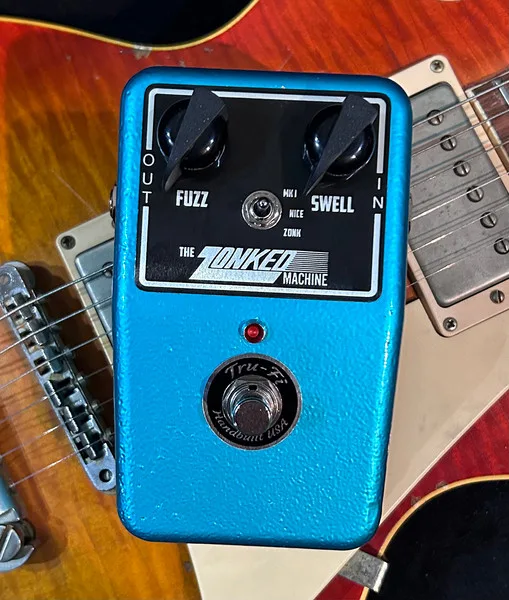

The Tru-Fi Zonked Machine is a germanium fuzz pedal built on the 1967 Zonk Machine circuit, with a three-way switch that adds a darker Tonebender MK1 voicing and an in-between "Nice" setting to the stock Zonk tone. Tru-Fi builds it by hand in Maine, USA, and lists it as currently available1. The original Zonk Machine is described by the maker as a classic fuzz pedal known for its unique sound and vintage appeal, with a thick and saturated fuzz tone2.
Controls and the three voicings
The pedal keeps the original two-knob layout and adds a three-position tone switch on top. Guitar Pedal X's reviewer, Stefan Karlsson, notes that "Here Fuzz is Gain, and Swell is Level essentially"3.
| Control | Function |
|---|---|
| Fuzz | Gain3 |
| Swell | Level3 |
| Tone switch, top position | Darker Tonebender MK1 tone1 |
| Tone switch, middle position | Nice setting, a noticeable difference from the other two1 |
| Tone switch, bottom position | Stock Zonk Machine tone1 |
Karlsson calls the 3-way Mode Selector "totally unique about this pedal"3. In his description, the MKI position gives a darker, fatter output, the Zonk position is brighter and sharper, and the Nice setting sits between them3. Tru-Fi's own description matches: MK1 has more bottom end, Nice is a noticeable difference, and Zonk has a bright bite1.
The germanium transistors
Like the original Zonk Machine, which used germanium transistors in its circuit1, the Zonked Machine runs three old-school germanium transistors. Tru-Fi specifies two G381 and one Black OC75 Mullard, which the maker says "bring you the best tone I can give"1. Karlsson notes that the literature talks of 2G381 (TI) and Mullard OC75 black glass transistors, while his own review unit carried the combination of AC125, NTK278 and OC753. That variation is worth knowing with any NOS-transistor pedal: the exact parts in your unit may differ from the headline specification.
The reviewer reported that the first batch sold out quickly, with NOS germanium transistor stocks dwindling4. Availability of pedals built from new old stock parts can change without notice.
Cleanup and how it behaves
Tru-Fi says cleanup is available with the guitar volume1, but Karlsson tempers that: "For this kind of circuit you don't get that great a guitar volume cleanup"3. His advice is that the output is best set at your preferred level on the pedal itself3. Players used to cleaning up a fuzz from the guitar should expect less range here than from some other designs.
What reviewers said
In Guitar Pedal X's roundup of the best new fuzz pedals of 2024, Karlsson described the pedal as "so vibrant and searing sounding - they really sound exceptional", especially on the unique in-between Nice mode, and noted it came close to the highest accolades and sold out very quickly at Joe's Pedals Boutique4. He also praised the vibrancy of its turquoise paint job3. At the time of review it was listed at $225 on the Tru-Fi webstore and £229 at Joe's Pedals Boutique in the UK3.
Videos
FX Pedal Hobbyist
Questions
Does the Tru-Fi Zonked Machine run on a battery?
Yes. Tru-Fi specifies a negative tip 9V power supply plug for ease of use, or a battery, so the pedal can be run either way. The maker lists both options on the product page, which is unusual among modern germanium fuzzes and handy if you want to keep it off a daisy chain.
Is the Tru-Fi Zonked Machine true bypass?
Yes. The maker lists the pedal as Tru-Bypass, meaning the effect is taken fully out of the signal path when the pedal is off.
What is the Nice setting on the Zonked Machine?
Nice is the middle position of the three-way tone switch, between the darker Tonebender MK1 voicing and the stock Zonk Machine tone. Tru-Fi describes it as a noticeable difference from the other two, and Guitar Pedal X's reviewer singled it out as a unique in-between mode where the pedal sounded especially vibrant and searing.
Does the Zonked Machine clean up with the guitar volume knob?
Only to a limited extent. Tru-Fi says cleanup is available with the guitar volume, but Guitar Pedal X's reviewer found that for this kind of circuit you do not get that great a guitar volume cleanup, and that the output is best set at your preferred level on the pedal itself.
Where is the Tru-Fi Zonked Machine built?
Tru-Fi builds the Zonked Machine by hand in Maine, USA. The maker's product page states it is made in Maine with the builder's own two hands.
Sources (4)
- The Zonked Machine Fuzz, tru-fi.com
- Creation of Zonk Machine Fuzz, tru-fi.com
- Guitar Pedal X, Guitar Pedal X, 2024-10-28
- Guitar Pedal X, Guitar Pedal X, 2024-12-18