| Type | fuzz box, three germanium transistors16 |
| Maker | John Hornby Skewes, Leeds, England; built by Wilsic Electronics, Doncaster6 |
| Produced | 1965 to 1966; discontinued 196821 |
| Status | discontinued; vintage units are collectible51 |
| Circuit | nearly identical to the Tone Bender MKI23 |
| Power | 9 volt battery1 |
| Controls | two controls, fuzz and volume7 |
The Zonk Machine is a three-transistor germanium fuzz box made by the Leeds firm John Hornby Skewes between 1965 and 1966, and discontinued in 196812. It is one of the more famous fuzzes influenced by the Sola Sound Tone Bender MKI, and multiple sources describe the two circuits as nearly identical23. D*A*M calls it "the freakier, weirder looking cousin to the Tone Bender MKI"4, and its sound is famously bright and searing41.
A separate Italian Zonk Machine also exists: created in the late 1960s by Jen Elettronica as part of its Super Sound series, with a colorful psychedelic enclosure common among fuzzes of the era5. This page deals mainly with the British John Hornby Skewes pedal, the circuit most builders mean when they say "Zonk Machine."
How it works: germanium and leakage bias
The Zonk Machine is a three-transistor fuzz circuit in the MKI family. An original unit traced for a Guitar FX Layouts project measured Q1 as a TI AO2 with 180 Hfe and 0.12 mA leakage, Q2 as a Mullard OC75 with 78 Hfe and 0.29 mA leakage, and Q3 as an OC44 with 58 Hfe8. Those leakage figures matter more than they would in a silicon pedal: in this kind of circuit the transistors are biased through their own leakage current, which is why the pedal behaves the way it does.
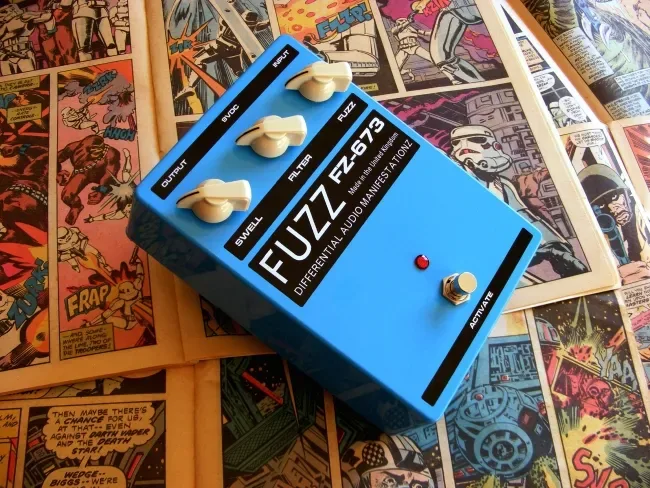
Germanium leakage is temperature-sensitive, and that is the root of the Zonk Machine's reputation for shifting behavior. D*A*M, whose FZ-673 is built on the same circuit, states it plainly910:
"you will hear a significant move in gain in colder climates"
D*A*M, on the Zonk Machine/Tone Bender MKI circuit type10
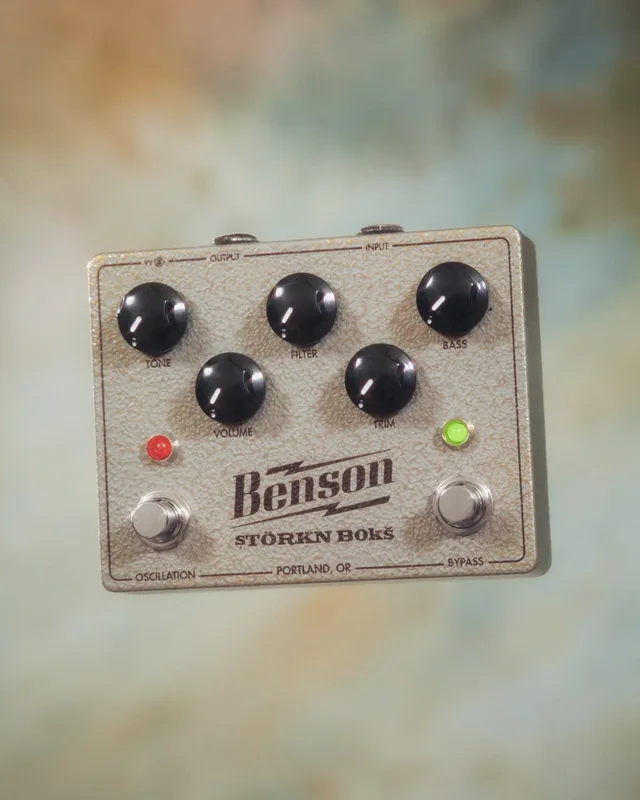
D*A*M also notes that this circuit type is prone to shifts in output due to heat, and that the fuzz control can be "all on nothing at times" in stock form10. ZVEX describes the same class of problem from the builder's side, saying the germanium transistors normally used in this circuit "will misbehave when you're playing hot outdoor gigs above 80 degrees Fahrenheit"11. Modern makers have answered this in different ways: Benson Amps' Störkn B0kš uses an automatic thermal bias circuit that gently warms its germanium transistors to a preset operating point, and the Scott McKeon SM Fuzz uses temperature-tolerant circuitry to keep its tone stable in hot climates1213.
The sound, in the words of those who make and study it:
| Source | Description |
|---|---|
| BLAMMO! Electronics | "spitting / slightly gated sound"; brighter than a Tone Bender MKI but with more sustain and bite than the FZ-114 |
| D*A*M | "ultra bright and searing"4 |
| Guitar FX Layouts (Zach) | "very bright"; suggests input cap values between .001uF and .01uF to tame it8 |
| Guitar FX Layouts, on the Zonk II | "more stable, smoother, and less dark sounding" than the Zonk Machine I15 |
The PCB, stripboard and tag board versions
Original Zonk Machines were built in three construction phases, and collectors distinguish them by board type1.
- PCB version, c. 1966-1967: built on printed circuit boards. Particularly early examples used a triplet of Mullard transistors; more typically a Texas Instruments 2G309 or TI AO2 in the first position with Mullard "black glass" OC44, OC71 or OC75 in the second and third. Earlier examples had brown carbon composite resistors, later ones yellow types, likely Iskra. The very earliest known examples had Bulgin open jack sockets, later ones closed-type Cliff sockets1.
- Stripboard version, c. 1967-1968: built on Veroboard. Earlier units used the AO2/OC75/OC71 transistor set; towards the end of production the second-position transistor was replaced with a silicon 2N4061, along with a trimpot to adjust its bias. Component date codes reveal these stripboard units were actually among the youngest built1.
- Tag board version: one unusual tag board Zonk Machine surfaced in 2015, using 2G309 transistors, suggesting it may predate the shift to stripboard. At the time of writing it was the only one of its kind known to have survived1.
Early examples had a battery clasp fastened to the main chassis, while later units had the clasp attached to the removable cover behind the controls1. Some units also came with a 25k log fuzz pot and a 220k resistor instead of 470k8.
The builder community has traced and redrawn the circuit for DIY use. Guitar FX Layouts published a tag-board layout for the Zonk Machine I, describing it as "almost identical in circuitry" to the Tone Bender MKI, "topographically identical sans the 33K resistor"8. Builders reporting on that layout found the original 1nf input cap sounded tinny, and that a 10nf cap gave a beefier sound with stronger midrange, while a 1nf cap to ground removed sizzling "bacon noise" artifacts without killing the highs8. PedalPCB sells a DIY PCB, the Zonkbox, described as "Compare to D*A*M Zonk Machine"16.
Power and battery
Like the Tone Bender, the Zonk Machines were powered by 9 volt batteries1. There is no maker-published current draw or polarity figure for the original pedal; it predates the 9V DC center-negative power supply convention that later pedals follow.
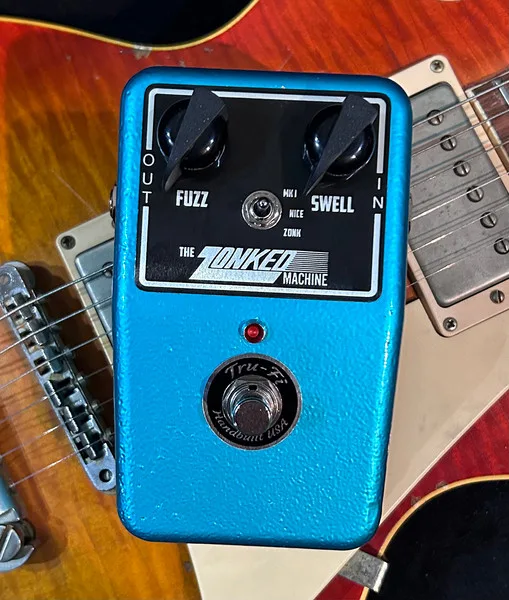
Modern Zonk-based pedals are more board-friendly. The Tru-Fi Zonked Machine takes a negative tip 9V power supply plug or a battery17, and the BLAMMO! P2P Buzz Tone offers a 9 volt battery option that disconnects at the input jack18.
Reissues and pedals based on it
The Zonk Machine was made only in small numbers before being updated with a more modern, easier to produce unit2, and various companies have produced reissues and clones5. Vintage units have become collectible among enthusiasts and collectors of vintage guitar gear5.
| Pedal | Maker | Relationship to the Zonk Machine |
|---|---|---|
| BPC Zonk Machine | The British Pedal Company (former JMI), England, 2013 | reissue2 |
| Zonked Machine | Tru-Fi | based on the 1967 Zonk, with a Tone Bender MK1 tone option17 |
| Skronk Machine | BLAMMO! Electronics | "a modernized version of the Zonk"14 |
| FZ-673 | D*A*M | Zonk Machine/Tone Bender MKI circuit with a few subtle tweaks10 |
| 1965 Tone Distorter VZM | D*A*M | based on the second Zonk Machine its maker encountered, circa 2007, the first Veroboard-loaded unit he had seen4 |
| Bonk Machine | DanDrive | "pays homage to the Zonk Machine"19 |
| Zonkbox | PedalPCB | DIY PCB16 |
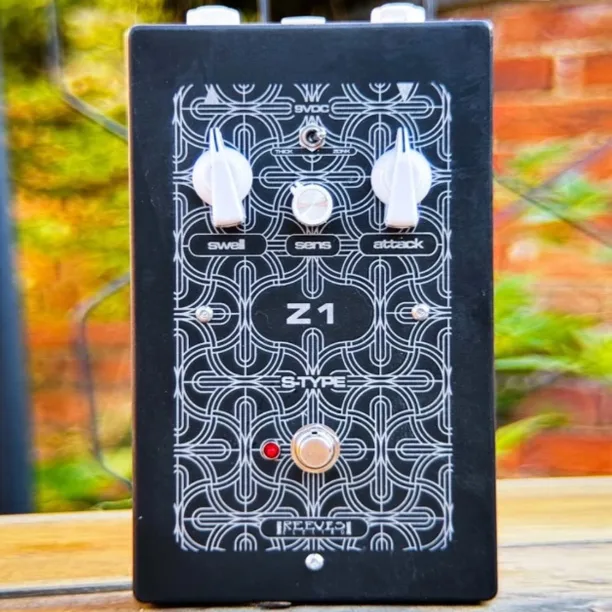
| Z1 and Z1 S-Type | Reeves Electro | silicon recreations of the MKI Zonk Machine20 |
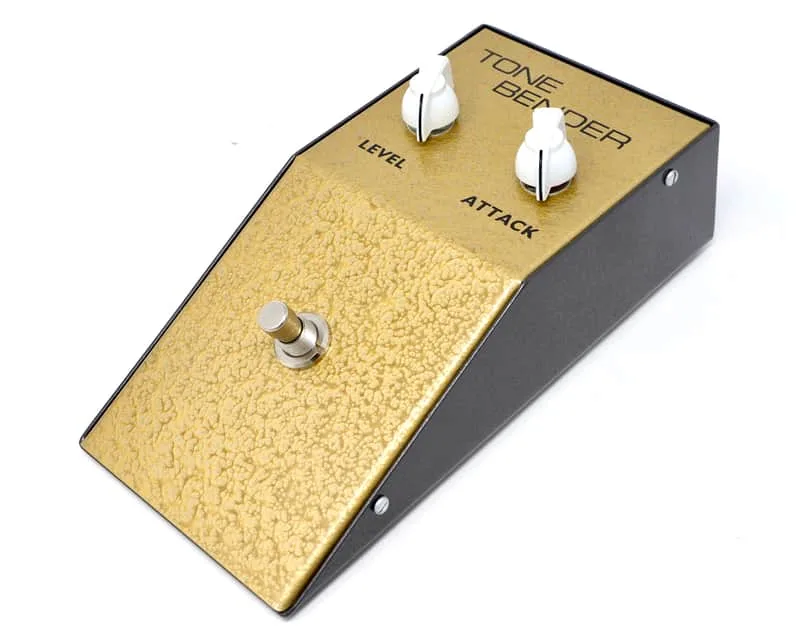
MusicRadar reported in 2024 that JHS itself has two of its own versions out, a Vintage Series in the larger wedge-style enclosure and one in its Compact Series21. The Reeves Electro Z1 is described by its maker as a deliberate homage to the rare John Hornby Skewes MK1 Zonk Machine and its MK1 Tone Bender cousin22.
Tru-Fi's Zonked Machine gives the circuit three voicings on a switch: the Zonk setting has a bright bite, the MK1 setting has more bottom end, and the maker reports cleanup is available with the guitar volume knob17.
The Zonk II and the circuit's later life
The Zonk Machine was followed by the Zonk Machine II, the result of a re-engineered Zonk Machine I15. Early Zonk II pedals, from around 1967, were built with various two- and three-transistor germanium circuits23. By the 1970s the Zonk II featured a two-transistor silicon circuit, and a c. 1969 revision used two 2N4061 silicon transistors on stripboard before construction changed to a dedicated printed circuit board; that silicon circuit was used until the model was discontinued23. One traced Zonk II used two PNP M2N 4403 silicon transistors instead of the earlier three-germanium Zonk Machine I arrangement15.
Where it came from
The circuit's lineage runs from the Maestro Fuzz-Tone through the Tone Bender. BLAMMO! traces it as the Maestro FZ-1 inspiring Gary Hurst's Tone Bender, "which was later taken by John Hornby Skewes and further tweaked into the Zonk Machine"14. Fuzzboxes.org agrees the Zonk Machine's circuit resembled Gibson's Maestro Fuzz-Tone but was much more similar to the Tone Bender MKI, likely its true inspiration1. British Pedal Company's history adds that Skewes approached Charlie Ramskirr of Wilsic Electronics in Doncaster to build his new fuzz box6, and that the pedal was housed in a simple steel box with two controls6.
The enclosure was not as heavy duty or robust as the MKI's2. Melody Maker reported in August 1966 that the company had been exporting fuzz boxes1, and original Zonk Machines overwhelmingly resurface in Canada1.
Pedals on this page
Questions
Who designed the Zonk Machine?
The Zonk Machine was developed by John Hornby Skewes, a Leeds firm, and Skewes approached Charlie Ramskirr of Wilsic Electronics in Doncaster to build it. Skewes recalled in 2015 that Ramskir designed it, though that recollection has been called unreliable. Ramskir's death is given as the reason the pedal was discontinued in 1968.
Is the Zonk Machine the same circuit as the Tone Bender MKI?
Almost. Multiple sources describe the Zonk Machine as nearly identical in circuitry to the Sola Sound Tone Bender MKI, with one technical analysis finding it topographically identical apart from a 33K resistor. D*A*M describes its FZ-673 as the Zonk Machine/Tone Bender MKI circuit with a few subtle tweaks, treating the two as one circuit family.
Can I use silicon transistors in a Zonk Machine?
Yes. Toward the end of stripboard production, Hornby Skewes itself replaced the second-position transistor with a silicon 2N4061 and a bias trimpot. The later Zonk II went further and used silicon transistors throughout. Modern builders also make silicon versions, such as the Reeves Electro Z1 S-Type with three BC108C transistors.
Why does my Zonk Machine sound different on a cold day?
Germanium transistors are leakage-biased, and their gain shifts with temperature. D*A*M notes that on this circuit type you will hear a significant move in gain in colder climates, and that the fuzz control can behave in an all-or-nothing way in stock form. Builders address this with temperature-tolerant circuitry or automatic thermal bias.
Did Pink Floyd use a Zonk Machine?
Tru-Fi's history of the pedal says David Gilmour reportedly used a Zonk Machine during the early years of Pink Floyd. Fuzzboxes.org separately notes that the grey Tone Benders photographed with Syd Barrett were possibly an MK1.5 or MKII circuit, so the early-Pink-Floyd fuzz picture involves more than one pedal.
Why do so many original Zonk Machines turn up in Canada?
Fuzzboxes.org reports that original Zonk Machines overwhelmingly resurface in Canada, which fits the export trade: Melody Maker reported in August 1966 that Hornby Skewes had been exporting fuzz boxes. Canada was evidently a significant destination for the company's output.
Sources (23)
- John Hornby Skewes Zonk Machine • Fuzzboxes, Fuzzboxes.org, 2021-05-14
- TONEHOME, TONEHOME - the World of Vintage Guitar Effect Pedals
- A Little History, www.stompboxes.co.uk, 2017
- 1965, stompboxes.co.uk, 2025
- Creation of Zonk Machine Fuzz, tru-fi.com
- Zonk Machine History, British Pedal Company, 1965
- Zonk Machine History, britishpedalcompany.com
- Guitar FX Layouts: Hornby Skewes Zonk Machine I, Guitar FX Layouts (tagboardeffects.blogspot.com), 2017-05-01
- Guitar FX Layouts: DAM FZ-673, tagboardeffects.blogspot.com
- FZ-673, D*A*M (stompboxes.co.uk), 2017
- Silicon Fuzz Factory, ZVEX Effects
- Störkn B0kš, Benson Amps
- SM Fuzz by Scott McKeon, RockBoard (PedalPedia), 2026
- Skronk Machine, BLAMMO! Electronics
- Guitar FX Layouts: Hornby Skewes Zonk Machine II, Guitar FX Layouts (tagboardeffects.blogspot.com), 2017-05-01
- Zonkbox - PedalPCB.com, PedalPCB.com
- The Zonked Machine Fuzz, tru-fi.com
- P2P Buzz Tone, BLAMMO! Electronics
- Bonk Machine by Dandrive, RockBoard PedalPedia, 2026
- Guitar Pedal X, Guitar Pedal X, 2026-10-09
- Bored of your 'board? Stomp this way for the must-have new guitar effects pedals of 2024, MusicRadar, 2024-03-28
- New Pedal: Reeves Electro Z1 Fuzz, Delicious Audio, 2026-10-09
- John Hornby Skewes Zonk II • Fuzzboxes, Fuzzboxes.org, 2021-05-26