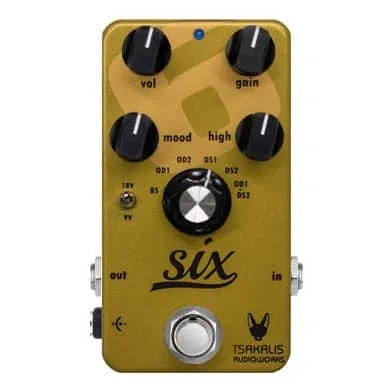
The Tsakalis AudioWorks Six B.O.D. is a boost, overdrive and distortion pedal that puts six analog dirt circuits in one box, selected by a six-position rotary switch. The name stands for Six Boost/Overdrive/Distortion. It was presented at the NAMM 2019 show, and Gearnews reported it would be available after NAMM through the company's own website12.
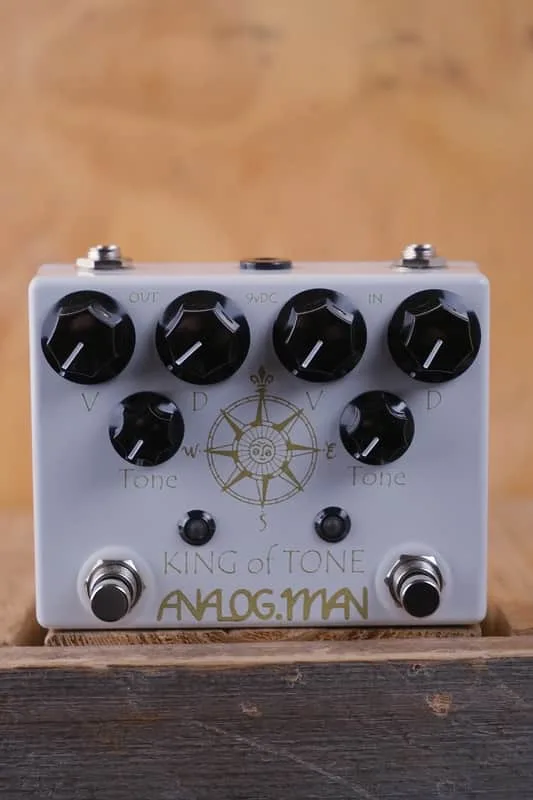
What sets it apart from most gain pedals is its circuit. Tsakalis built it without any coupling capacitors in the audio path, a design the maker calls cap-less technology, and claims it is the first cap-less pedal. The idea behind the pedal was to combine what the maker calls the good stuff found in the Timmy, Blues Breaker and KOT pedals into a small, practical overdrive-distortion pedal1. Gearnews put it more bluntly at launch: the maker says the Six B.O.D. mimics the iconic Timmy, Bluesbreaker and King Of Tone pedals2.
The six modes
The modes are chosen with a 6-position rotary switch, and they cover the full range from clean lift to stacked gain1.
| Position | Mode | What it is |
|---|---|---|
| 1 | Booster (BS) | Clean boost |
| 2 | Overdrive 1 (OD1) | First overdrive voice |
| 3 | Overdrive 2 (OD2) | Second overdrive voice |
| 4 | Distortion 1 (DS1) | First distortion voice |
| 5 | Distortion 2 (DS2) | Second distortion voice |
| 6 | OD1 + DS2 | Overdrive 1 routed into Distortion 2 |
Gearnews described the lineup the same way at launch: a booster, two overdrives and two distortions, with the first overdrive routed into the second distortion2. The sixth position is the one players who stack gain pedals will recognize, since it puts an overdrive and a distortion in series inside one box.
Controls
The control set is small. Beyond the mode selector there is a Mood knob, which Delicious Audio describes as simply a post-placed overall tone control of the circuit, and one heavy duty on/off footswitch1. There is also the voltage toggle described below. That is the whole panel: mode, tone, voltage, and one footswitch to engage the effect.
Power: 9V, with an 18V headroom switch
The Six B.O.D. runs from a regular 9V adapter2, specifically a regulated 9V supply with center negative polarity1. Inside, an advanced internal power supply with a voltage doubler lets a toggle switch change the circuit's operating voltage from 9 to 18 volts for extra headroom, while the pedal always runs from the external 9V supply12.
The two voltages change the character of the modes:
- At 18V: the pedal behaves more like an amplifier with tons of headroom, and the Overdrive and Distortion modes have more clarity1.
- At 9V: it sounds dirtier even at lower volume, and the Booster mode breaks up more easily1.
With a maximum power consumption of 10mA at 9V DC1, it is a light load on any pedalboard power supply.
The 18V setting is internal. You still feed the pedal 9V DC, center negative; never plug an 18V adapter into it. The voltage doubler does the work.
The cap-less circuit
Most analog pedals use coupling capacitors between stages of the audio path. Tsakalis removed all of them. The maker says the result is a more natural feel and respect for the guitar's original tone, and that by applying what it calls cap-less technology, "you can really hear the character of your instrument and consequently your own hands"1. At launch, Gearnews reported the maker's claim that cap-less technology brings "a whole new level of touch sensitivity and overall musicality"2.
"we decided to think out of the box and removed all the capacitors from the audio path (coupling capacitors)"
The designer's stated intent was to combine the good stuff found in the Timmy, Blues Breaker and KOT pedals into a small, practical overdrive-distortion pedal with what the maker calls huge powerful tones, natural feel and flexibility1. Delicious Audio lists the inspirations as the Analogman KOT, Marshall Bluesbreaker and Paul C Timmy, among other revered gain devices1.
Where it came from
Tsakalis AudioWorks is a Greek pedal maker, and the Six B.O.D. is handmade in Athens, Greece, in a heavy duty and lightweight aluminum box1. The pedal was announced ahead of NAMM 2019, where Gearnews called it "one to watch," and presented at the show itself12. The company's rep Nikos shot a demo video at the Delicious Audio Stompbox Booth at NAMM 20191.
Questions
Is the Tsakalis AudioWorks Six B.O.D. true bypass?
Yes. Both press sources describe the Six B.O.D. as true bypass, so it passes your clean signal through untouched when switched off and should sit happily in most pedalboard setups alongside other true-bypass pedals.
What does cap-less mean in a guitar pedal?
It means the audio path has no coupling capacitors. Tsakalis removed all of them from the signal path, which the maker says results in a more natural feel and greater respect for the guitar's original tone, letting the character of your instrument and hands come through.
How much current does the Six B.O.D. draw?
Maximum power consumption is 10mA at 9V DC, so it is a light load on any isolated power supply and easy to run from a standard pedalboard supply alongside other 9V pedals.
Is the Six B.O.D. analog or digital?
It is fully analog. Delicious Audio describes it as a strictly analog buffet of dirt circuitry, with six selectable modes inspired by classic gain pedals rather than digital modeling.
Where is the Six B.O.D. made?
It is handmade in Athens, Greece, by Tsakalis AudioWorks, and comes in a heavy duty but lightweight aluminum enclosure measuring 60mm wide, 112mm long and 50mm high.
What are the six modes on the Six B.O.D.?
Booster (BS), Overdrive 1 (OD1), Overdrive 2 (OD2), Distortion 1 (DS1), Distortion 2 (DS2), and Overdrive 1 routed into Distortion 2 (OD1 + DS2) for stacked gain. A six-position rotary switch selects the mode.
Sources (2)
- Tsakalis AudioWorks Six Boost/Overdrive/Distortion, Delicious Audio, 2022-10-26
- NAMM 2019: Tsakalis Audio Works Six B.O.D. overdrive pedal is one to watch, gearnews.com, 2019-01-14