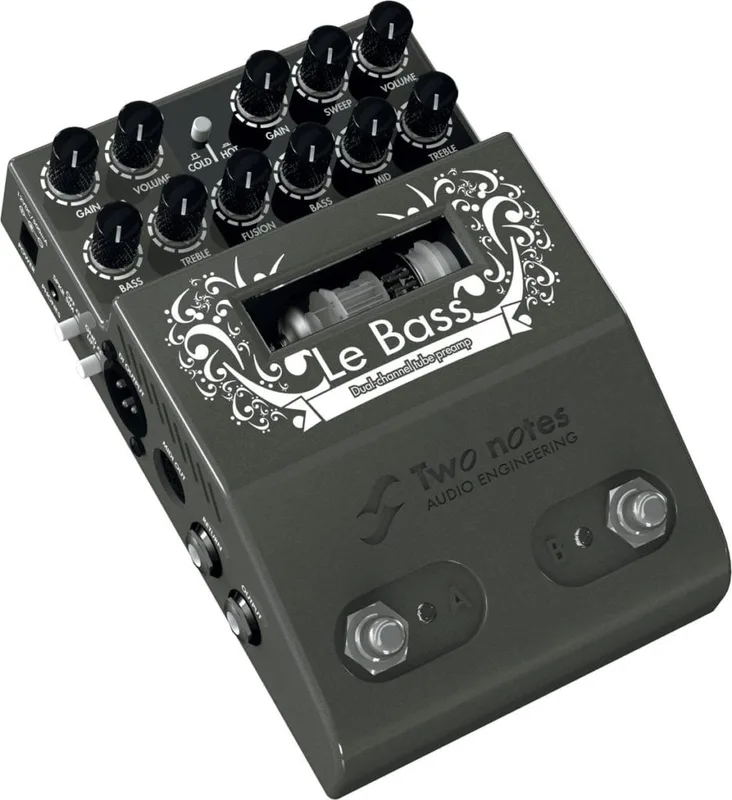


The Two Notes Le Bass is a dual-channel tube preamp pedal for bass, part of Two Notes' tube-based Le Preamp series alongside the Le Clean, Le Crunch and Le Lead1. Premier Guitar called it "the low-flying offering in the company's tube-based preamp pedal series," with one channel voiced for clean and responsive tones and the other for overdriven roar2. MusicRadar's reviewer found it offers plenty of tone-tweaking options for shaping a DI signal or adding a bit of flavor in front of an amp3.
At the heart of the pedal is a Ruby 12AX7 tube running at a massive 200 volts2. Two Notes describes its preamps as a True High Voltage Design, running internally at 200 volts to preserve the interaction between the tube and its circuitry the way a full amplifier would1. The pedal is analog throughout, categorized by the maker as an analog audio signal processor1.
What it does: a two-channel tube preamp for bass
The Le Preamp series gives each pedal two totally independent channels, A and B, each with its own voicing and EQ section1. On the Le Bass, the maker describes Channel A as ultra clean, aimed at modern playing techniques with a lightning fast response and a full low end, while Channel B is a rock bass voice with punch and sweet break up1. Hot Fusion mode extends this further, from focused distortion to synth-like growls1.
For a bassist, that means one box can cover several jobs: a clean preamp tone for recording or driving a power amp, an overdrive voice for grit, and blended combinations of the two. The balanced DI output with ground lift lets it feed a desk directly, and the analog speaker simulation means the DI signal can carry the character of a bass cab without one being present123.
The controls
The two channels are laid out with their own control sets, and a fusion dial administers Channel A's level when the pedal is running in a fusion mode2.
| Channel | Controls | What they do |
|---|---|---|
| A | Gain, volume, bass, treble | Premier Guitar describes Channel A as supporting a typically solid bass tone, with treble and bass controls placing it in the right zone23 |
| B | Bass, mids, treble, gain, mid-sweep, volume | Six controls governing the overdrive channel; MusicRadar's reviewer found Channel B adds a nice bit of growl while focusing how the midrange content sits23 |
| Fusion | Fusion dial | Sets Channel A's level when in fusion mode2 |
The series manual also covers an Input Gain control that determines the amount of gain for the clean tone, and a Channel B volume control located pre-FX loop, which sets the output volume of the overdrive channel1.
Engaging both channels at once is done by stomping both footswitches at the same time, which runs the channels simultaneously through the fusion feature2.
Hot and Cold Fusion modes
The fusion-mode switch selects either "cold" (parallel) or "hot" (series) operation when the fusion feature is engaged2.
- Hot Fusion: channels A and B are cascaded, meaning A can be used as a boost for B, with both channels' EQ sections available to shape the result1. MusicRadar's reviewer found Hot Fusion has the options for players who prefer their bass distorted3.
- Cold Fusion: channels A and B run in parallel. MusicRadar's Trevor Curwen found Cold Fusion mixes the growl with a bit of the clean sound for extra articulation3.
The parallel blend approach is one the Le Bass shares in spirit with other pedals in the series; Guitar World noted of the Le Lead that a parallel blend is particularly useful for adding a clean blend to higher-gain distortion tones, which is exactly the problem Cold Fusion solves for bassists who want grind without losing their low end412.
Connections, cab simulation and MIDI
Premier Guitar's rundown of the Le Bass housing lists a post-EQ effects loop, a thru output, MIDI in and out, an 1/8" headphone output, a balanced DI out with ground lift, and a switch for the analog speaker-simulation circuit2.
The speaker simulation is analog, and Two Notes based it on a mix of the vintage Fridge 8x10 and the more modern Alu XL 4x10, picked up with a Cnd87 microphone for the Le Bass1. This is the bass-specific version of the cab sim the series carries; the Le Clean, Le Crunch and Le Lead use a simulation based on a classic Brit VintC 4x12 picked up with a Dyn571.
The MIDI implementation is deeper than a simple program change hookup. The Le Preamp series sends and receives MIDI Program Change and has a MIDI Thru function, with the default MIDI channel set to OMNI and Multi-channel mode on by default1. In Multi-channel mode, connected preamps behave like the channels of an amplifier: pressing A on preamp 1 will bypass preamp 21. For a player running several Le Preamp pedals, this turns a MIDI controller into an amp-channel switcher.
The Le Bass runs on a 12V supply, included with the pedal2. Two Notes lists the Le Preamp series as supplied with or recommended to use its 12V power supply for pedal format products, so a standard pedal supply is not the right feed for it5.
What reviewers said
Premier Guitar's 2021 roundup praised the Le Bass as easy to use with plenty of connection options, with low noise, superb articulation, gobs of roaring overdrive, and fusion modes that offer even more versatility2.
MusicRadar's Trevor Curwen summed up the pedal as "A practical pedal for bassists that can offer a range of tones for recording and live use."3
"A practical pedal for bassists that can offer a range of tones for recording and live use."
Both reviewers point at the same strengths: the range of voices from one box, and the connectivity that makes it workable both on a stage and into a recording setup23.
Videos
Andertons Music Co
Sweetwater
TwoNotesTV
Questions
What tube is in the Two Notes Le Bass?
At the heart of the Le Bass is a Ruby 12AX7 tube running at 200 volts internally. Two Notes describes its preamp pedals as a True High Voltage Design, meaning the tube operates at a real amplifier voltage rather than the low voltages typical of pedal circuits.
Can the Two Notes Le Bass be used as a DI?
Yes. The Le Bass has a balanced DI output with a ground lift, so it can feed a mixing desk or audio interface directly. MusicRadar's reviewer described it as a practical pedal for bassists that can offer a range of tones for recording and live use.
What power supply does the Two Notes Le Bass need?
It runs on a 12V DC supply, which Premier Guitar noted is included with the pedal. Two Notes lists the Le Preamp series as supplied with or recommended to use its 12V power supply for pedal format products, so a standard 9V pedal supply is not appropriate.
Does the Two Notes Le Bass have MIDI?
Yes. The Le Preamp series sends and receives MIDI Program Change and has a MIDI Thru function. The default MIDI channel is OMNI and Multi-channel mode is on by default, so pressing A on one connected preamp bypasses another, like switching channels on an amplifier.
Does Le Bass have a cab simulation?
Yes. The Le Bass has an analog speaker simulation based on a mix of the vintage Fridge 8x10 and the more modern Alu XL 4x10, picked up with a Cnd87 microphone. A switch on the pedal engages or disengages the simulation circuit.
Sources (5)
- Le Preamp Series User's Manual, Two notes Audio Engineering (OROSYS SAS), 2024-01-17
- Bass OD/DI/Preamp Pedal Roundup, Premier Guitar, 2017-05-08
- Two Notes Le Bass review, MusicRadar, 2016-05-25
- Best distortion pedals for metal: get the ultimate metal tone | Guitar World, Guitar World, 2022-04-26
- Two notes 12V Power Supply for Pedal Format Products, Two notes, 2026-04-24