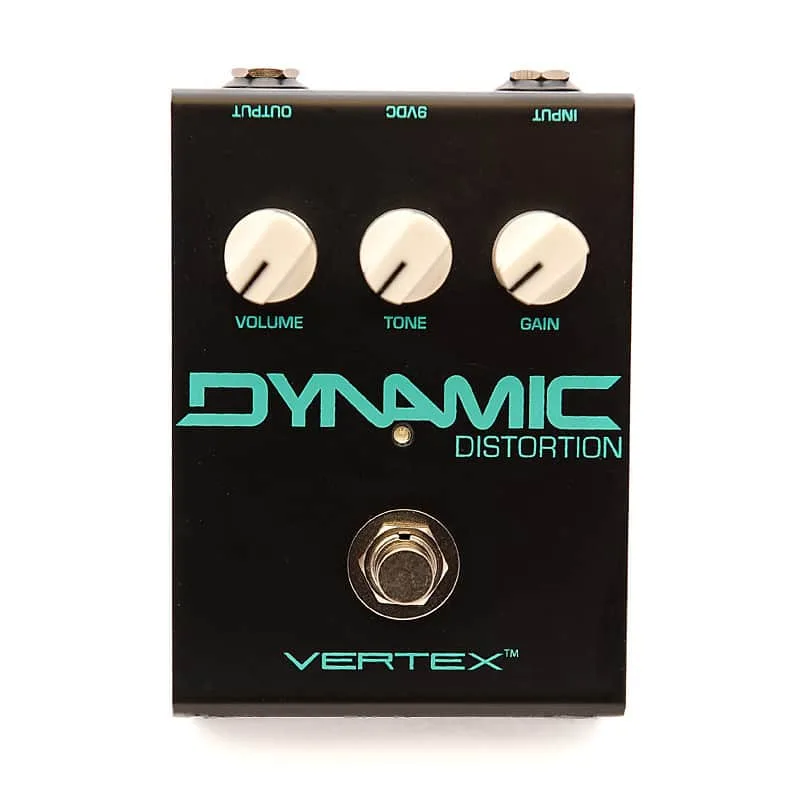


The Vertex Dynamic Distortion is a distortion pedal made by Vertex Effects, assembled in California1. Vertex describes it as "a sonic hybrid of the two most iconic distortion pedals in Rock 'n Roll history, the Germanium Fuzz of the 60's and the TS Overdrive of the 80's"1. In practical terms, that means one box that covers clean, overdrive, distortion and fuzz, with the gain controlled largely from your guitar's volume knob1.
The idea behind the pairing is that each circuit covers the other's weakness. Vertex says the pedal provides "unmatched touch sensitivity and clean-up with your guitar volume knob from sparkley cleans, to overdrive, to fuzz, while providing the mid-range cut of a classic TS pedal and the full-bodied woolliness of a vintage Fuzz"1. So you get the fuzz side's response to picking dynamics and volume-rollback, plus the overdrive side's midrange focus, in a single gain stage.
What it does: clean, overdrive and fuzz from the guitar volume knob
The Dynamic Distortion's core trick is that the guitar's volume knob, not the pedal's gain control alone, sets where you sit between clean and fuzz. Vertex lists "Control Gain (from clean, to OD, to fuzz) with Guitar Volume Knob" and "Touch Sensitivity & Clean Up of Germanium Fuzz" among its features1. Roll the guitar back for cleans, push it up for overdrive, and go further for fuzz, all without touching the pedal.
On the design side, the pedal has a specific origin. Mason Marangella, owner and CEO of Vertex FX, says in a Sweetwater demo video that "the dynamic distortion was one of the first products of the vertex line and it resembles a modified pedal that i used to do for a lot of the la session musicians that wanted a super versatile distortion box that could do everything from beautiful cleans to thunderous monstrous dirty tones kind of resembling a high gain marshall jcm800 or jmp era marshall and everything in between"4. He adds that "it's almost like you have five different overdrive distortion style pedals just by way of where you put your tone control and your volume control on your guitar"4.
In that demo, run through a Fender Hot Rod Deville, Ford Thurston plays through the range of the pedal while Marangella walks through its controls4.
The controls
The layout is the standard three-knob distortion arrangement. Performer Mag's reviewer Chris Devine noted "the standard distortion pedal control layout is here: Volume, Tone and Gain, along with a negative center 9v connection and 1/4" input and output"3.
| Control | What it does |
|---|---|
| Volume | Sets the pedal's output level3 |
| Gain | Behaves as a boost at lower settings; increasing it takes the gain from overdrive to distortion and then into fuzztone territory3 |
| Tone | Acts like a hi-pass filter; turning it clockwise increases the high end3 |
| Tone (MKII note) | Vertex says the pedal can make everything extremely bright when the tone is past 9 o'clock1 |
| Thin/Fat (MKII only) | Offers tones ranging from a robust classic British 4x12 sound to a treble-heavy RAT-style distortion5 |
The Tone control is the one that behaves differently from a typical distortion pedal. Rather than a broad treble roll-off, it works as a hi-pass filter, so clockwise settings thin the low end while adding highs3. That brightness can get extreme: Vertex's own guidance is that everything gets extremely bright past about 9 o'clock on the tone knob1.
History and versions: MKI and the limited MKII
The Dynamic Distortion has been through several versions. Vertex's product pages cover the original Dynamic Distortion, a v1 (NOS) version sold as new old stock6, and the MKII.
The MKII is a 250 piece limited edition5. Its circuit "Combines SD-9, RAT, and Fuzz tone stacks"5, which is a broader set of references than the original's germanium fuzz and TS overdrive pairing, and it adds the thin/fat knob described above5. Otherwise it shares the original's core identity: the same fuzz-plus-TS hybrid description, true bypass, assembly in California, 9VDC power operation with adapter not included, and a lifetime warranty5. The MKII page also lists a 30-day money back guarantee return policy5.
There is also a Surf Green Limited Edition of the MKII, sold through dealers. Flores Music Equipment listed it at an original price of $199.99, discounted to $49.98, a 75 percent reduction7. Music Max Factory likewise listed the Surf Green Limited Edition at $199.997. Vertex itself has sold refurbished B-stock units of the original Dynamic Distortion8.
The MKII is a 250 piece limited edition5, and Surf Green units have appeared at dealers at steep discounts from their original $199.99 listing7. If you want a specific version, check which one a seller actually has before ordering.
Buffer and wah behavior
Two things set the Dynamic Distortion apart from most fuzz-derived pedals. First, Vertex states you can "use a buffer before or after the the pedal with ZERO compromise in sound"1. Vintage germanium fuzz circuits are famously sensitive to what feeds them, and a buffer in front usually changes their character, so a fuzz-voiced pedal that tolerates one is unusual.
Second, the pedal is wah friendly. Vertex says you can "get the full sweep of your Wah pedal with Dynamic Distortion set for Fuzz (impossible with vintage fuzz)"1. The same applies to the MKII5. For players running a wah pedal into a fuzz, this is the practical difference: the Dynamic Distortion keeps its response where a vintage fuzz would collapse.
Who uses it
Vertex's demo video features David Ryan Harris playing the Dynamic Distortion, which the company describes as "a sonic hybrid of the two most iconic distortion pedals in history, the Germanium Fuzz Face and the TS-808 Tube Screamer"9.
What reviewers said
Performer Mag's Chris Devine reviewed the pedal in 2017 and found it works across pickup types: "It reacts equally well with humbuckers and single coil pickups"3. On value, he wrote that "The street price is $199, and considering it covers gain stages from boost, overdrive, distortion and fuzz it's perfectly reasonable"3.
"the Gain control behaves as a boost at lower settings, increasing it takes the gain from overdrive to distortion and then into fuzztone territory."
For players comparing gain pedals, the Dynamic Distortion sits between categories: it is not purely an overdrive, a distortion or a fuzz, but a single analog box meant to cover all three, with the volume knob doing much of the switching.
Videos
Vertex Effects
Questions
What circuits is the Vertex Dynamic Distortion based on?
Vertex describes it as a sonic hybrid of the Germanium Fuzz of the 60's and the TS Overdrive of the 80's, meaning it pairs the touch sensitivity and clean-up of a vintage germanium fuzz with the midrange cut and presence of a Tube Screamer style overdrive. The MKII version also combines SD-9, RAT, and Fuzz tone stacks in its circuit.
Is the Vertex Dynamic Distortion true bypass?
Yes. Vertex lists true bypass for the Dynamic Distortion, and the MKII version is true bypass as well. When bypassed, the pedal is out of your signal path entirely, and Vertex also states it can be used before or after a buffer with no compromise in sound.
Does the Dynamic Distortion work with a wah in front?
Yes. Vertex says you get the full sweep of your wah pedal with the Dynamic Distortion set for fuzz, which the company describes as impossible with vintage fuzz. The pedal is listed as buffer and wah friendly, so it does not load down a wah the way many vintage fuzz circuits do.
What does the thin/fat knob do on the MKII?
On the MKII, the thin/fat knob sets the overall tonal weight. Vertex says it offers tones ranging from a robust classic British 4x12 sound at one end to a treble-heavy RAT-style distortion at the other, letting one pedal cover both thick, full tones and brighter, cutting ones.
Can the Dynamic Distortion be used with a buffer?
Yes. Vertex states you can use a buffer before or after the pedal with zero compromise in sound. That is unusual for a fuzz-derived circuit, since vintage germanium fuzzes typically change character when a buffer sits in front of them.
Is the Vertex Dynamic Distortion MKII true bypass?
Yes. The MKII product page lists true bypass among its features, alongside its 250 piece limited edition run, assembly in California, and 9VDC power operation. Like the original, it can also be used with a buffer before or after it with no compromise in sound.
Sources (9)
- Dynamic Distortion, vertexeffects.com
- Dynamic Distortion by Vertex Effects, RockBoard PedalPedia, 2026
- Vertex Effects Dynamic Distortion Pedal Review, Performer Mag, 2017-08-21
- Vertex Effects Dynamic Distortion Pedal Demo, Sweetwater, 2020-12-05
- Dynamic Distortion MKII, Vertex Effects (vertexeffects.com)
- dynamic-distortion-nos, vertexeffects.com
- Vertex Effects Dynamic Distortion Surf Green Limited Edition, www.floresmusicequipment.com
- Dynamic Distortion Seafoam, vertexeffects.com
- Dynamic Distortion: David Ryan Harris, Vertex Effects, 2016-05-05