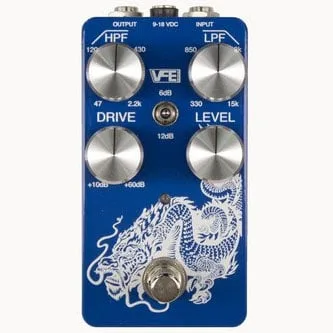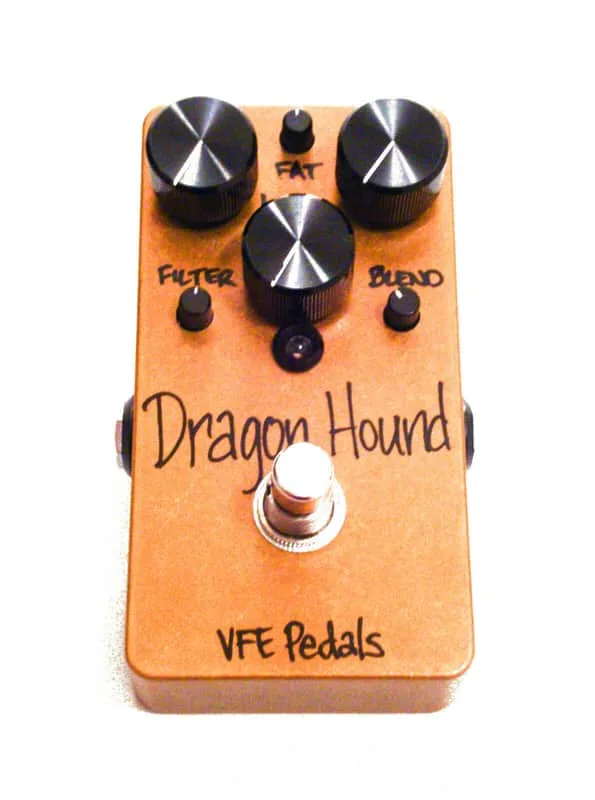


The VFE Dragon is a dynamic overdrive built around one idea: take the EQ shaping that most overdrive circuits do invisibly and put it on the front panel. Where a Tube Screamer, Rat, Klon, OCD, Tim or King of Tone all cut bass before the distortion stage and cut treble after it, the Dragon gives you a knob for each of those cuts, so you set the recipe yourself12.
The gain itself comes from two mosfet clippers, with a drive section that pushes up to 50dB of gain12. VFE describes it as a dynamic overdrive designed to give you ultimate power over the pre-gain bass cut (HPF) and post-gain treble cut (LPF)1.
The controls
The Dragon's control set centers on the two filters that frame the gain stage, plus a clipping control that shapes how the mosfets behave12.
| Control | What it does |
|---|---|
| HPF | Adjusts the pre-gain bass cut, controlling how much low end reaches the clipping stage2 |
| LPF | Adjusts the post-gain treble cut, shaping the highs after the drive2 |
| COMP | Dynamic control over the two mosfet clippers that create the overdrive. The center position uses the least amount of clipping; the CCW and CW positions blend in different amounts of clipping via the series mosfets1 |
The COMP control is the unusual one. Rather than a simple more-or-less gain knob, it changes how the pair of mosfet clippers engages: centered, the circuit clips least, and rotating it either way blends in a different character of clipping through the series mosfets1.
A further option sits inside the pedal: the cut filters can be set to 6dB or 12dB slopes for more extreme EQ cuts2. That choice decides how aggressively the HPF and LPF knobs carve the lows and highs.
The bass-cut, treble-cut recipe behind the circuit
The Dragon's design starts from an observation about the drive pedals most players already know. As VFE's own project document puts it21:
"They all cut bass before distortion, and cut treble after distortion."1
The manual lists the circuits in question: Tubescreamer, Rat, Klon, OCD, Tim and KoT1. Delicious Audio made the same point when the pedal was introduced, framing the Dragon as the pedal that lets you play with that recipe through separate knobs controlling a Lo-Pass and a High Pass filter2.
For a player, this matters in two ways:
- Pre-gain bass cut (HPF): cutting lows before the clipping stage keeps the drive from getting flubby or over-compressed, which is why so many classic overdrives do it. On the Dragon you choose how much of that cut to apply, including keeping more bass than a fixed-filter circuit allows21.
- Post-gain treble cut (LPF): trimming highs after the gain stage tames fizz. Making it a knob means you can also leave the top end open for bite21.
With up to 50dB of gain on tap2, the filters do real work: the same clipping stage can sit anywhere from a light edge to a heavy drive depending on what you feed it and what you let through afterward.
Where it came from and where it went
The Dragon's place in the wider family of drive circuits comes from its filtering recipe. Like the Tubescreamer, Rat, Klon, OCD, Tim and KoT drive circuits, it cuts bass before the distortion stage and cuts treble after it1. That pre and post filtering shape is the common thread running through many of the best known overdrive and distortion designs.
VFE's own designer frames the Dragon's circuit in the same terms, pointing to those popular drive circuits as the model for what the Dragon does: cutting bass before distortion and cutting treble after it1. For a player, that means the Dragon sits in a documented lineage with some of the most widely used drive pedals, rather than being an unrelated design.
The Dragon's drive stage follows a filtering recipe shared by the Tubescreamer, Rat, Klon, OCD, Tim and KoT circuits: bass is cut before distortion and treble is cut after it1. Knowing that lineage helps when comparing the Dragon against those better known pedals on a board.
The DIY side of the Dragon is well documented. Madbean Pedals hosts the VFE_SPS_Dragon project document, a build guide based on the VFE Dragon, last updated April 26, 20241. VFE also released its full design files, including the Dragon's, through its Motherload page3. The project document notes a detail from the designer: Peter indicated that the switch type is On/On/On1.
Related Dragon-named pedals
Several other pedals carry a dragon name, and they are easy to confuse with the VFE original. None share its circuit:
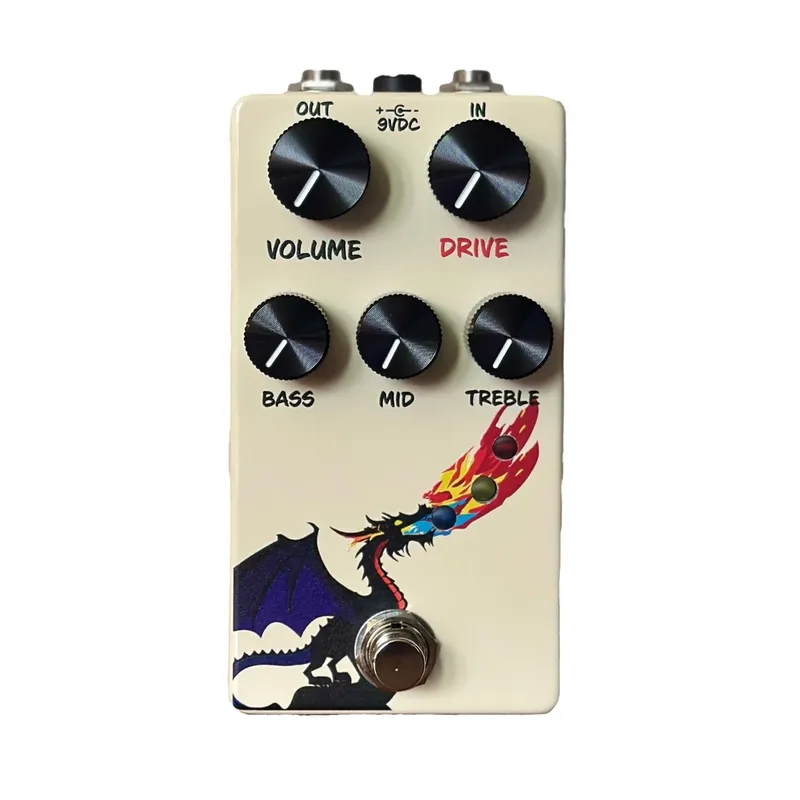
- The Anode Effects Dragon Drive V2 is a hard-clipping overdrive with a passive 3-band EQ, a different control scheme from the Dragon's filter pair4.
- The de Lisle Pet Dragon is a fuzz with true bypass switching5.
- The Lizard Leg Flying Dragon, reviewed in Premier Guitar, is also true bypass but a distinct design6.
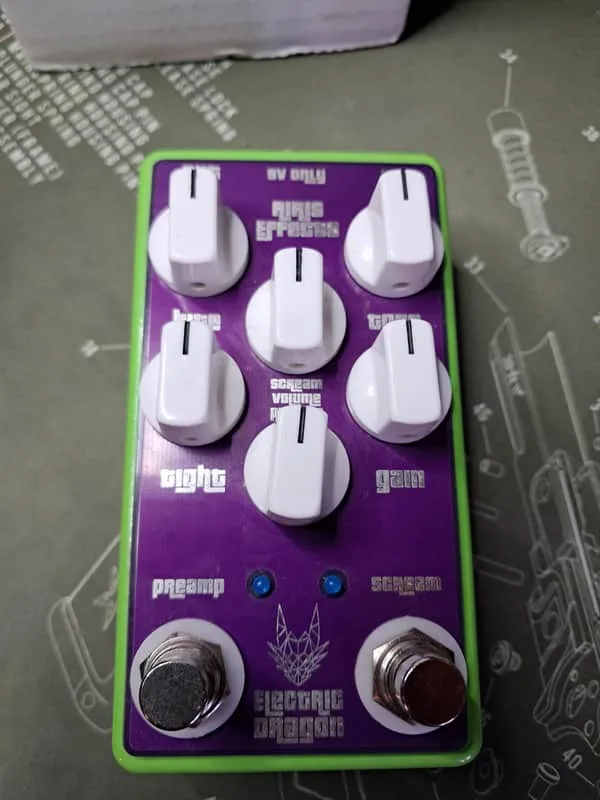
- The Airis Electric Dragon is a distortion with true bypass and a heavy duty mechanical footswitch7.
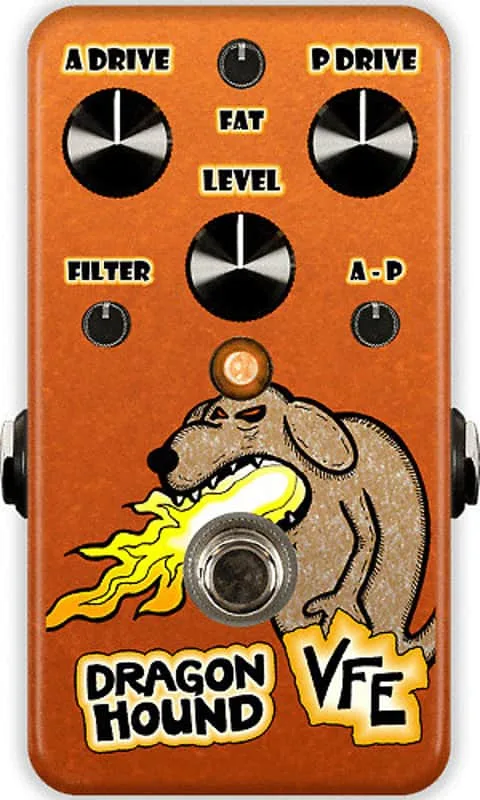
The VFE Dragon Hound, by contrast, is the true relative: it shares VFE's design lineage and its Pale Horse side uses the same mosfet clipping approach8.
Videos
Rabea Massaad
Mike Hermans
Stu Weinberg
Questions
What do the HPF and LPF knobs do on the VFE Dragon?
HPF sets the pre-gain bass cut, so you decide how much low end reaches the clipping stage. LPF sets the post-gain treble cut, shaping the highs after the drive. Together they give you hands-on control of the bass-cut, treble-cut recipe that most popular overdrive circuits apply internally.
Is the VFE Dragon true bypass?
Yes. The Dragon is true bypass, with a buffered bypass option available through an internal switch, so you can run it either way depending on where it sits in your signal chain.
How much gain does the VFE Dragon have?
The drive section pushes up to 50dB of gain, which is far more than a typical low-gain overdrive needs, so the pedal can cover everything from light breakup into distortion territory depending on where the filters and COMP control are set.
Who made the VFE Dragon demo video?
Rabea Massaad made the demo video that circulated when the Dragon was introduced. It was shared alongside the pedal's original product coverage in 2018.
Sources (8)
- VFE_SPS_Dragon.pdf, madbeanpedals.com, 2024-04-26
- VFE Dragon Dynamic Overdrive, Delicious Audio, 2018-09-21
- The Motherload, VFE Pedals
- Anode Effects Dragon Drive V2 Reactive Distortion - Pedal of the Day, Pedal of the Day, 2025-03-13
- de Lisle Pet Dragon Fuzz Pedal, de Lisle Guitar Co., de Lisle Guitar Co.
- Lizard Leg Flying Dragon Pedal Review - Premier Guitar, Premier Guitar, 2008-10-15
- Airis Electric Dragon Distortion | Delicious Audio, Delicious Audio, 2022-08-17
- VFE_DragonHound.pdf, madbeanpedals.com, 2021