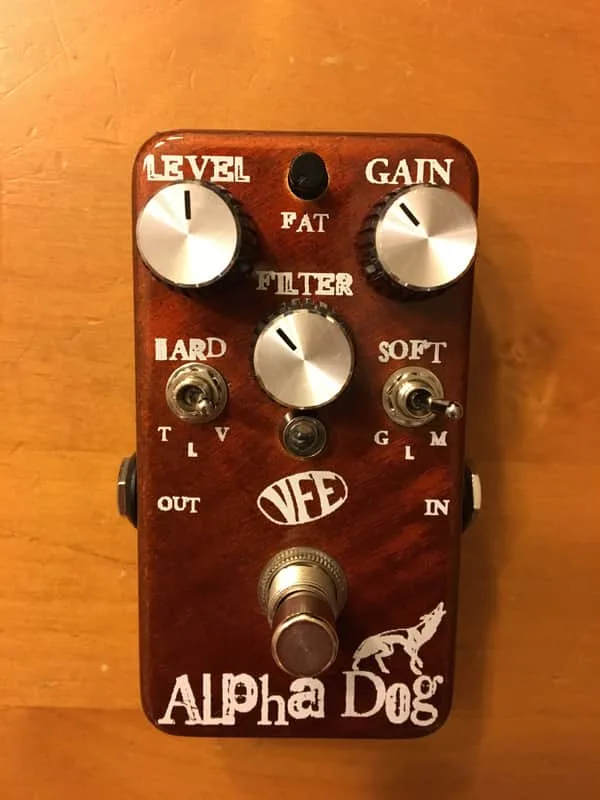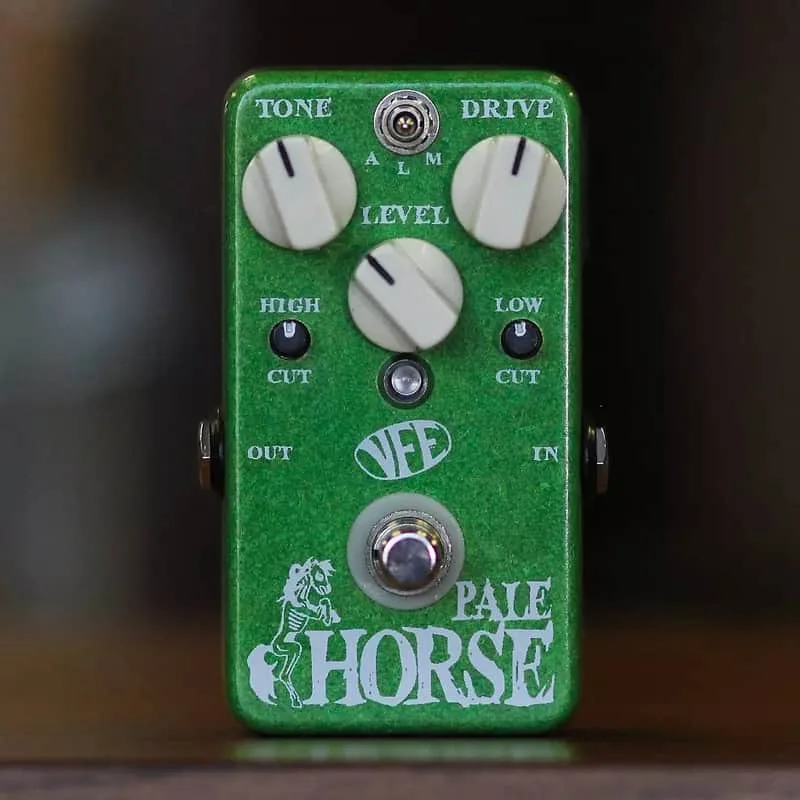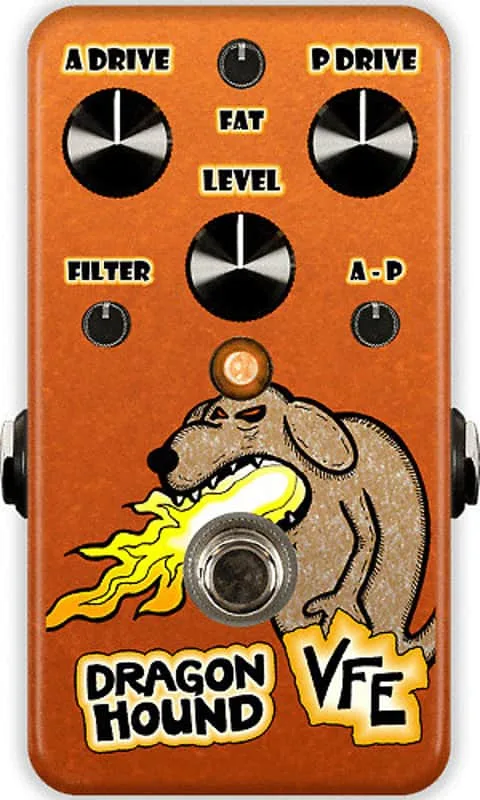


The VFE Dragon Hound is a dual overdrive and distortion pedal that combines the core circuits from two other VFE designs, the Alpha Dog distortion and the Pale Horse overdrive, into one box1. Instead of stacking the two gain stages in series, it runs them in parallel and blends between them, so each circuit keeps its own character while the mix control sets how much of each you hear12.
The idea came out of designer experimentation with multiband distortion. As the project documentation puts it1:
"This pedal is able to add more harmonic saturation without losing the clarity of each note, and do it naturally."1
The result, in the maker's description, is a pedal "able to add more harmonic saturation without losing the clarity of each note, and do it naturally"1. The first prototype was code named "Crown Jewel"1. The original built pedal is now discontinued2.
What it does: overdrive and distortion in parallel
Most two-gain-stage pedals run one into the other, so the second stage clips an already-clipped signal. The Dragon Hound splits the signal instead, sending it through the Alpha Dog distortion circuit and the Pale Horse overdrive circuit at the same time, then blending the two outputs12. Each circuit has its own dedicated drive control, and the blend control can dial in saturated distortion tones that retain the clarity of an overdrive2.
The maker's own preference is telling: the designer writes, "I prefer the Dragon Hound over both the Alpha Dog and Pale Horse, especially for chords"1.
The controls
The pedal has six knobs, plus one internal trimmer1.
| Control | What it does | Pot value |
|---|---|---|
| P DRIVE | Sets the gain of the Pale Horse overdrive circuit, a smooth, transparent drive with better top-end clarity | 1MA |
| A DRIVE | Sets the gain of the Alpha Dog distortion circuit | |
| MIX | Blends between the Pale Horse and Alpha Dog circuits; full P isolates the overdrive, full A isolates the distortion | |
| FAT | Dual-gang control affecting the low end response of both sides simultaneously | Dual 10kC |
| FILTER | Post-gain, post-mix treble response; cut highs to smooth the top end, or crank it for extra bite and grit | 10kC |
| LEVEL | Output volume | 100kA |
| COMP (internal) | Sets the compression of the mosfet clipping section in the Pale Horse | 100K trimmer |
Because FAT is dual-gang, it shifts the low end of both parallel circuits together rather than thickening one side and not the other1. One documented modification narrows the Filter control's range: lowering C17 from 47n to 22n reduces the full counter-clockwise treble cut and gives more control over the clockwise setting1.
Power: bipolar supply, about 33mA
The Dragon Hound does not run on a standard single-supply pedal power scheme. The project documentation states plainly: "This circuit does use the bi-polar power option (+/-9v)"1. Current draw is about 33mA, measured on a 9.42V One Spot supply1. You can use a 12V or 15V Zener for the protection diode on the switching board1.
For anyone debugging a build, the documentation includes reference voltages taken with all knobs set to noon: IC1 (LM308N) pin 2 reads 4.27, IC2 (OPA2134a) pin 1 reads -250mV, and on the 2N5458 JFET the drain reads 8.62, the source 0.75 and the gate 01.
The bipolar (+/-9V) power requirement means this circuit is not a drop-in candidate for a typical daisy chain or a standard single-supply pedalboard setup. Plan the power scheme before building.
Building one: the DIY board and layouts
Although the built pedal is discontinued, the Dragon Hound lives on as a DIY project. VFE released its design files, including the Dragon Hound's, in a public archive1, and the project documentation permits purchased circuit boards to be used for both DIY and small commercial operations. The PCBs themselves may not be offered for resale or as part of a commercial kit, though peer-to-peer re-sale is fine1.
Two routes exist for a builder:
- The official PCB, documented in the VFE project file, with build notes, voltage references and a parts list1.
- A vero (stripboard) and tagboard layout, available for DIY build and verified working by builder glasspak732.
On difficulty, the documentation is encouraging: "As vfe builds go, this one is actually pretty easy even with two circuits in one," though it notes that a couple of areas on the 16mm pots are a bit tricky to solder1. Technical assistance for builds is available through the madbeanpedals forum rather than by email1.
Parts are mostly standard, with two exceptions. The LM308N op-amp must be sourced on your own, through eBay, forum members or other online shops1. The 2N5484 JFET is also hard to get, and a J113 can be substituted since it has the same pinout1. Note that the two JFETs in the circuit are different: a 2N5484 and a 2N5458, and they are not interchangeable positions1.
glasspak73's verified build report is a useful data point for anyone considering the project. He moved the COMP trimmer outside as a B100k pot, and reported2:
"I have built the Plimsoul befor this but i think this circuit is soooo much better sounding. I'm going to try replacing t"2
He went on to describe it as his main overdrive/distortion2.
Videos
Mike Hermans
dk pedals
Questions
Is the VFE Dragon Hound discontinued?
Yes. The original built pedal is discontinued, according to the Guitar FX Layouts post covering it. VFE Pedals has also stated it will close down at the end of 2026, though repair service continues indefinitely. The design files and DIY circuit boards remain available.
What chips are in the VFE Dragon Hound?
The circuit uses an LM308N op-amp (IC1) in the Alpha Dog side and an OPA2134a (IC2), plus two different JFETs, a 2N5484 and a 2N5458. The LM308N has to be sourced on your own, and a J113 can substitute for the hard-to-get 2N5484 since it shares the same pinout.
Can I build a VFE Dragon Hound myself?
Yes. VFE's project documentation allows purchased circuit boards to be used for DIY and small commercial operations, though the PCBs themselves may not be resold or sold as part of a commercial kit. A vero layout verified by builder glasspak73 was published in November 2017, and build help is available through the madbeanpedals forum.
What is the COMP trimpot on the Dragon Hound?
The internal COMP trimpot, a 100K trimmer, sets the compression of the mosfet clipping section in the Pale Horse side of the pedal. One builder, glasspak73, moved it outside the enclosure as a B100k pot in his verified build so it could be adjusted from the top.
Is VFE Pedals closing down?
Yes. The maker states that VFE Pedals will close down at the end of 2026, while continuing to offer repair service for out-of-warranty products indefinitely. Its design files, including the Dragon Hound's, have been released for DIY builders.
Sources (2)
- VFE_DragonHound.pdf, madbeanpedals.com, 2021
- Guitar FX Layouts: VFE Pedals Dragon Hound, Guitar FX Layouts (tagboardeffects.blogspot.com), 2017-11-06