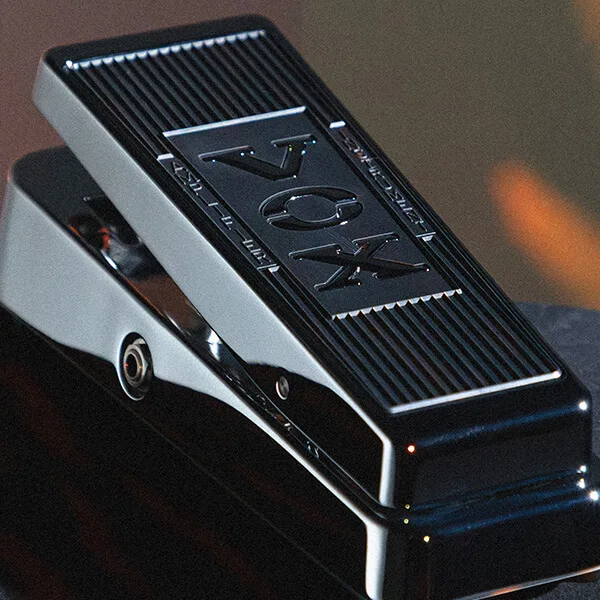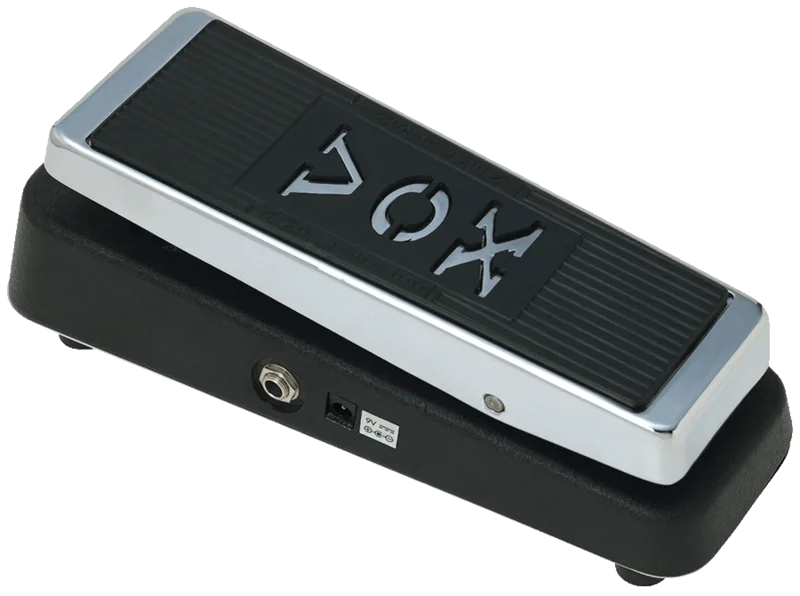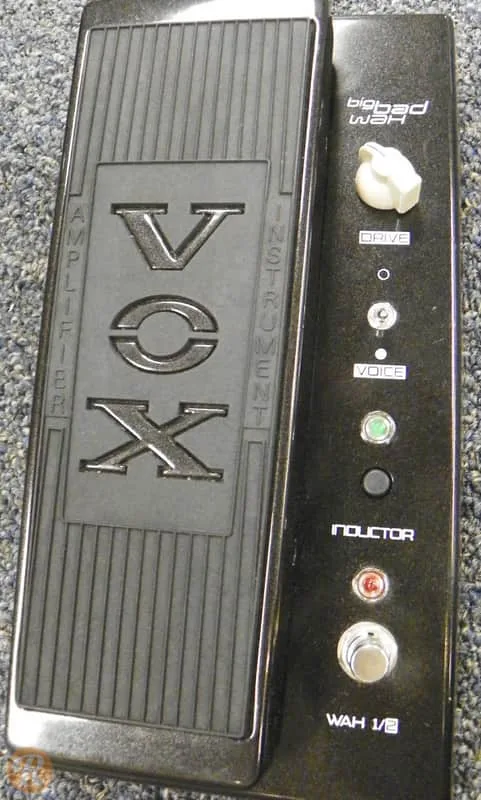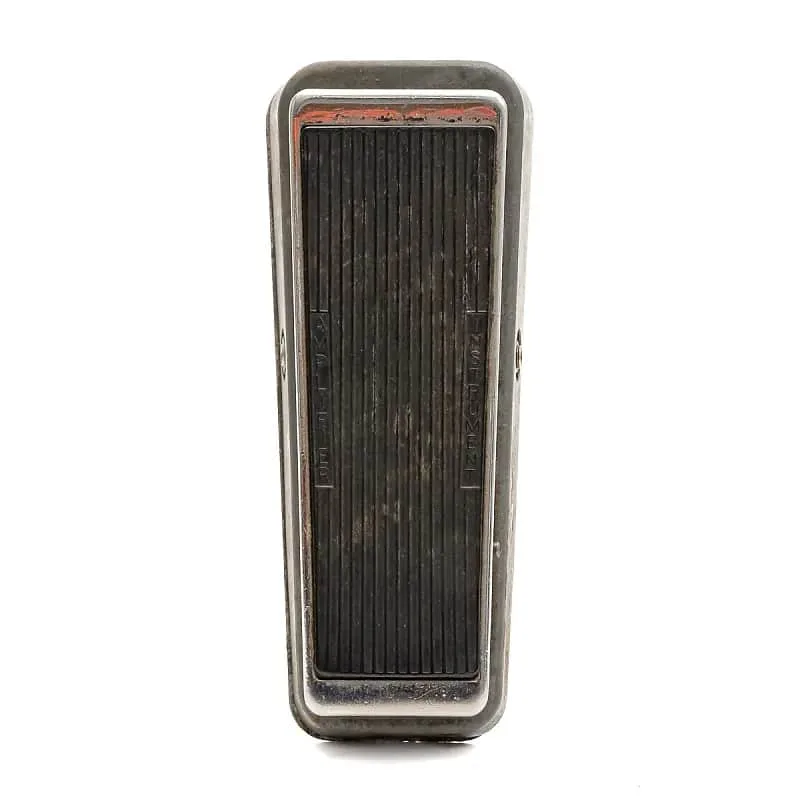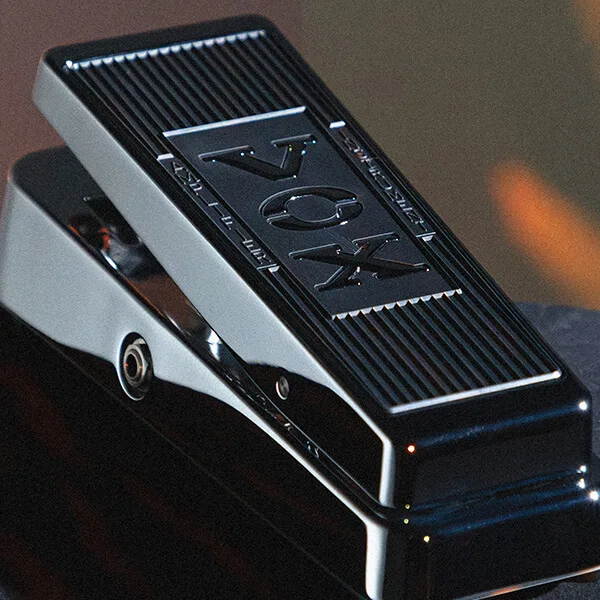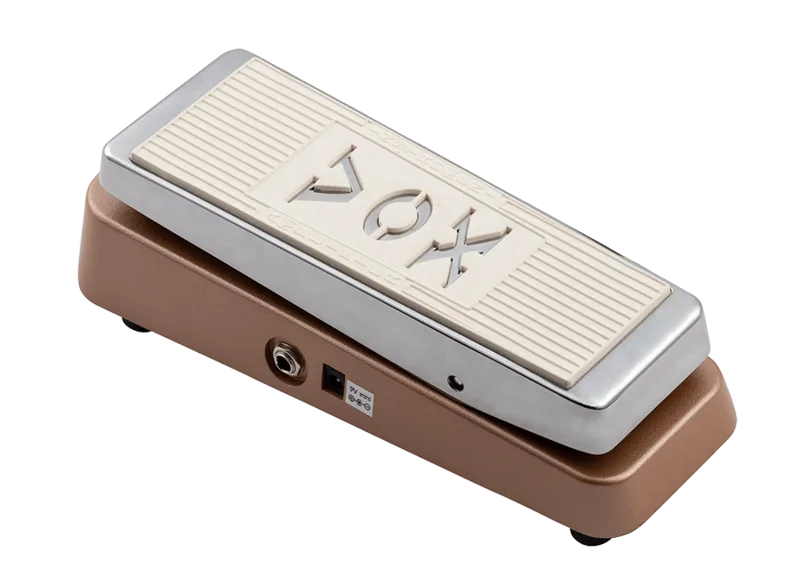


The Vox V847-C is a wah pedal from Vox, developed in collaboration with Japanese guitarist Char123. It is built in Japan, and its front and bottom plates feature illustrations of traditional Japanese artwork3. Vox no longer makes it: the product is listed as no longer in production3.
What sets it apart from the standard V847 is the voicing. Vox set the wah's frequency range lower, boosted the gain and adjusted the Q-value, aiming for what the maker calls a powerful sound with a low center of gravity3. Guitar.com described the result as a warmer and more powerful tone than the regular V847, due to an adjustment of the wah's input impedance1.
A V847 wah with a lower, more powerful voicing
The V847-C is based on the specs of the original Vox wah from the 1960s, the same lineage the standard V847 carries3. Where the regular model keeps the classic sweep, the V847-C moves it down. Vox's own description of the changes:
"The frequency range of the wah (frequencies in which the wah can be varied) has been set lower, with the gain boosted and the Q-value (the sharpness of the wah’s peak) adjusted to deliver a powerful sound with a low center of gravity."3
Press coverage at the announcement agreed on the character of the change. gearnews reported that the frequency range had been set lower than that of a standard model, and that by changing the output impedance the pedal should deliver a more powerful sound with a nice warm tone4. Guitar World called it a modern reimagining of the classic wah, with a lower frequency sweep and higher gain5.
For context on what a lower sweep means in this circuit: GuitarPCB's technical analysis of the V847 explains that the C2 capacitor primarily determines the center frequency of the wah sweep, and that bigger values move it down toward bass while smaller values move it up6. The same analysis notes that the V847's stock 68K input impedance is low and that the guitar signal might suffer tone sucking, a loss of high frequencies6. The V847-C's stated 210 kOhm input impedance3 is the adjustment Guitar.com credited for the warmer, more powerful tone compared with the regular model1.
How the V847 family sounds against its main rival: MusicRadar's buying guide found the Vox V847 has bite with the toe down but is less nasal than the Dunlop voicing when compared side by side7, and GuitarPCB's circuit comparison found the low frequency harmonics are more present in the Vox than in the Dunlop8.
Power and connections
The pedal runs on a single 9V DC battery, or on an AC adapter that is optional and sold separately3. There is a dedicated AC power supply jack, so the pedal can sit on a powered board without a battery inside.
| Connection | What it is |
|---|---|
| Input | 1 x 1/4" input jack3 |
| Output | 1 x 1/4" output jack (to amplifier)3 |
| Power | 1 x AC power supply jack3 |
The true bypass design means the signal does not pass through the circuit when the unit is switched off3. gearnews noted at the announcement that this should let it play nicely on modern pedalboards, which old '60s wah do not4.
Videos
TheSuperFunAwesomeHappyTimePedalShow
Okamoto's Gear
Okamoto's Gear
News
Questions
Is the Vox V847-C still in production?
No. Vox lists the V847-C as no longer in production. It was announced at NAMM 2020 as a limited-edition model, so remaining units are whatever stock is still in the resale and clearance market.
Who designed the Vox V847-C?
The V847-C is the result of a collaboration with Japanese guitarist Char. Vox announced it at NAMM 2020 as a signature wah developed with Char, who spec'd this version of the venerable V847.
How does the V847-C differ from the regular V847?
The V847-C sets the wah's frequency range lower, boosts the gain and adjusts the Q-value for a more powerful sound with a low center of gravity. Guitar.com described the result as a warmer and more powerful tone than the regular V847, due to an adjustment of the wah's input impedance.
Is the V847-C true bypass?
Yes. Vox states the true bypass design means the signal does not pass through the circuit when the unit is switched off, and gearnews noted it should play nicely on modern pedalboards, which old '60s wah do not.
Does the V847-C run on a battery?
Yes. It runs on one 9V DC battery, or on an AC adapter that is optional and sold separately. There is a dedicated AC power supply jack alongside the quarter-inch input and output jacks.
Where is the Vox V847-C made?
Japan. Vox describes it as a true Made In Japan product manufactured in Japan, and press coverage at its announcement called it a limited-edition model made in Japan.
Sources (8)
- NAMM 2020: Vox’s new V847-C wah hits the sweet spot, Guitar.com, 2020-01-13
- NAMM 2020: Is the V847-C “the perfect modern Vox wah”?, Guitar World, 2020-01-10
- V847-C Wah Pedal, Vox Amps, 2025-09-30
- NAMM 2020: Vox announces new V847-C Custom Char signature wah model, gearnews.com, 2020-01-13
- The VOX Amps Wah Wah Pedal Story, Vox Amps (voxamps.com), 2023-01-18
- Vox V847 Wah-Wah Analysis, GuitarPCB
- 5 great wah pedals guitarists need to try, MusicRadar, 2021-06-24
- Dunlop CryBaby GCB-95 Cicuit Analysis, GuitarPCB