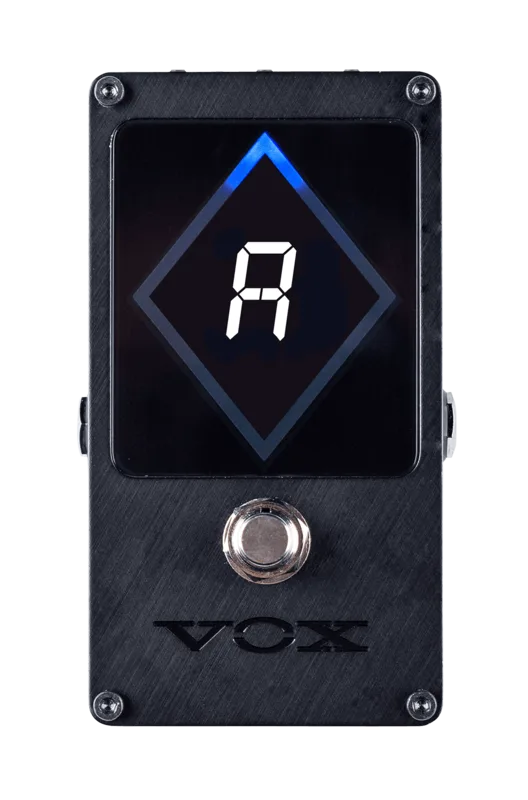


The VOX VXT-1 Strobe Pedal Tuner is VOX's first stomp tuner, a floor pedal that sits in your signal chain and gives you strobe-grade tuning accuracy of plus or minus 0.02 cents1. Vox describes it as a stomp tuner with a high-visibility display, ultra-precise tuning and an offset tuning mode, built around a diamond visual meter1. MusicRadar's Richard Blenkinsop called it "a sleek and simple unit from Vox" that is "ideal for most situations" at that accuracy2.
The three display modes
The VXT-1 offers three display modes, and RockBoard's PedalPedia notes you can switch between them "as appropriate for the player's style"3. Each reads the same information differently:
| Mode | How it reads |
|---|---|
| Strobe | Tune by stopping the flow of the LED meter illumination; it rotates clockwise when sharp and counter-clockwise when flat1 |
| Diamond | Tune so the angle above the LED meter is lit; the blue LED of the top angle lights when the pitch is correct1 |
| Vertical | Tune so the left and right angles are lit; the LED above center lights when sharp, the one below when flat1 |
The strobe mode is where the headline accuracy lives. RockBoard's PedalPedia entry explains that tuning to within ±0.02 cents is "difficult for previous LED meters" and is achieved in the strobe display mode3. If you want the full precision the pedal is rated for, use the strobe display; the other two modes are easier to read at a glance on a dark stage.
Muting and bypass
Two behaviors matter for how the pedal sits on a board. When the tuner is on, Vox states the input sound is completely muted, which the company positions as making the unit ideal for on-stage use: you tune silently between songs1. When the tuner is off, the true bypass design passes the input sound through without any effect on it1. RockBoard's PedalPedia describes the same design as one "that does not affect the tonal character in any way"3.
Power and connections
The VXT-1 runs on a 9V battery or a 9V AC adapter, and Vox lists the 9V DC power supply adapter as sold separately, so battery power is what you get out of the box1. Current consumption is 20 mA1.
Battery life depends on the battery type. Vox gives a figure of approximately 12 hours with a zinc-carbon battery, measured with a continuous A4 input, the tuner on and the display in strobe mode1.
The 9V adapter is optional and sold separately1. If you plan to run the VXT-1 on a pedalboard power supply rather than a battery, budget for that adapter or a compatible 9V supply.
Connections are straightforward:
- INPUT: mono 1/4" jack1
- OUTPUT: mono 1/4" jack1
- DC 9V IN: for the optional adapter1
- DC 9V OUT: a power output jack1
The DC 9V OUT jack means the pedal can share its adapter power with another pedal, which is a common convenience on tuner pedals1.
Build and placement on a board
The enclosure is an aluminum diecast body, which Vox says ensures outstanding durability1. With dimensions of 65 mm x 120 mm x 53 mm including the foot switch and rubber feet, and a weight of 309 g including the battery, it is a standard-sized stompbox that fits a typical tuner slot on a pedalboard1.
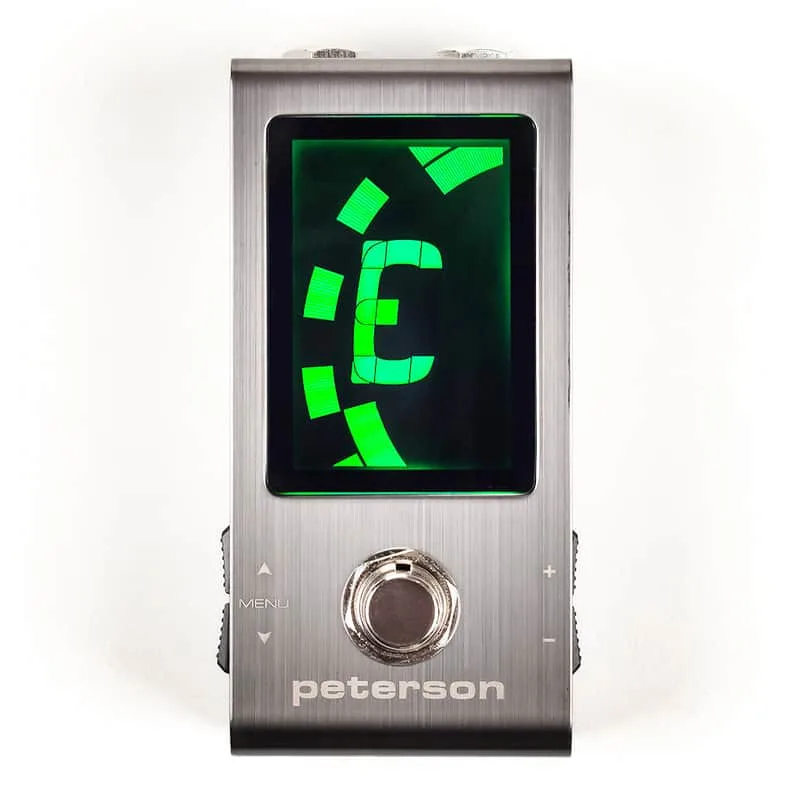
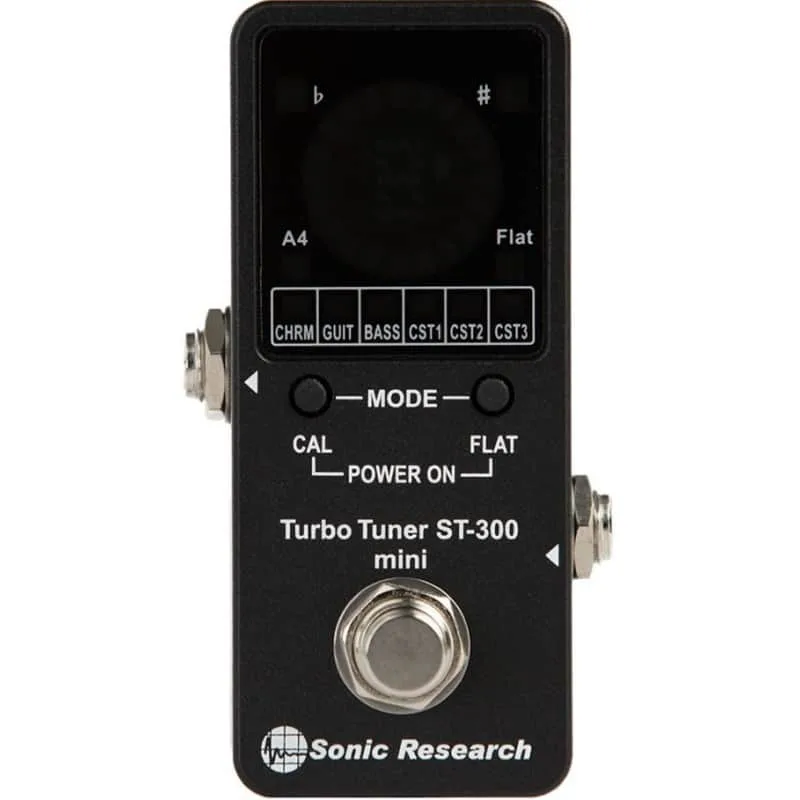
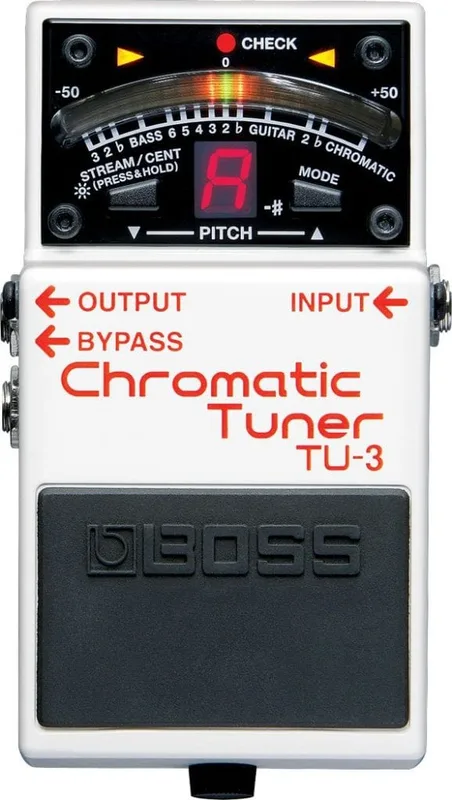
If you are comparing strobe-accuracy pedal tuners, the Peterson StroboStomp Mini and Sonic Research Turbo Tuner ST-300 Mini occupy similar territory, while the Boss TU3 Tuner is the familiar LED-meter alternative. For more on the category, see Tuner Pedals.
Videos
ギター博士
Musiker TV
미앤사TV - MNSKoreaTV
Questions
Is the Vox VXT-1 true bypass?
Yes. Vox describes the VXT-1 as true bypass when the tuner is off, so the input sound passes through without any effect on it. RockBoard's PedalPedia entry likewise describes a true bypass design that does not affect the tonal character in any way. When the tuner is switched on, the input sound is completely muted instead, which is what makes silent on-stage tuning possible.
Does the VXT-1 mute the signal when the tuner is on?
Yes. Vox states that the input sound is completely muted when the tuner is on, making the unit ideal for on-stage use. You tune silently while the audience hears nothing from your signal path, and switching the pedal off returns the signal in true bypass.
How long does a battery last in the VXT-1?
Vox gives a figure of approximately 12 hours of continuous use with an A4 input, the tuner on, the display in strobe mode and a zinc-carbon battery. Actual life depends on the battery type and how often the pedal is used, so a 9V adapter is the practical choice for regular players.
Does the VXT-1 come with a power adapter?
No. Vox lists a 9V DC power supply adapter as sold separately, so the pedal runs on a 9V battery out of the box and needs an optional adapter for adapter power.
What reference pitch range can the VXT-1 be set to?
The calibration range is 436 to 445 Hz in 1 Hz steps, so you can set a reference pitch anywhere in that window rather than being locked to a single A440 standard. That covers common concert pitch settings and slightly flat or sharp references.
Can the VXT-1 power other pedals?
Yes. Alongside the standard input and output jacks, the VXT-1 has a DC 9V OUT jack, so it can pass power from its adapter supply on to another pedal on your board.
Sources (3)
- VXT-1 Strobe Pedal Tuner, Vox Amps (voxamps.com), 2026-08-13
- Peterson StroboStomp Mini review, MusicRadar, 2024-09-27
- VXT-1 STROBE PEDAL TUNER by VOX, RockBoard PedalPedia, 2026