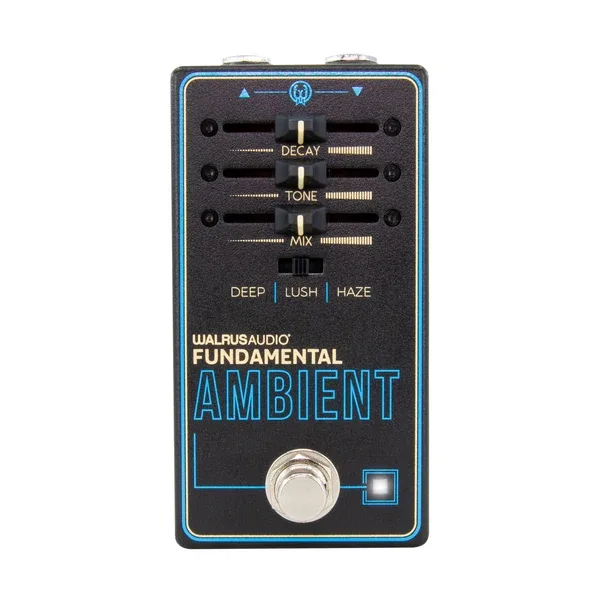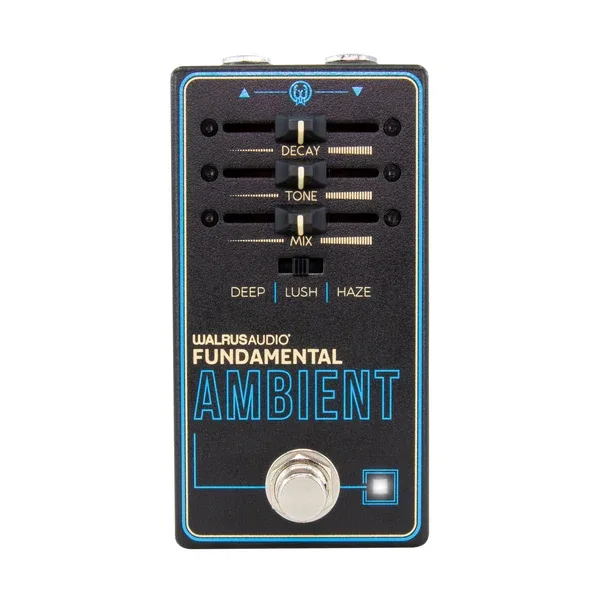


The Walrus Audio AMBIENT, sold as the Fundamental Ambient, is a compact digital reverb pedal in Walrus Audio's entry-level Fundamental series. Where the series' earlier Fundamental Reverb covered traditional Hall, Spring and Plate sounds, the AMBIENT goes the other way: three atmospheric algorithms called Deep, Lush and Haze, built for pad-like decay, lo-fi texture, and long, pillowy sustain1. It lists at $99.992.
Guitar Pedal X called it the ninth pedal in the Fundamental series and "a somewhat grown-up Ambient effect," more reminiscent of the kind of reverbs Old Blood Noise Endeavors is known for than a typical budget pedal1.
Three ambient modes
A three-way mini-switch on top of the pedal selects the reverb algorithm5. Walrus Audio describes each mode on its product page:
| Mode | What the maker says it does |
|---|---|
| Deep | A dark ambient reverb with an added low octave, for murky, cavernous sustain or a touch of moody atmosphere6 |
| Lush | A breathy, expansive reverb featuring ultra-long sustain, for silky pads and immersive soundscapes2 |
| Haze | A textured, lo-fi reverb featuring distortion, sample rate reduction, and a resonant bandpass tone control, for vintage or experimental tones6 |
The range runs from dark, pad-like sounds to AM-radio-style lo-fi, which is what separates the AMBIENT from a general-purpose reverb2. Guitar.com's beginner pedal guide notes that Haze "introduces a dash of distortion"7.
The sliders and trails mode
Instead of rotary knobs, the Fundamental Ambient uses three sliders for Decay, Tone and Mix8. The sliders are the same three as on the earlier Fundamental Reverb1.
| Slider | What it does |
|---|---|
| Decay | Sets the reverb's decay time1 |
| Tone | Shapes the overall tonality of the reverb. On Deep and Lush it controls the cutoff of a synth-style lowpass filter. On Haze it controls the width of a resonant bandpass filter, filtering high and low end at the right and letting more through at the left6 |
| Mix | Blends the effect with the clean signal. All the way left is fully clean, all the way right is only reverb6 |
The Tone control is worth a closer look: it behaves differently on Haze than on the other two modes, acting as a bandpass width control rather than a simple lowpass cutoff6.
The single footswitch disengages the pedal, and a long press handles trails. As MusicRadar puts it: "Simply hold down the footswitch until the LED flashes to turn trails mode off and on again"5. With trails on, the reverb's tails keep resonating after you switch the pedal off; with trails off, the decay stops when you disengage9. Guitar Pedal X describes the trails setting as a power-up sequence1. The pedal uses buffered bypass and passes the dry signal through analog circuitry, so your clean tone does not go through the digital conversion42.
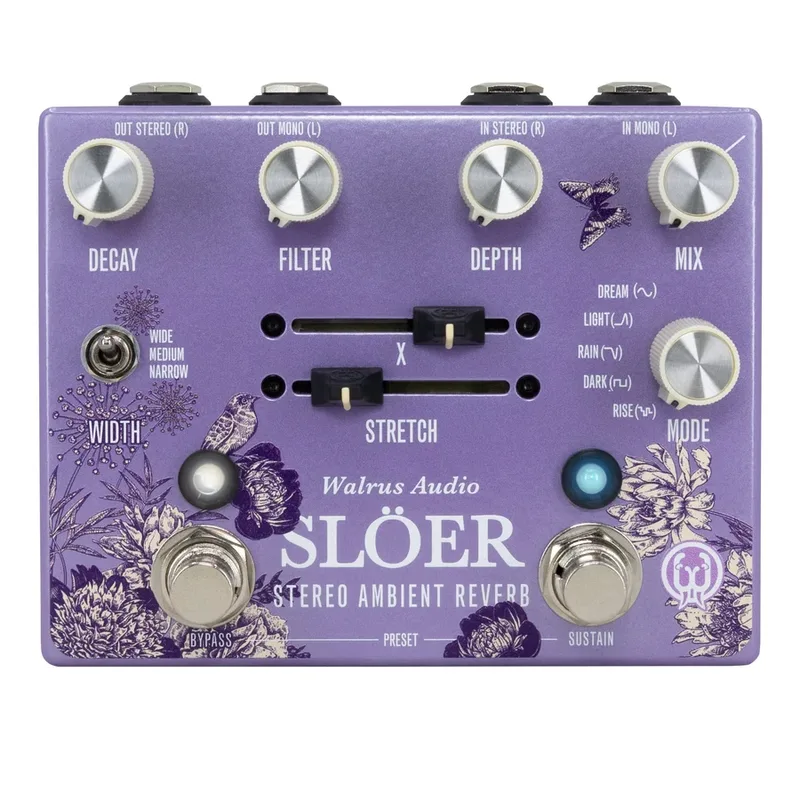
The AMBIENT is mono, with a standard input and a standard output41. Players running stereo rigs will not get a stereo image from it; Walrus Audio's larger ambient reverbs, such as the Slöer Stereo Ambient Reverb, handle Mono In/Stereo Out and Stereo In/Stereo Out setups instead.
How it differs from the Fundamental Reverb
The AMBIENT is a sibling to the earlier Fundamental Reverb rather than a replacement. The Fundamental Reverb delivered a traditional trio of Hall, Spring and Plate flavors, while the AMBIENT's Deep, Lush and Haze algorithms lean firmly into ambient territory1. The two pedals share the same Decay, Tone and Mix sliders1, so the choice between them comes down to which set of sounds you want: classic reverb types, or atmospheric pads and lo-fi textures.
Guitar World's review framed the trade-off plainly, listing "not stereo" among the pedal's features and noting it is not stereo "like some of its more expensive siblings"4. Guitar Pedal X's reviewer concluded that "for those with mono rigs, I feel the Ambient is a pretty intriguing proposition and should be very well received"1.
Where it sits in the Walrus Audio lineup
The Fundamental series is Walrus Audio's entry-level line. Reviewers place the AMBIENT a step above the usual budget pedal: one described it as "a somewhat grown-up Ambient effect, more reminiscent of the kind of reverbs OBNE is better known for"1. The same reviewer felt that "for those with mono rigs - I feel the Ambient is a pretty intriguing proposition and should be very well received"1.
Videos
walrusaudioeffects
walrusaudioeffects
Ambient Endeavors
Questions
Is the Walrus Audio AMBIENT mono or stereo?
It is mono. Guitar Pedal X's reviewer noted the pedal is mono, limiting fully immersive stereo rigs, and Guitar World's review lists not being stereo among its features. Players who need stereo ambient reverb would have to look at Walrus Audio's larger pedals, such as the Slöer, which runs Mono In/Stereo Out and Stereo In/Stereo Out setups.
How do you turn trails on or off on the AMBIENT?
Hold down the footswitch until the LED flashes to toggle trails mode off and on again, per MusicRadar. With trails on, the reverb's tails continue to resonate after you switch the pedal off; with trails off, the decay is cut when you disengage. Guitar Pedal X describes it as a power-up sequence that sets the Trails mode on or off.
What are the Deep, Lush and Haze modes?
Deep is a dark ambient reverb with an added low octave, for murky, cavernous sustain. Lush is a breathy, expansive reverb with ultra-long sustain for silky pads and immersive soundscapes. Haze is a textured, lo-fi reverb with distortion, sample rate reduction, and a resonant bandpass tone control, for vintage or experimental tones.
How much current does the Fundamental Ambient draw?
It draws 100mA at 9V DC, center negative, according to RockBoard's PedalPedia listing for the pedal. That is modest by digital reverb standards, but it means the pedal runs on a standard center-negative 9V supply rather than a battery.
Is the AMBIENT the same as the Fundamental Reverb?
No. The earlier Fundamental Reverb delivered a traditional trio of Hall, Spring and Plate sounds, while the AMBIENT offers three atmospheric algorithms: Deep, Lush and Haze. The two share the same Decay, Tone and Mix sliders, but the AMBIENT leans toward ambient, pad-like and lo-fi textures rather than classic reverb types.
Sources (9)
- Guitar Pedal X, Guitar Pedal X, 2024-03-22
- Fundamental Series Ambient, Walrus Audio
- Fundamental Ambient by Walrus Audio, RockBoard PedalPedia, 2026
- Walrus Audio Fundamental Ambient review, Guitar World, 2024-06-17
- “A great entry point into ambient exploration”: Walrus Audio unveils the Fundamental Ambient, a $129 reverb pedal for dreamy, affordable soundscaping, MusicRadar, 2024-03-19
- Fundamental Series Ambient, Walrus Audio
- The best guitar pedals for beginners: distortions, tuners and more, Guitar.com, 2026-06-05
- Walrus Audio Fundamental Ambient, gearnews.com, 2024-03-19
- Walrus Audio Fundamental Ambient, Delicious Audio, 2025-11-18