

The Walrus Audio Fundamental Ambient is a compact digital reverb pedal aimed at players who want big, atmospheric reverb without a big pedal or a big price. Walrus Audio describes it as bringing "expansive pillowy reverb" to its entry-level Fundamental series, with three atmospheric modes in a compact enclosure1. It launched in March 2024 as an expansion of the Fundamental series, Walrus Audio's entry-level line of guitar effects pedals2, and carries a list price of $99.991.
The core of the pedal is three reverb algorithms, selected by a slide switch: Deep, Lush and Haze. Walrus Audio says the three algorithms let you "experiment with deep, dark pad-like sounds to AM Radio-like lo-fi sounds," with plenty of decay time for "pillowy soft pad-like decay"1.
What it does: Deep, Lush and Haze reverbs
The three modes are the whole personality of the pedal, and each one takes a different approach to ambient reverb14.
| Mode | What Walrus Audio says it does |
|---|---|
| Deep | A dark ambient reverb with an added low octave, for "murky, cavernous sustain" or moody atmosphere1 |
| Lush | A "breathy, expansive reverb featuring ultra-long sustain," for silky pads and immersive soundscapes1 |
| Haze | A textured, lo-fi reverb featuring distortion, sample rate reduction, and a resonant bandpass tone control, for vintage or experimental tones1 |
In Guitar.com's beginner pedal guide, Pete Wise noted that "The 'Deep' mode adds a lower octave to your sound, fattening up the bass," while "Haze" introduces a dash of distortion5. MusicRadar quoted Walrus Audio's own description of Lush as a "breathy, expansive reverb featuring ultra-long sustain" at launch2.
The range runs from conventional-sounding ambient washes in Lush to deliberately degraded, lo-fi character in Haze, which makes the pedal useful both as a general-purpose reverb and as a texture tool1.
The controls: three faders and a slide switch
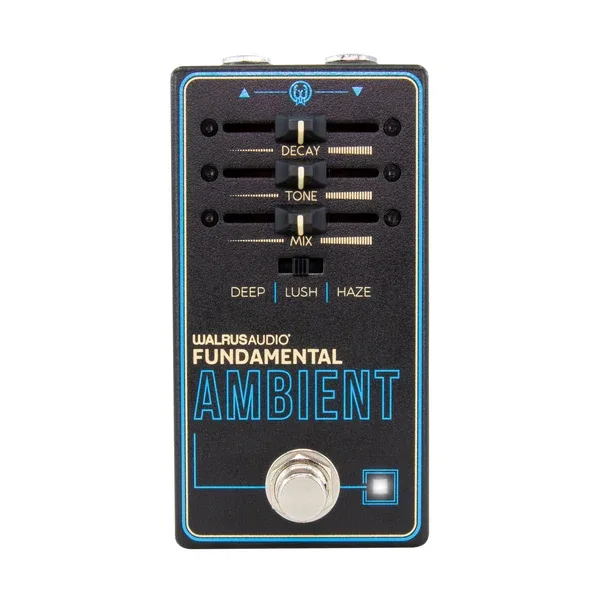
The control surface is deliberately simple: three horizontal faders and a slide switch, plus a bypass footswitch. Guitar World's reviewer, Trevor Curwen, described it as "three centre-detented sliders governing the reverb mix, decay and tone" alongside "a switch that selects one of three different ambient reverb algorithms"4.
| Control | What it does |
|---|---|
| Decay fader | Controls the reverb decay time; left is minimum, right is maximum1 |
| Tone fader | Shapes the reverb's tonality. On Deep and Lush it controls the cutoff of a synth-style lowpass filter. On Haze it controls the width of a resonant bandpass filter, filtering high and low end at the right and letting more through at the left1 |
| Mix fader | Governs the reverb mix4 |
| Slide switch | Changes between the three reverb algorithms, Deep, Lush and Haze1 |
| Bypass footswitch | Engages and bypasses the pedal4 |
The Tone control is worth a closer look because it behaves differently per mode: a lowpass filter sweep on Deep and Lush, but a bandpass width control on Haze, which is part of why Haze sounds so distinct1.
Trails, bypass and power
The pedal ships with trails mode active by default, so the reverb decay fades off naturally after you turn the pedal off rather than cutting abruptly. To disengage trails, hold the bypass stomp switch while applying power; a flashing LED indicates trails are off, and the LED turning dark indicates they are back on1. Delicious Audio also describes a long press on the footswitch triggering Trails mode, letting the reverb's tails resonate after switching off6.
It is a buffered-bypass pedal, not true bypass1, and it is not stereo: Guitar World notes "it's not stereo like some of its more expensive siblings," with a standard input and standard output4. Power requirements are 9 VDC at 100mA minimum1, and RockBoard's PedalPedia lists the current draw at 100mA3.
At 100mA, this pedal needs a proper 9V DC power supply or an isolated output. It is not a low-current pedal you can share casually on a small daisy chain.
Where it came from
Walrus Audio also sells a blemished version at $84.99, where the blemish is cosmetic only, such as scratches or dents in the finish of the pedal7.
What reviewers made of it
Guitar World's Trevor Curwen concluded that the pedal is "a nicely affordable option of adding some atmospheric soundscapes to a standard guitar signal chain, and is a practical complement to a more conventional reverb pedal"4.
How it differs from other Walrus Audio reverbs
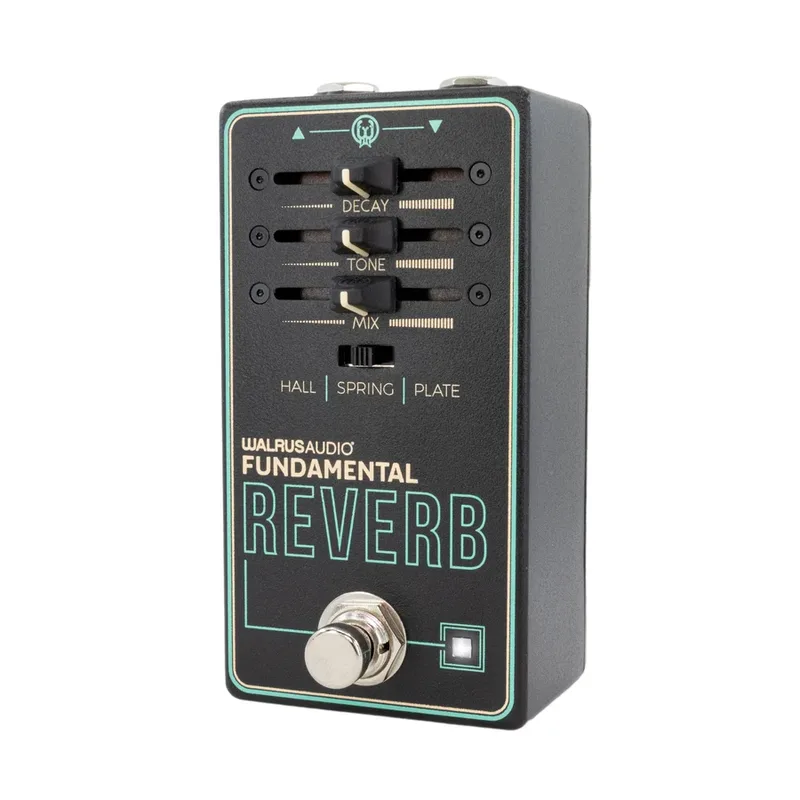
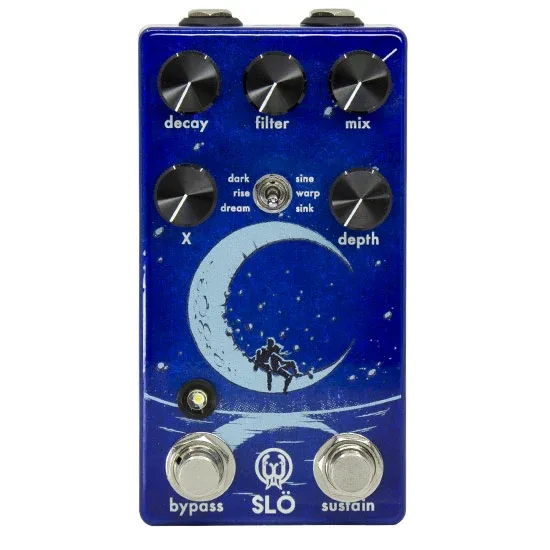
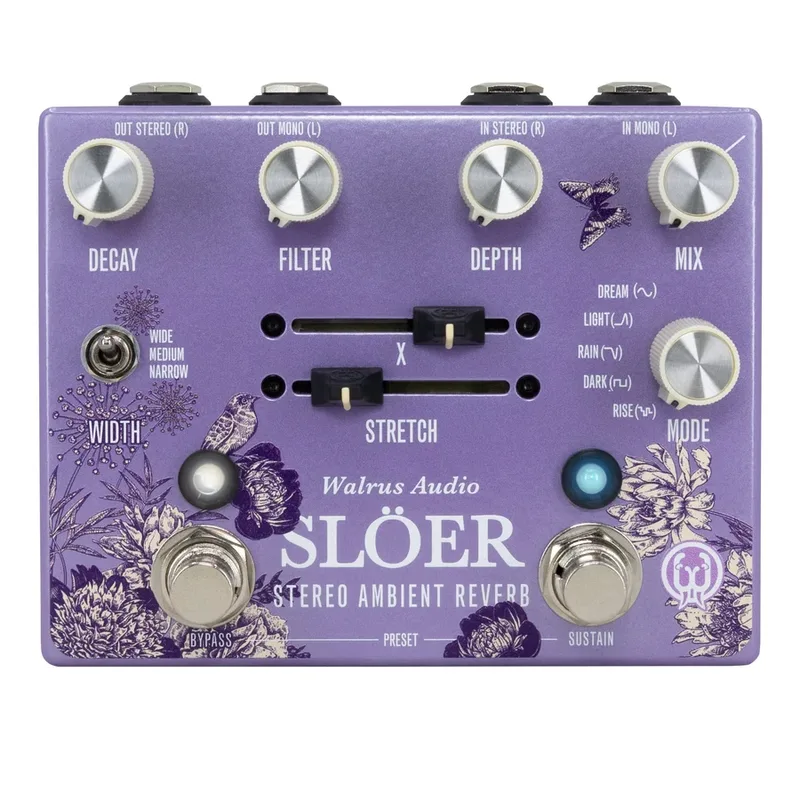
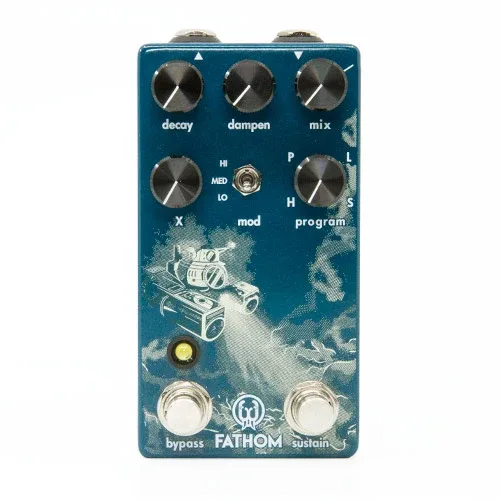
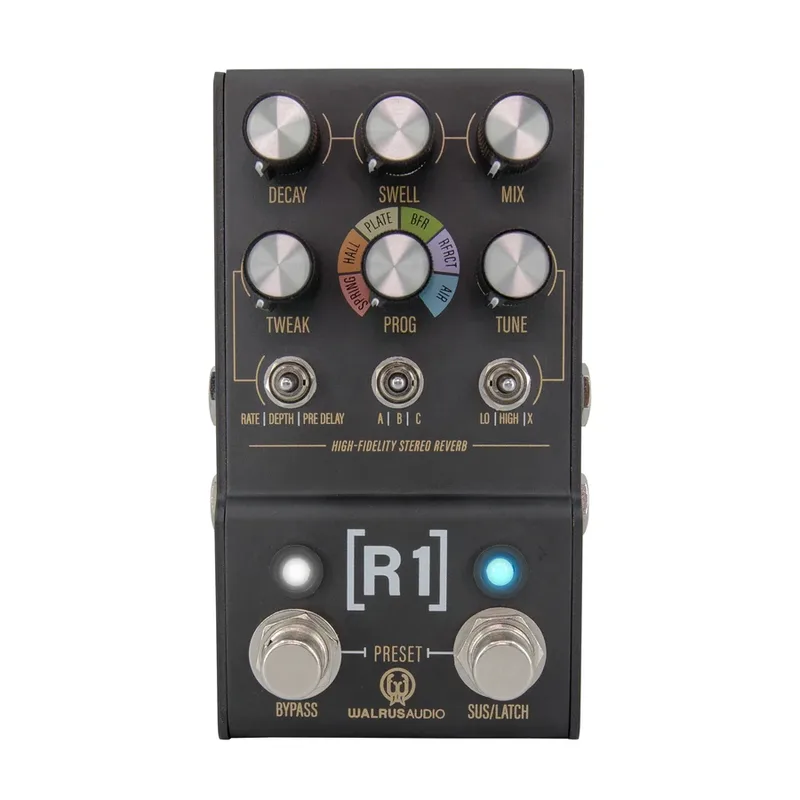
Within Walrus Audio's reverb line, the Fundamental Ambient is the entry point: mono, buffered bypass, three modes and three faders, at $99.9914. The company's larger reverbs, such as the Slö, the stereo Slöer, the Fathom and the Mako Series R1, offer more controls, presets and in several cases stereo operation, at higher prices. Guitar World's framing, that the Ambient is "not stereo like some of its more expensive siblings," captures the trade-off directly4. For a player who wants one ambient reverb on a small board, the Fundamental Ambient covers the ground at a fraction of the cost.
Videos
walrusaudioeffects
walrusaudioeffects
Ambient Endeavors
News
Questions
Is the Walrus Fundamental Ambient stereo?
No. Guitar World's review notes it is not stereo, unlike some of Walrus Audio's more expensive reverb pedals. It has a standard input and a standard output, so it runs mono in and mono out. Players who need stereo ambient washes would have to look at Walrus Audio's larger reverb pedals instead.
Does the Fundamental Ambient have trails?
Yes. The pedal ships with trails mode active by default, so the reverb decay fades off naturally after you switch the pedal off. To disengage trails, hold the bypass stomp switch while applying power; a flashing LED indicates trails are off, and the LED turning dark indicates they are back on.
How is the Fundamental Ambient different from the Slö?
The Fundamental Ambient is part of Walrus Audio's entry-level Fundamental series, priced at $99.99, with three faders and a slide switch and a mono, buffered-bypass design. The Slö sits in Walrus Audio's larger reverb line with more controls and a different feature set. The Fundamental Ambient is the simpler, cheaper way into ambient reverb.
Is the Fundamental Ambient analog or digital?
It is a digital pedal. The three reverb algorithms, Deep, Lush and Haze, are digital ambient reverb algorithms, and the Haze mode in particular uses digital sample rate reduction and a resonant bandpass tone control for its lo-fi character.
Is the Fundamental Ambient true bypass?
No. Walrus Audio lists the Fundamental Ambient as buffered bypass. When the pedal is off, the signal passes through a buffer rather than a true bypass switch. The pedal also uses its bypass footswitch for the trails mode setting, which is held down while power is applied to toggle trails on or off.
Sources (7)
- Fundamental Series Ambient, Walrus Audio
- “A great entry point into ambient exploration”: Walrus Audio unveils the Fundamental Ambient, a $129 reverb pedal for dreamy, affordable soundscaping, MusicRadar, 2024-03-19
- Fundamental Ambient by Walrus Audio, RockBoard PedalPedia, 2026
- Walrus Audio Fundamental Ambient review, Guitar World, 2024-06-17
- The best guitar pedals for beginners: distortions, tuners and more, Guitar.com, 2026-06-05
- Walrus Audio Fundamental Ambient, Delicious Audio, 2025-11-18
- Fundamental Series Ambient, Walrus Audio