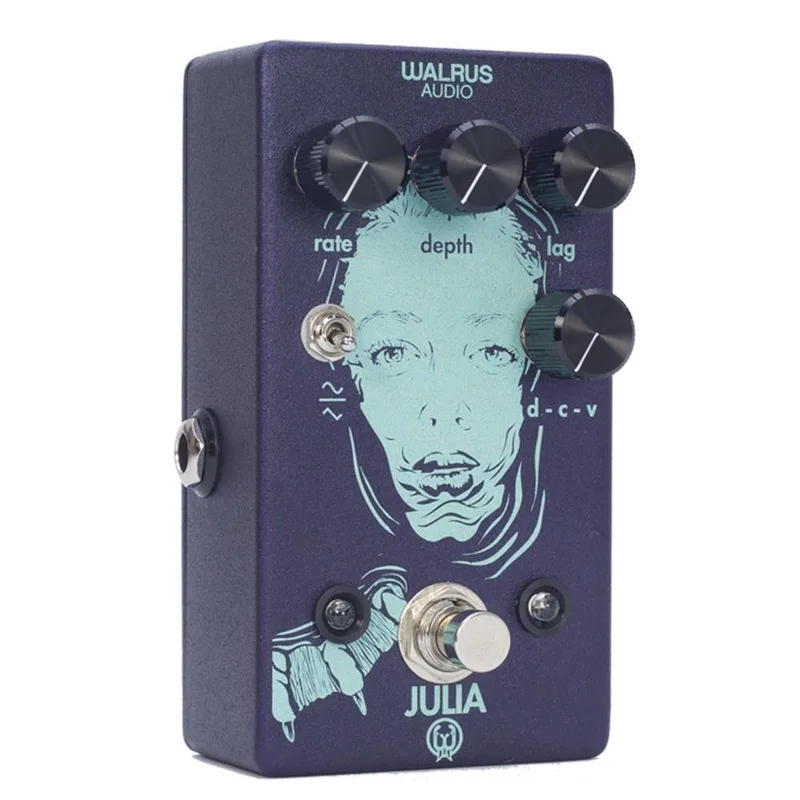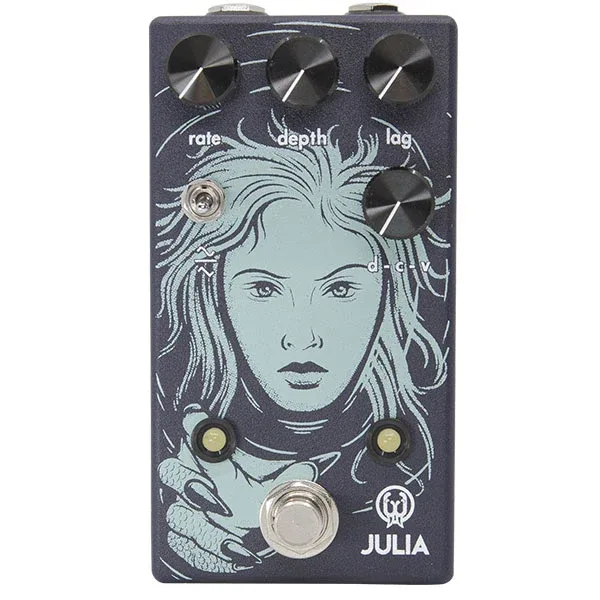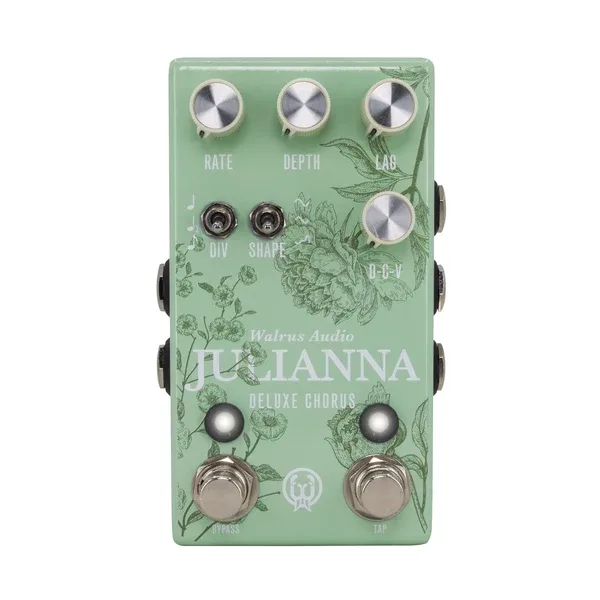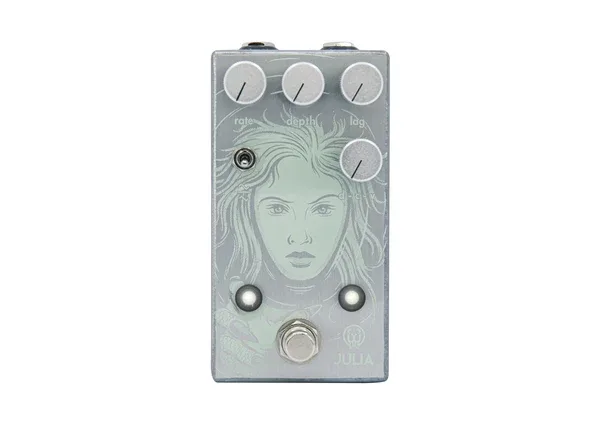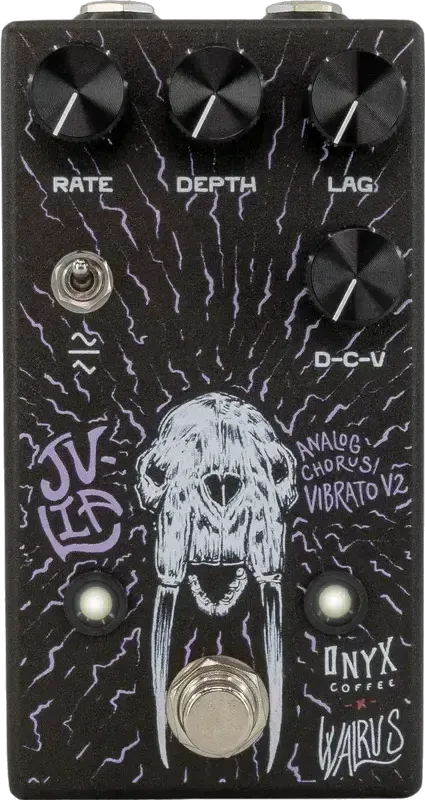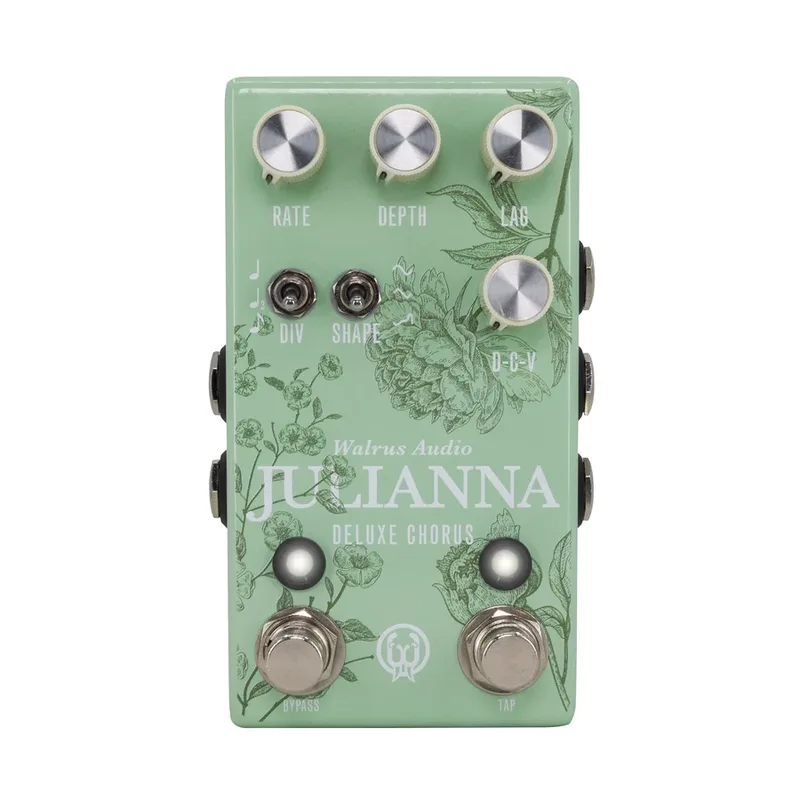


The Walrus Audio Julianna is a stereo chorus/vibrato pedal that builds on the company's Julia Analog Chorus/Vibrato. Walrus Audio describes it as "an all analog, digital LFO, stereo chorus/vibrato with new expanded features," able to produce "mild smooth chorus, to seasick vibrato, to everywhere in between"1. Where the Julia is a mono pedal with sine and triangle wave shapes, the Julianna adds stereo in/out jacks, a highly requested tap tempo switch, a Drift function and a third random wave shape2.
The pedal launched in September 2020 as the Julianna Deluxe Chorus/Vibrato at $249 in the US3. It is made in the USA4 and comes in a deep lavender enclosure with surf green ink, featuring original artwork of Julia's big sister emerging from the depths, with illustration by Adam Forster12.
The controls
The Julianna carries over the Julia's core controls and adds to them. The familiar controls from the Julia are all still here: Lag, the Dry-Chorus-Vibrato Blend, and selectable LFO wave shapes5.
| Control | What it does |
|---|---|
| Rate | Sets the speed of the LFO, by knob or tap tempo switch6 |
| Depth | Depth of the modulation, controllable by expression pedal7 |
| D-C-V blend | Runs from totally dry (D) to totally wet (V for vibrato), with traditional chorus around the middle4 |
| Lag | Sets the center delay time the LFO modulates, from smooth and tight modulation at lower settings to a warbling detune at maximum1 |
| Shape toggle | Chooses sine, triangle or random LFO wave shape7 |
| Div switch | Selects quarter note, eighth note or quarter triplet for tap tempo4 |
The D-C-V blend knob is the heart of the pedal. Guitar World's reviewer Trevor Curwen found it "runs from totally dry (D) to totally wet (V for vibrato) with traditional chorus around the middle and nuanced blends throughout the travel"4. Guitar.com's Michael Watts noted "there's an enticingly smooth transition along the dial and makes for some genuinely beautiful blends"8.
The Lag knob determines the center delay time the LFO modulates from, widening the pitch shift for a richer effect4. At lower settings it brings what Watts described as "a warm 3D shimmer to chord work that's reminiscent of vintage Roland units"8.
Tap tempo and Drift mode
The Julianna's tap tempo control lets you set the rate of the LFO with the Rate knob or the tap tempo switch6. The tap footswitch is a secondary momentary footswitch9, and holding it toggles between two user-set Rate values, with the transition ramping very naturally, rotary speaker-style4.
The Div switch works with tap tempo, selecting quarter note, eighth note or quarter triplet divisions4.
Drift mode gently speeds up and slows down the LFO rate6. MusicRadar explained it as the LFO rate moving "like you're moving the Rate control up and down"10. Walrus Audio's own description of the function, quoted by Guitar.com:
"Like having a little robot inside your pedal who can work the rate knob for you"
The random wave shape is the other addition over the Julia. In addition to sine and triangle, the Julianna adds a random wave shape option to modulate the pitch of your signal6. Guitar.com's launch coverage described it as "a third 'random' wave shape for a more chaotic modulation of your pitch"9, and Watts called it "an additional random wave LFO option for increased wooziness should you feel inclined"8.
An expression pedal can be connected to control Depth, Rate or both7.
Stereo, power and connections
The Julianna has stereo in/out jacks and can run mono in/mono out, mono in/stereo out, or stereo in/stereo out1. When both outputs are connected, setting the D-C-V knob to full counterclockwise sends the dry signal to the mono output and the vibrato signal to the stereo output for a traditional stereo chorus sound7.
Power requirements are 9VDC, center negative, with a 100mA minimum2. The Limited Edition Gold version lists 9V DC center negative at 75mA current draw5.
The power supply is not included with the Julianna1, so you will need a compatible 9VDC center negative supply capable of at least 100mA1.
What reviewers said
Guitar.com's Michael Watts concluded:
"we conclude this is one of the most engaging chorus/vibrato units we've encountered for a long time."
His overall verdict was "A powerful source of sublime textures from a boutique powerhouse - strongly recommended," at a UK price of £2258. Guitar World's Trevor Curwen found "the chorus and vibrato are impressive, but blending the two yields some fascinating hybrid sounds to explore"4. Gearnews wrote that "the demos sound wonderful and the concept looks well implemented, it looks like a joy to use"11, and Pedal of the Day highlighted the random wave shape option added to sine and triangle12. In Delicious Audio's best pedals of 2020 roundup, the Julianna placed 11th with 2 points132.
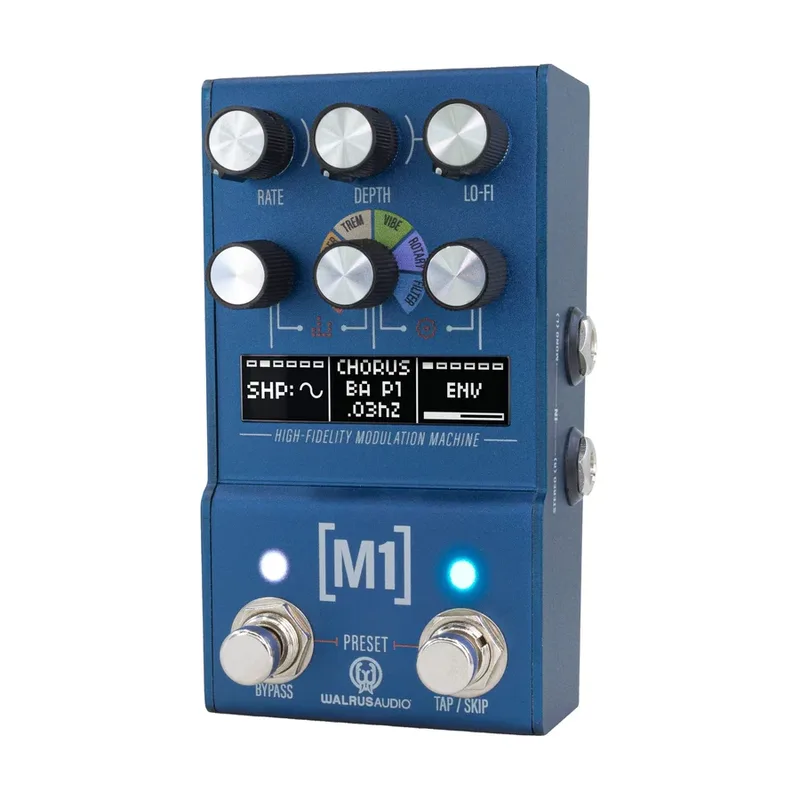
Guitar World's review also noted there are no onboard preset slots4, so players who want stored settings may want to compare it with a programmable modulation pedal such as the Walrus Audio Mako M1.
Versions
- Julianna Deluxe Chorus/Vibrato: the original September 2020 release at $2493.
- Limited Edition Gold: a Sweetwater exclusive version of the same circuit5.
- Blemished units: Walrus Audio has sold blemished units at $237.99, with the blemish being cosmetic only, such as scratches or dents in the finish of the pedal, against a list price of $279.991.
Videos
Sweetwater
walrusaudioeffects
walrusaudioeffects
Questions
What is the difference between the Walrus Julia and Julianna?
The Julianna builds on the Julia Analog Chorus/Vibrato circuit with an expanded feature set. It keeps familiar controls like Lag, the Dry-Chorus-Vibrato blend and selectable LFO wave shapes, but adds stereo in/out jacks, a tap tempo switch, a Drift function and a third random wave shape. Guitar World describes it as an enhanced version of the Julia.
Is the Walrus Julianna stereo?
Yes. It has stereo input and output jacks and can run mono in/mono out, mono in/stereo out, or stereo in/stereo out. With both outputs connected, setting the D-C-V knob fully counterclockwise sends the dry signal to the mono output and the vibrato signal to the stereo output for a traditional stereo chorus sound.
Does the Julianna have presets?
No. Guitar World's review notes there are no onboard preset slots. You can, however, set two values for the Rate knob and hold the tap footswitch to toggle between them, with the transition ramping naturally in a rotary speaker style.
Is the Julianna analog?
It is an all-analog chorus/vibrato with a digital LFO. The audio path is analog while the low-frequency oscillator that drives the modulation is digital, which is what makes features like tap tempo and the random wave shape possible.
What is the random wave shape on the Julianna?
Alongside the sine and triangle waves carried over from the Julia, the Julianna adds a third random wave shape that modulates the pitch of your signal in a more chaotic, less predictable way. Guitar.com's reviewer called it an option for increased wooziness.
Is the Julianna true bypass?
Yes. Walrus Audio lists the Julianna as true bypass, so with the pedal disengaged the signal passes through without the effect circuit in the path.
Sources (13)
- Julianna Deluxe Chorus/Vibrato, Walrus Audio
- Walrus Audio Unveils Julianna Deluxe Chorus/Vibrato, Premier Guitar, 2020-09-09
- Walrus Audio takes its chorus/vibrato game to the next level with the Julianna, Guitar World, 2020-09-07
- Walrus Audio Julianna review, Guitar World, 2020-12-17
- Julianna, Limited Edition Gold (Sweetwater Exclusive) by Walrus Audio, RockBoard (www.rockboard.de), 2026
- Julianna Deluxe Chorus/Vibrato, Black Friday 2024 Floral Series, Walrus Audio
- Julianna Deluxe Chorus/Vibrato, Walrus Audio
- Review: Walrus Audio Julianna, Guitar.com, 2020-09-14
- Julianna, the big sister of Walrus Audio’s Julia, emerges from the depths, Guitar.com, 2020-09-07
- We're loving the demo for Walrus Audio's new Julianna Chorus / Vibrato pedal, MusicRadar, 2020-09-07
- Walrus Audio Julianna Deluxe Chorus/Vibrato: Smooth tones with modern features, gearnews.com, 2020-09-07
- Walrus Audio Julianna Deluxe Chorus Vibrato, Pedal of the Day, 2020-10-03
- The Best Guitar Pedals Of 2020 according To The Internet Experts, Delicious Audio, 2021-01-21