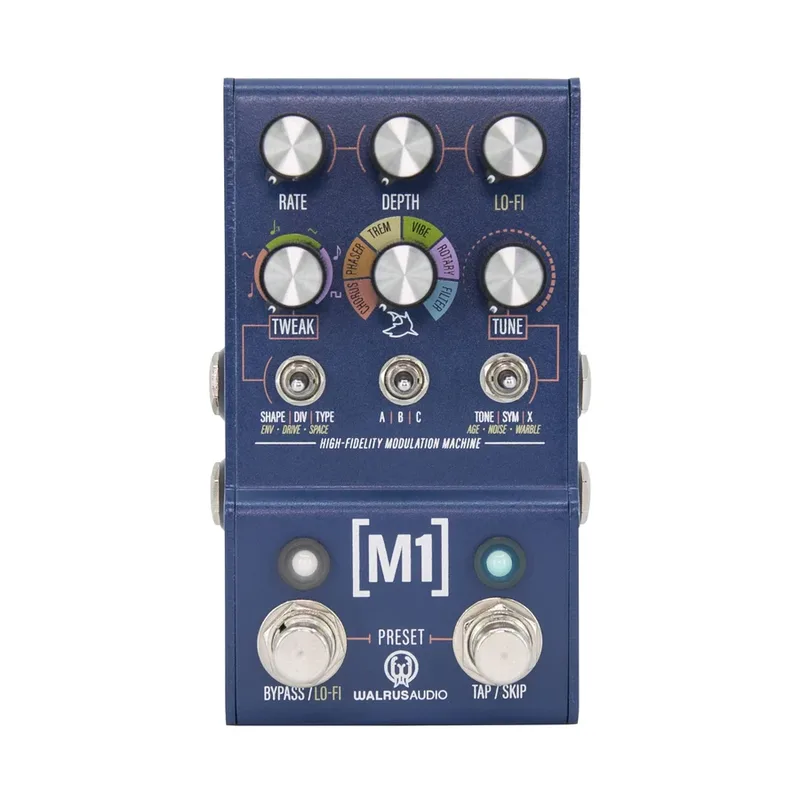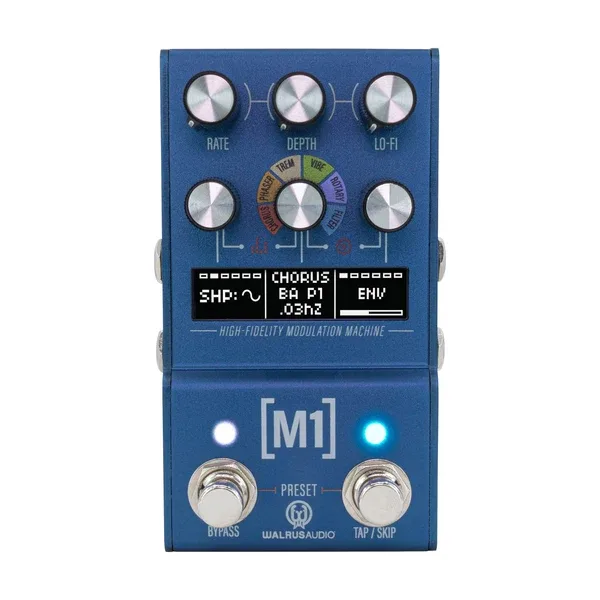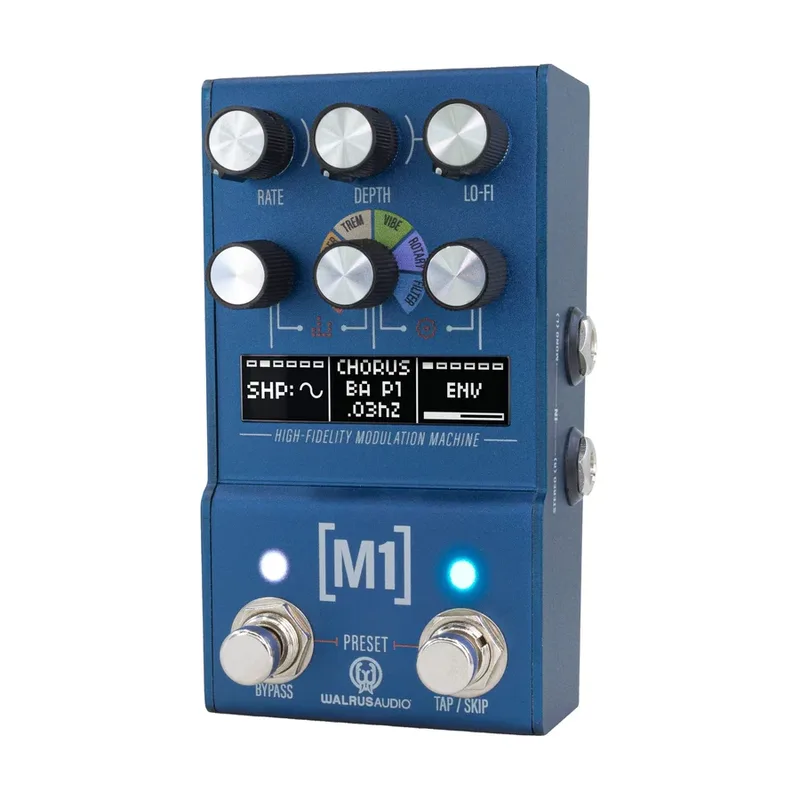


The Walrus Audio Mako M1 is a stereo, all-in-one digital modulation pedal: one box holding six studio-grade programs, Chorus, Phaser, Tremolo, Vibrato, Rotary and Filter, each with multiple voicings inside it1. It arrived in 2022 as part of Walrus Audio's Mako series of stereo multi-algorithm pedals, and a MKII version followed in 2024 with a screen-based interface, a flanger, and a much larger preset bank23. The idea behind it is straightforward: instead of a pedalboard full of single-effect boxes, you carry one chorus, phaser, tremolo, vibrato, rotary and filter pedal that also lets you deliberately degrade all of them.
Six modulation types in one stereo pedal
At the M1's core are six modulation voices, and each voice contains several types14. The Chorus program alone spans a wide range: Type I is a traditional chorus for tight, smooth tones; Type II adds a second chorus with offset rate and depth, essentially two chorus pedals in series for a more dramatic character; Type III is rooted in the classic tri-chorus effect, three chorus units in parallel for a lush, multi-dimensional sound3. On the MKII, a flanger voicing sits among the chorus options, replacing the MKI's dual chorus program74.
| Program | What the types cover |
|---|---|
| Chorus | Traditional (Type I), dual chorus in series (Type II), tri-chorus in parallel (Type III), plus flanger on the MKII37 |
| Phaser | Type I is a 2-stage phaser producing a single notch, similar to Walrus's Lillian3 |
| Tremolo | Type I covers traditional optical and bias tremolo sounds, similar to the Monument in standard mode3 |
| Vibrato | Type I focuses on traditional vibrato sounds3 |
| Rotary | Speaker-style modulation, updated algorithm on the MKII37 |
| Filter | Filter effect, updated algorithm on the MKII37 |
The pedal runs stereo in and out, so it works in mono in/mono out, mono in/stereo out, or full stereo in/stereo out configurations2. Guitar.com's reviewer called it "a stunning collection of modulation in one stompbox"12.
The controls and lo-fi functions
The headline control feature is the lo-fi section. A dedicated lo-fi knob mixes a set of lo-fi parameters into every program, and those parameters are warble, age, drive, space (an ambient reverb), noise and envelope25. On the original M1 you adjust them by holding a knob down; on the MKII the right encoder knob cycles through the lo-fi sounds via the navigation menu134. Premier Guitar's reviewer noted that the lo-fi sounds, like age, space, drive and noise, can shape straightforward modulation in very cool ways14.
The core knobs are Rate, Depth and Lo-Fi, plus a Mode selector and two parameter controls11. An X knob changes job depending on the program: on Chorus it controls Lag, setting the maximum pitch detuning; on Phaser it sets how much phase-shifted signal feeds back to the input; on Tremolo it manipulates the phase of the left and right volume modulation for a wide stereo panning effect3.
The lo-fi section is the M1's signature trick: the same knob that makes the pedal "high-fidelity" by name can make it sound like a worn tape, which Delicious Audio described as taking the device into worn tape simulation territory3.
Presets, MIDI and tap tempo
The original M1 saves up to nine onboard presets, with 128 accessible via MIDI2. The MKII expands onboard storage to 128 presets, held in a preset bank you open by tapping down on the bottom left and bottom middle knobs simultaneously; presets 10 to 128 can also be reached through manual selection or MIDI1. Both versions carry MIDI in and thru jacks, plus USB for firmware updates1413.
Tap tempo is on a footswitch, with three subdivisions on the original58. That same switch doubles as a performance effect: press and hold the TAP/SKIP and the pedal momentarily engages a "skipping" effect, like a needle skipping on a record player, repeating the last few milliseconds of audio until you release it3. The MKII adds total BPM control, letting you dial in a specific tempo and read it on the menu screen for the Chorus, Phaser, Tremolo and Vibrato programs3.
Power and connections
The M1 runs on 9V DC only, drawing 300mA minimum, center negative, with the power supply sold separately. There is no battery option, and the 300mA draw means it needs a proper isolated output rather than a shared daisy chain1212.
Connections on the original are 1/4-inch mono and stereo I/O, MIDI I/O and mini USB5. The MKII keeps MIDI IN, MIDI THRU and USB13. Input impedance is 1.1M ohms and the outputs are two 1/4-inch unbalanced TS jacks75.
History and versions: the original M1 and the MKII
The original M1 shipped in 2022 at $34978. When the Mako series arrived, guitar.com's Josh Gardner noted it was a very big deal, and the M1 was the compact high-end multi-modulation pedal that started it15. Its front panel used a bank of mini-toggle switches instead of a screen, with 11 switches, knobs and toggles governing primary and secondary functions1415.
The MKII was announced in September 2024 at $399, alongside updated D1, R1 and ACS1 pedals in the Mako range119. Side by side:
| Original M1 (2022) | MKII (2024) | |
|---|---|---|
| Price | $3498 | $39916 |
| Interface | Mini-toggle switches, no screen15 | LED screen with navigation menu3 |
| Flanger | No5 | Yes, in the Chorus algorithm133 |
| Onboard presets | 9, plus 128 via MIDI2 | 128 onboard, plus MIDI8172 |
| Bypass | True, DSP+True (trails), or DSP, selectable13 | Relay true or buffered, selectable13411 |
| Algorithms | Six programs4311 | Updated Rotary and Filter algorithms3 |
Reviewers split on the trade-off. Guitar World's Jonathan Horsley found the MKII delivers top-shelf sounds and creative ways to manipulate them, with the display screen very welcome and the new flanger a reason to buy4. But guitar.com's Josh Gardner, comparing the two directly, cautioned that the MKII is a lot more difficult to use than the original:
"If the thing you liked about the original was its ease of use and simple operation, I would stand firm where you are"15
Josh Gardner, guitar.com15
Guitar World's 2026 chorus pedals guide named the Mako M1 MKII its pick for features, describing a studio-grade digital chorus in a compact chassis11. On the original, MusicRadar's team called the choice of a filter instead of a flanger an odd one5, a gap the MKII closed.
Videos
Sweetwater
walrusaudioeffects
walrusaudioeffects
News
Questions
Does the Walrus Audio Mako M1 have a flanger?
The original M1 did not, and several reviewers flagged that as a gap. The MKII adds a flanger voicing inside the Chorus algorithm, replacing the MKI's dual chorus program. So if a flanger matters to you, it is the MKII or nothing in the Mako M1 line.
What changed on the Mako M1 MKII?
The MKII adds an LED screen with a navigation menu for secondary controls and lo-fi parameters, a flanger in the Chorus algorithm, updated Rotary and Filter algorithms, total BPM control with a tempo readout, and 128 onboard presets instead of nine. It lists at $399, fifty dollars more than the original.
Can the Walrus Mako M1 run on a battery?
No. Both the original M1 and the MKII run on a 9V DC power supply only, drawing 300mA minimum, and the supply is sold separately. That current draw also rules out sharing a simple daisy chain with low-current analog pedals.
How many presets does the Mako M1 store?
The original M1 saves up to nine onboard presets, with 128 accessible via MIDI. The MKII expands this to 128 onboard presets held in a preset bank, opened by tapping down on the bottom left and bottom middle knobs simultaneously, with presets 10 to 128 also reachable by manual selection or MIDI.
Is the Mako M1 analog or digital?
It is digital. The M1 uses DSP to emulate analog-style modulation effects, and Premier Guitar's reviewer found those emulations beautifully accurate and rich in overtone detail in their traditional voices. Walrus positions it as a high-fidelity, studio-grade digital pedal.
Does the Mako M1 MKII have true bypass?
The MKII offers relay true bypass and buffered bypass, selectable, with relay set as the default. The original M1 offered three selectable bypass types: true bypass, DSP plus true bypass with trails, and DSP bypass.
Sources (17)
- Mako Series MKII: M1 High-Fidelity Modulation Machine, Walrus Audio
- MAKO Series: M1 High-Fidelity Modulation Machine, Walrus Audio
- Walrus Audio Mako M1 MkII, Delicious Audio, 2026-10-06
- Walrus Audio Mako M1 MKII High-Fidelity Modulation Machine review, Guitar World, 2025-01-10
- Walrus Audio Mako Series M1 High-Fidelity Modulation Machine pedal review, MusicRadar, 2022-06-09
- Is the new Walrus Audio MAKO M1 the only modulation pedal you'll ever need?, MusicRadar, 2022-01-20
- Guitar Pedal X, Guitar Pedal X, 2024-11-19
- Best Pedals For Synths: Multi-Modulation Stompboxes, Reviewed, Delicious Audio, 2023-11-02
- Guitar Pedal X, Guitar Pedal X, 2024-09-27
- Walrus Audio MAKO M1 High-Fidelity Modulation Machine: With 18 modulation effects!, gearnews.com, 2022-01-20
- Best chorus pedals 2026: My pick of choices for your 'board at every price point, Guitar World, 2022-06-09
- Walrus Audio Mako M1 review, guitar.com, 2022-03-29
- Walrus Audio Mako M1 High-Fidelity Modulation Machine review, Guitar World, 2022-07-28
- Walrus Audio Mako Series M1 Modulation Pedal Review, Premier Guitar, 2022-05-03
- Walrus Mako M1 MKII review, guitar.com, 2025-09-22
- Kernom Elipse review, Guitar World, 2025-02-21
- 385 Overdrive, Walrus Audio