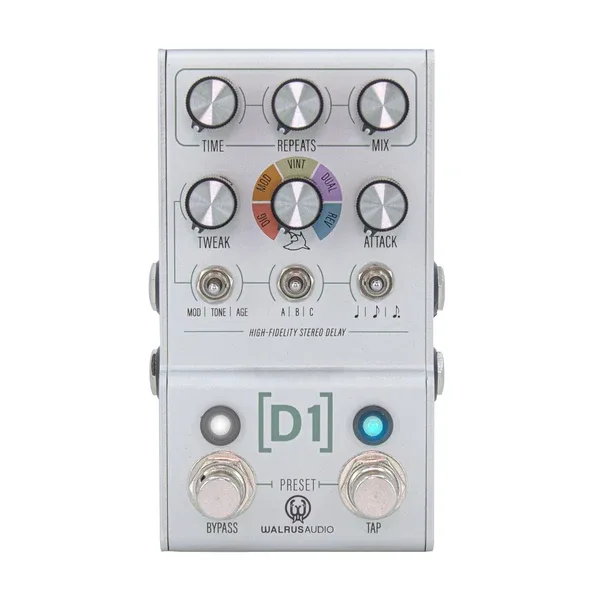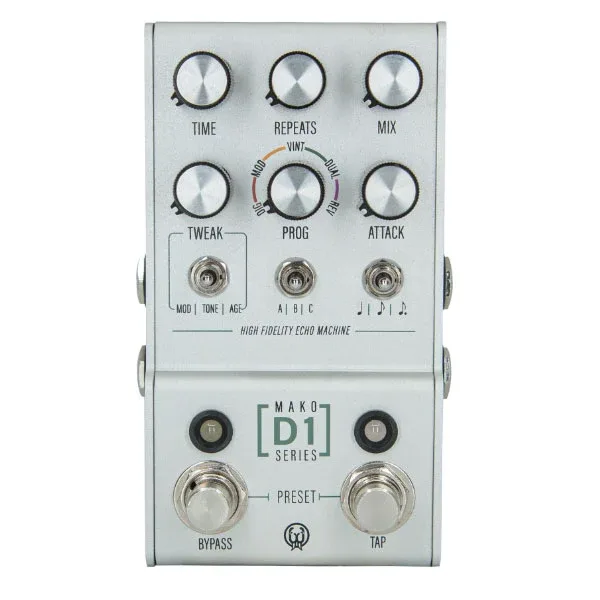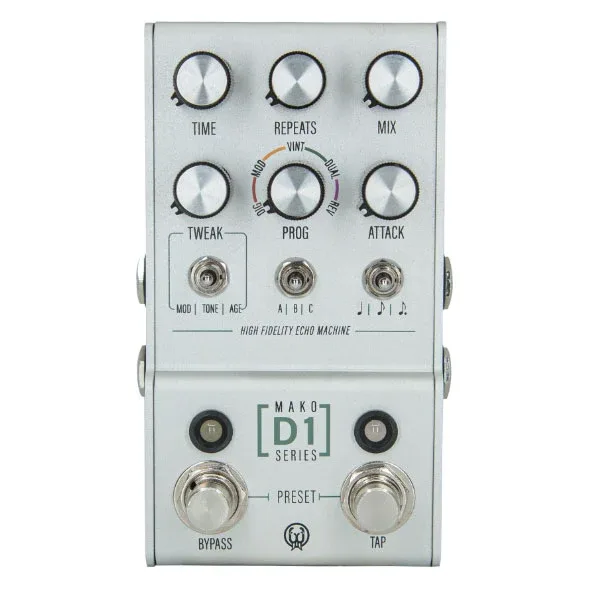

The Walrus Audio Mako D1 High-Fidelity Delay v1 is a stereo digital delay pedal and the first release in Walrus Audio's Mako series. Walrus Audio describes it as "a powerful multi-function delay with five, studio-grade, high-fidelity, custom-tuned programs," covering everything from clean rhythmic echoes to reversed repeats1. It is now discontinued and no longer available from the maker1.
The five programs
The D1's five programs each take a different approach to delay, and Walrus Audio gives a sense of what each does. The Digital program is the straightforward one: the maker describes "a clean and crystal-clear delay that is perfect for rhythmic guitar parts where ultra-defined echoes are desired"1. The Mod, Vintage, Dual and Reverse programs round out the set, giving players darker, modulated, doubled and backwards-repeat options without leaving the same box1.
What ties the programs together is the Tweak knob. Each program can be "fully customized to your taste and playing style with the Tweak knob," and the maker notes that every program can be tuned and tweaked with modulation, tone, age, and subdivisions1. In practice that means one control reshapes the character of whichever program is loaded, rather than a fixed set of parameters per mode.
Presets, MIDI and bypass
For a single pedal, the D1 carries a lot of recall and routing options1:
- Onboard presets: up to nine can be saved on the pedal itself1
- MIDI presets: up to 128 are accessible via MIDI1
- MIDI control: the pedal accepts MIDI for remote control1
- Stereo: stereo input and stereo output1
- Bypass modes: True bypass, DSP+True Bypass (trails), and DSP Bypass1
The three bypass modes matter for how the pedal behaves when switched off. True bypass removes the circuit entirely, while the DSP bypass options keep the digital engine in the signal path, with the trails mode letting repeats continue to fade after the pedal is disengaged, a common preference on delays1.
The D1 needs a 9VDC supply rated for at least 300mA, and Walrus Audio recommends an isolated power supply for all of its pedals. A battery will not run this pedal, and a daisy-chain output shared with other pedals may not supply enough current1.
The enclosure
The v1 D1 came in an anodized silver finish with black, dark green, red, orange and purple ink, in a compact enclosure measuring 4.9" x 2.52" x 2.64" with knobs1.
Where the D1 sits in the Mako line
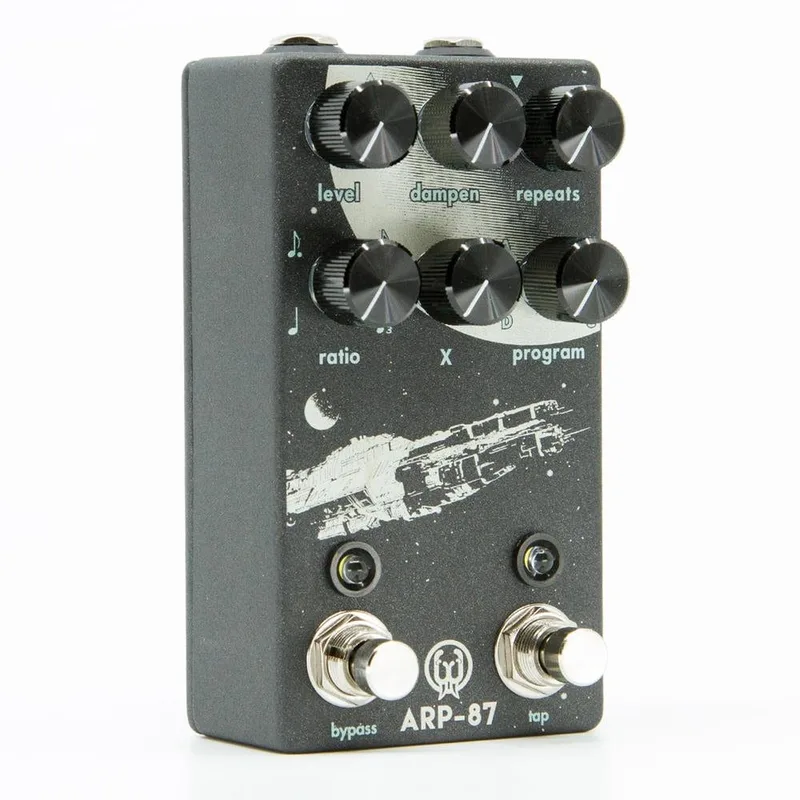
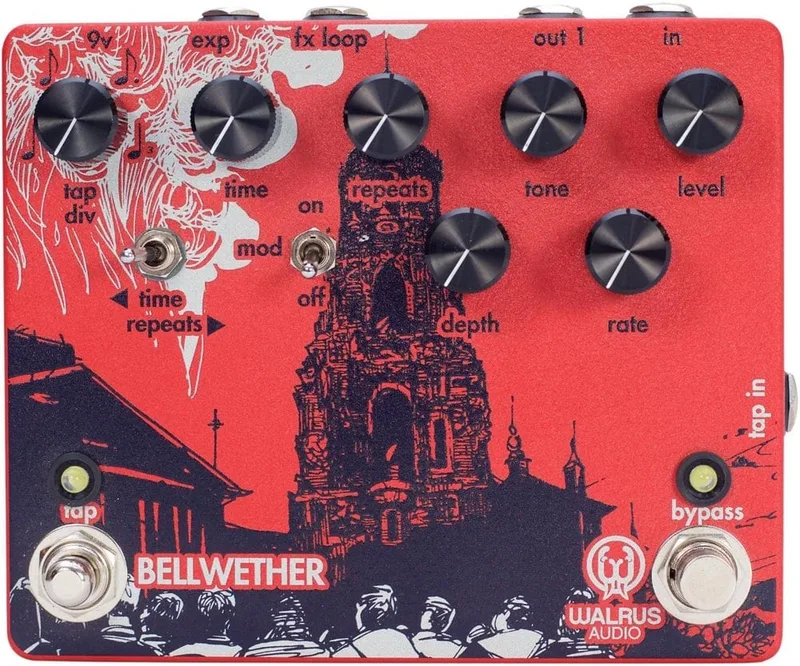
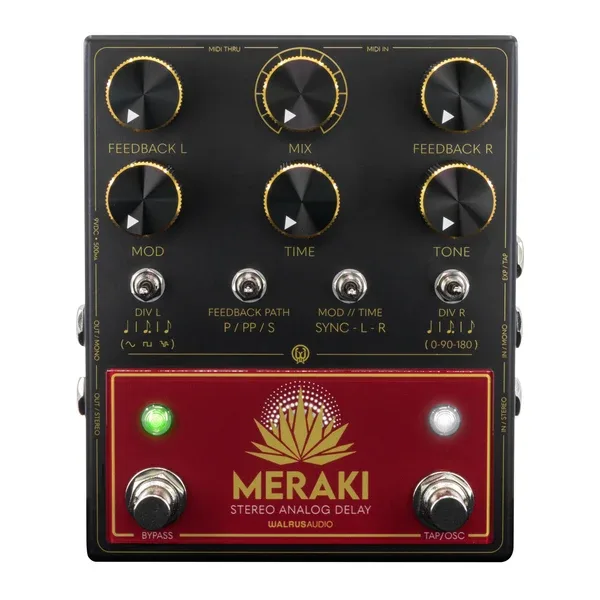
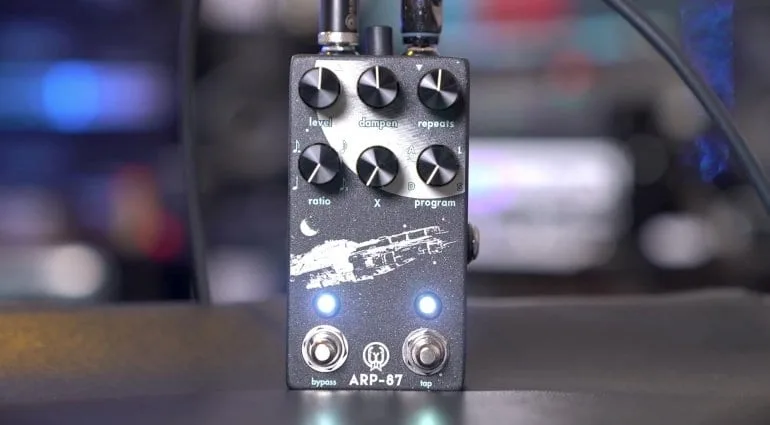
The D1 was "the first in the Mako series," and Walrus Audio has since revised the design in later versions of the pedal1. Players comparing this discontinued v1 with what followed can look at the current Mako Series D1 High-Fidelity Delay and the Mako Series MkII D1, or at other delays in the Walrus range such as the ARP-87 Delay, the Bellwether analog delay and the Meraki Stereo Analog Delay. For more on the effect type itself, see the site's Delay Pedals page.
Videos
Dickie's 90-Second Pedal Demos
Questions
Is the Walrus Audio Mako D1 v1 still made?
No. Walrus Audio lists the Mako D1 v1 as discontinued and no longer available. The pedal was the first in the Mako series, and the line has since moved on to later versions of the D1, so a player looking for this exact pedal would need to find it secondhand or look at the current Mako D1 models instead.
Does the Mako D1 have true bypass?
Yes, and it goes further than a simple true bypass switch. The D1 offers three bypass modes: True bypass, DSP+True Bypass (trails), and DSP Bypass. The trails option lets delay repeats ring out naturally after you switch the pedal off, which many players prefer on a delay.
Can the Mako D1 be used in stereo?
Yes. The D1 has stereo inputs and stereo outputs, so it can sit in a stereo rig or effects loop and pass a full stereo signal. It also accepts MIDI control, which pairs with its preset system for players who run a MIDI switcher or controller.
How many presets does the Mako D1 hold?
The D1 can save up to nine presets on the pedal itself. If you connect it to a MIDI setup, up to 128 presets become accessible, which suits players who organize their board around a MIDI controller and want more sounds than the onboard slots allow.
Can I power the Mako D1 with a battery?
No. The D1 requires a 9VDC power supply rated for at least 300mA, and Walrus Audio recommends using an isolated power supply for all of its pedals. A battery or a shared daisy-chain output that cannot supply the current is not suitable for this pedal.
What is the difference between the Mako D1 v1 and V2?
The v1 covered here was the first D1 in the Mako series, with five programs, stereo input and output, MIDI control, nine onboard presets and three bypass modes. Walrus Audio later released updated versions of the D1, so the v1 is the discontinued original in that line.
Sources (1)
- MAKO Series: D1 High-Fidelity Delay v1, Walrus Audio