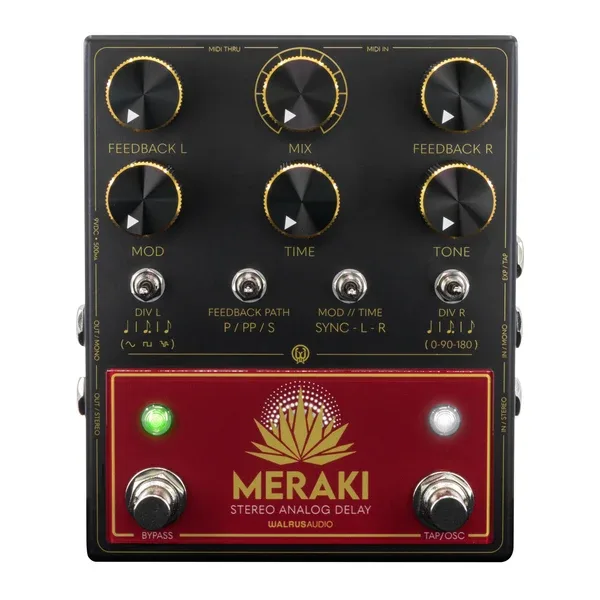


The Walrus Audio Meraki is a true stereo analog delay pedal built around eight MN3005 bucket brigade chips, the classic delay part used in vintage analog pedals. Where a single MN3005 gives a few hundred milliseconds of delay, the Meraki stacks eight of them to reach up to 1200ms per channel, with fully independent left and right delay lines12. Walrus Audio describes the result as "warm, rich repeats capable of 1200ms of delay time"1.
It is an analog delay with a digital control layer: the repeats themselves come from the bucket brigade circuit, while time, modulation, tap tempo and tap division can be manipulated digitally over five-pin MIDI1. The pedal carries six knobs, four toggle switches and two footswitches3, and joins Walrus Audio's Monarch series alongside the Mantle Analog Bass Preamp // D.I. and the Highpoint Analog Optical Compressor1. As of late October 2026, the maker's product page lists the Meraki as sold out1.
What the Meraki does
An analog delay stores your signal in bucket brigade chips, which pass it along in small steps and smear it slightly as it travels, giving the repeats a softer, darker character than a digital delay. The Meraki runs this in true stereo, with independent delay times and modulation for the left and right channels4. Gearnews described it at launch as "a true analog delay" with "eight MN3005 chips to produce warm, rich repetitions"2.
The long delay time is the headline. Guitar World noted "true stereo in/out jacks with fully independent delay lines" and a Time control rated between 80 and 1200ms81. Delicious Audio's buying guide called it "a super-tweakable stereo analog delay with modulation delivering repeats up to 1200 ms per channel"9.
The controls
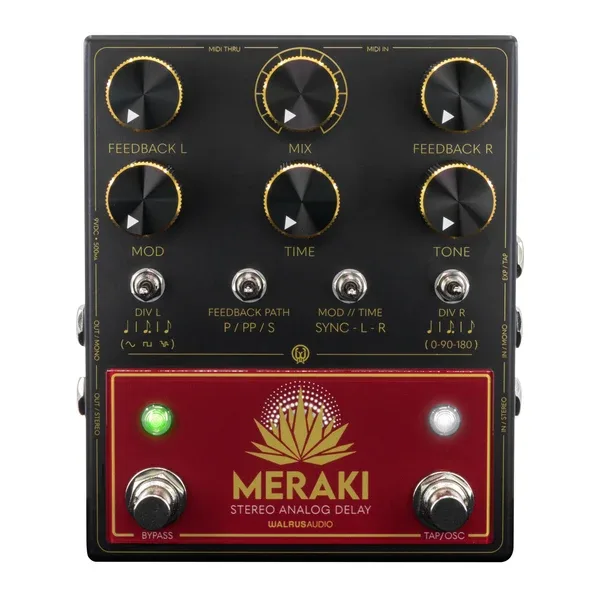
The Meraki's six knobs include separate Feedback controls for the left and right channels, with the other four handling Mix, Time, Tone and Modulation3. The maker's page describes what each does14:
| Control | What it does |
|---|---|
| Time | Sets delay time from 80ms to 1200ms |
| Mix | Blends wet and dry signals, with full wet/dry mix capability |
| Tone | Shapes the character of the repeats |
| Modulation | Sets modulation depth on the repeats |
| Feedback Left / Right | Fine-tunes repeats per channel, from subtle echoes to full oscillation |
The two footswitches are an on/off stomp and a Tap Tempo switch8. The Tap switch sets the delay time, and holding it ramps up the repeats and sends the pedal into self-oscillation1, which Pedal of the Day called "gloriously analog oscillation"10. The four toggle switches include the Feedback Mode switch and time division switches; the division toggles also have an alt function that picks from three modulation waveforms, sine, square and random, with 0, 90 or 180 degrees of phase shifting3.
Parallel, ping-pong and series modes
The Feedback Mode switch selects between three delay line configurations: Parallel, Ping-Pong and Series1. Delicious Audio details how each routes the feedback3:
- Parallel: The left and right feedback paths operate independently, with each channel's repeats feeding back only into its own input.
- Ping-Pong: The feedback alternates between the left and right inputs, creating a back-and-forth bouncing effect between the two sides.
- Series: The left channel's repeats feed into both its own input and the input of the right delay line, while the right channel's repeats feed its own input and incorporate the left channel's feedback.
Delicious Audio's buying guide also notes a desynch mode that lets you run the two channels with completely different settings9. Because the Feedback Left and Right knobs are separate, the two channels can carry different repeat amounts in any mode1.
Power and connections
The Meraki runs on 9V DC, center negative, with a 500mA minimum supply1. RockBoard's PedalPedia lists the actual current draw as 357mA5. Walrus Audio recommends an isolated power supply for all its pedals and does not recommend daisy chains2.
At 357mA drawn and a 500mA minimum supply rating, the Meraki needs a dedicated output on a power brick. A typical 100mA daisy chain output will not run it.
Connection options go well beyond in and out jacks. Five-pin MIDI In and Thru lets you digitally manipulate time, modulation, tap tempo, tap division and more12. An expression pedal input gives control over time or modulation depth, and there is an external tap option alongside the Tap Tempo footswitch1. Bypass is switchable: true bypass, or buffered bypass for trails, with a Bypass switch toggling between Trails (the default, letting repeats ring out after bypass) and Relay (no trails)1. MusicRadar confirmed "you can run the Meraki as buffered or true bypass"11.
History and versions
The Meraki first appeared in late 2023 as a blacked-out limited edition, released through a Reverb.com special under Reverb's multi-builder 2023 Blackout Series initiative3. MusicRadar reported that "it was available as a Black Friday special, but now takes a regular spot in the Walrus line up of effects"6. The regular version ships in a matte black enclosure with gold ink1, where the Blackout edition was fully blacked out3.
Pricing has moved since launch. Gearnews listed it at $599.00 in November 20232, MusicRadar noted "$599" in March 2024267, and an April 2026 gearnews price survey showed $629.007.
What reviewers said
Reviewers focused on how far the Meraki pushes the analog delay format. Pedal of the Day wrote that it "pushes the very boundaries of analog delay sound AND functionality, with more delay time" and a modern feature set10. Gearnews' verdict at launch was mixed on price but positive on the package:
"But the whole thing in stereo, with Tap Tempo, MIDI, and all these possibilities in a compact housing is great. It is pretty expensive, though if you like delay, then it will be worth it."
MusicRadar included the Meraki in its roundup of must-have new guitar effects pedals of 20249. Walrus Audio covers the pedal, like all its products, with a limited lifetime warranty1.
Videos
Sweetwater
walrusaudioeffects
walrusaudioeffects
News
Questions
Does the Walrus Meraki have MIDI?
Yes. The Meraki has five-pin MIDI integration, with MIDI In and Thru connections. MIDI can be used to digitally manipulate controls including time, modulation, tap tempo and tap division, which lets you automate the pedal from a controller or switcher rather than bending down to turn knobs.
What is the delay time range of the Walrus Meraki?
The Time control sets delay time from 80ms to 1200ms, and the pedal is capable of up to 1200ms of delay per channel. That range is long for an analog bucket brigade delay, which is part of why the pedal needs eight MN3005 chips to get there.
Can the Meraki be set to buffered bypass?
Yes. The Meraki can run as true bypass or buffered bypass, and a Bypass switch toggles between Trails mode, the default, which lets repeats continue after you disengage the pedal, and Relay mode, which cuts everything off immediately.
Does the Walrus Meraki have tap tempo?
Yes. There is a Tap Tempo footswitch for setting the delay time, and you can also use an external tap switch or an expression pedal for control over time or modulation depth. Holding the Tap switch ramps up the repeats and sends the pedal into self-oscillation.
Can the Meraki self-oscillate?
Yes. The Feedback Left and Right controls go from subtle echoes to full oscillation, and holding the Tap switch ramps up the repeats and sends the pedal into momentary self-oscillation, a classic bucket brigade trick you can use for swells and noise.
How many bucket brigade chips are in the Walrus Audio Meraki?
Eight. The Meraki uses eight MN3005 bucket brigade delay chips, the same part found in many classic analog delays. Multiple chips are needed to reach its 1200ms maximum delay time in true stereo with independent left and right delay lines.
Sources (11)
- Meraki Stereo Analog Dual Delay, Walrus Audio
- Walrus Audio Meraki Stereo Delay, gearnews.com, 2023-11-17
- Walrus Audio Meraki Stereo Analog Delay, Delicious Audio, 2025-07-22
- Deep Six Compressor Stomp Box, Walrus Audio
- Meraki Stereo Analog Delay by Walrus Audio, RockBoard (PedalPedia), 2026
- Bored of your 'board? Stomp this way for the must-have new guitar effects pedals of 2024, MusicRadar, 2024-03-28
- Walrus Audio Highpoint: Studio Grade Analog Optical Compressor, gearnews.com, 2026-04-21
- “A passion project nearly two years in development”: Walrus Audio debuts the Meraki, the world's only stereo analog dual delay, Guitar World, 2024-01-18
- 2023 UPDATE: The Best Analog Delay Pedals (Mono & Stereo), Delicious Audio, 2024-01-04
- Walrus Audio Meraki Stereo Analog Delay, Pedal of the Day, 2024-01-18
- NAMM 2024: “Cozy up and immerse yourself in true stereo analogue delay”, MusicRadar, 2024-01-22