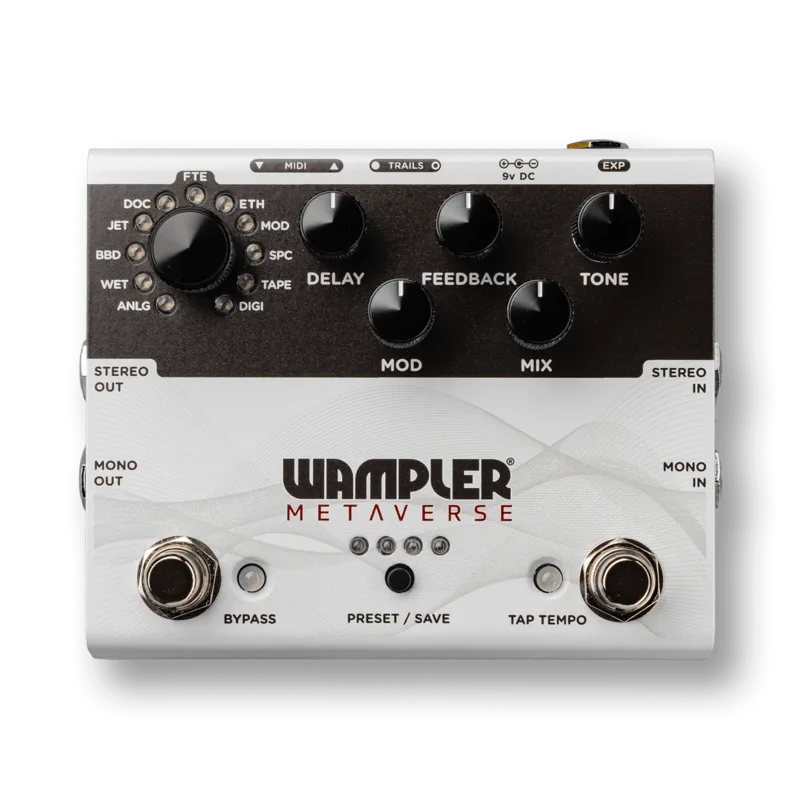


The Wampler Metaverse is a digital multi-delay pedal from Wampler Pedals, built as a studio- and stage-ready DSP unit with eleven delay programs in one compact enclosure1. Announced in June 2022, it packs analog-style, bucket brigade, tape, flanger and digital delay algorithms alongside recreations of several Wampler pedals, with presets, stereo I/O, MIDI and an expression input2. It currently lists at $299.971.
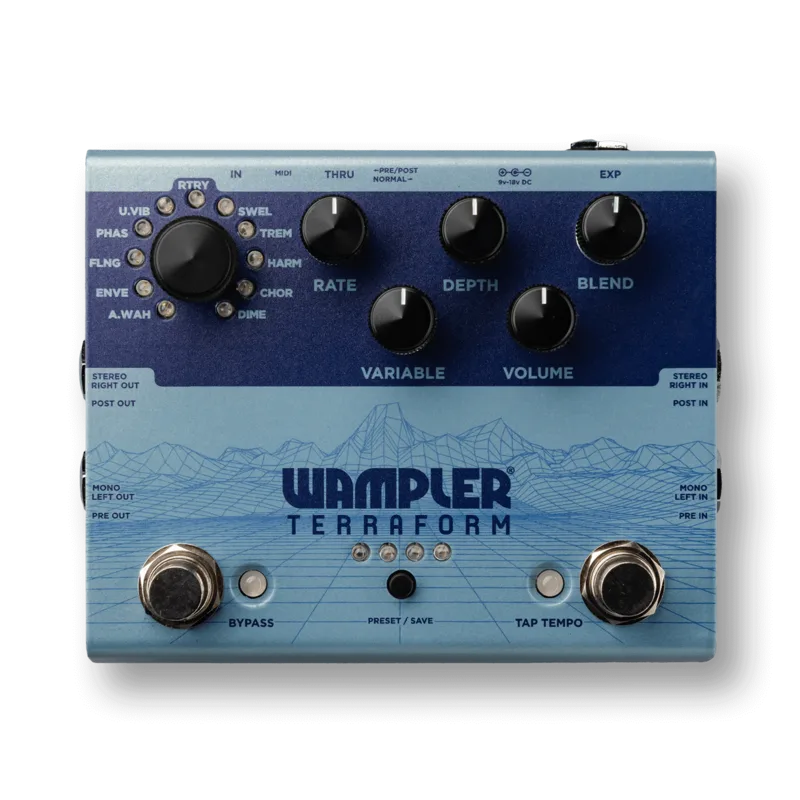
The idea behind the pedal is simple: instead of choosing one delay circuit, you get eleven of Brian Wampler's favorite delays in a single box, each selected by a rotary controller and adjusted by a shared set of knobs1. Guitar World described the relationship to Wampler's earlier multi-effect pedal plainly: "the Metaverse does for delay what Wampler's Terraform did for modulation"3.
The eleven delay programs
The Metaverse's primary rotary controller selects between the eleven onboard delays, which Wampler calls Programs1. Each is a distinct algorithm hand picked by Brian Wampler1, and several are drawn from Wampler's own pedal line.
| Program | Delay type |
|---|---|
| ANLG | Analog style delay |
| WET | Modulated analog delay |
| BBD | Bucket brigade delay |
| JET | Analog flanger delay |
| DOC | Wampler 'The Doctor' |
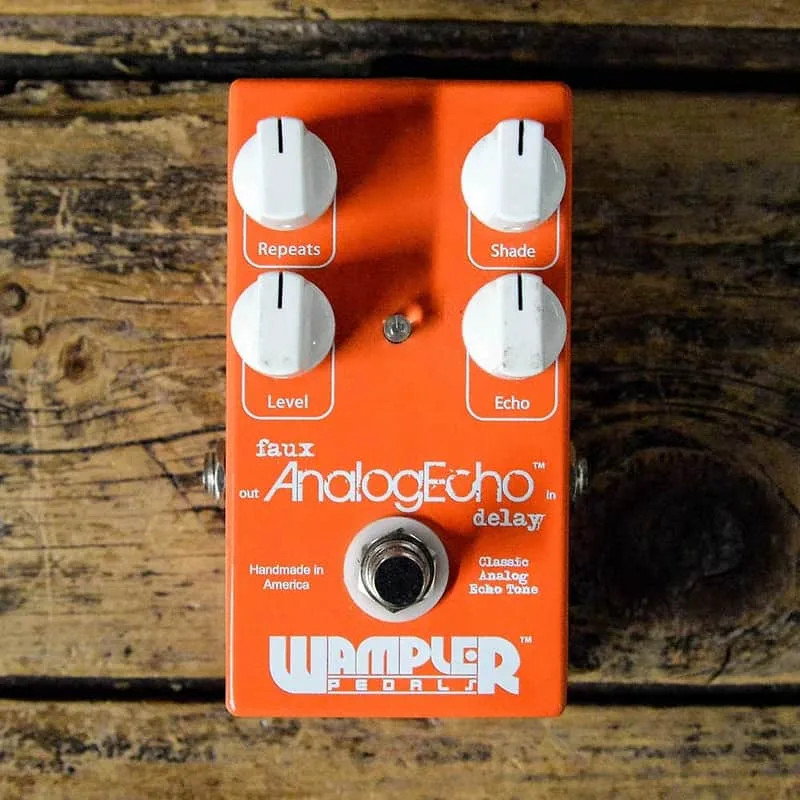
| FTE | Wampler 'Faux Tape Echo' |
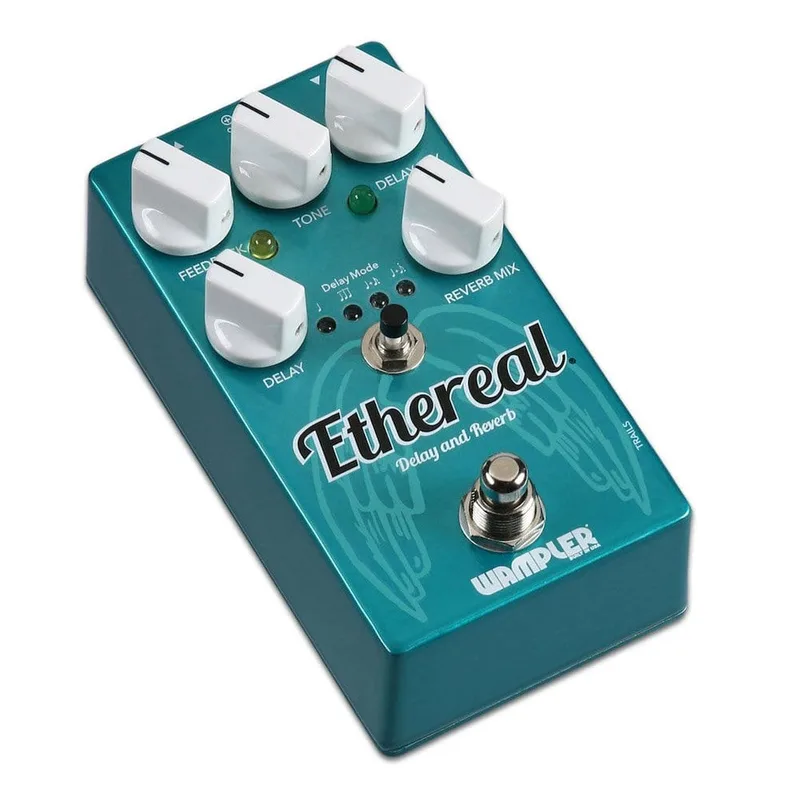
| ETH | Wampler 'Ethereal' delay |
| MOD | Digital flanger delay |
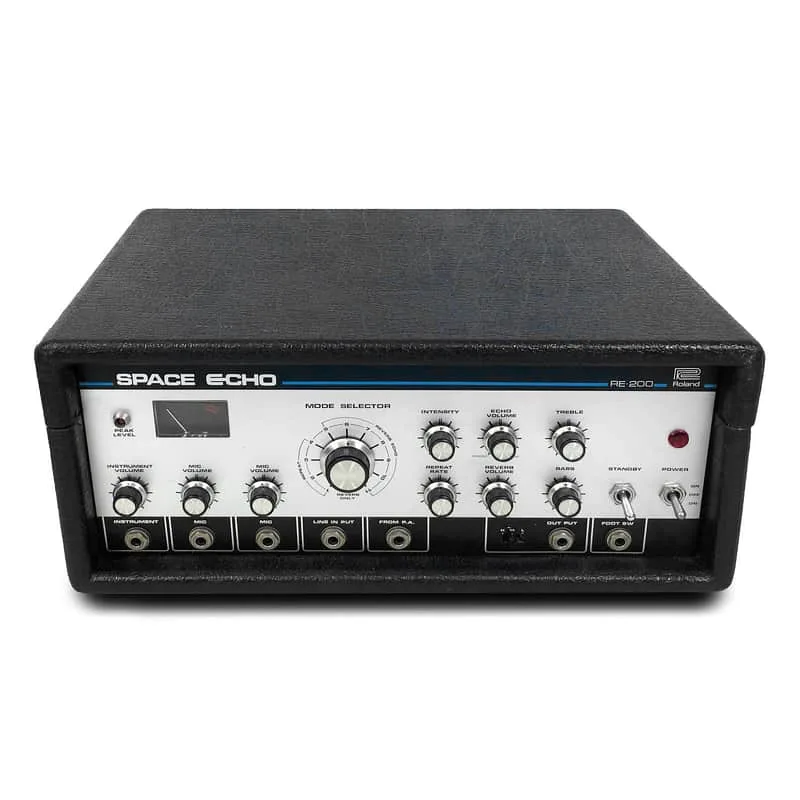
| SPC | Space echo delay |
| TAPE | Multi-head tape delay |
| DIGI | Digital delay |
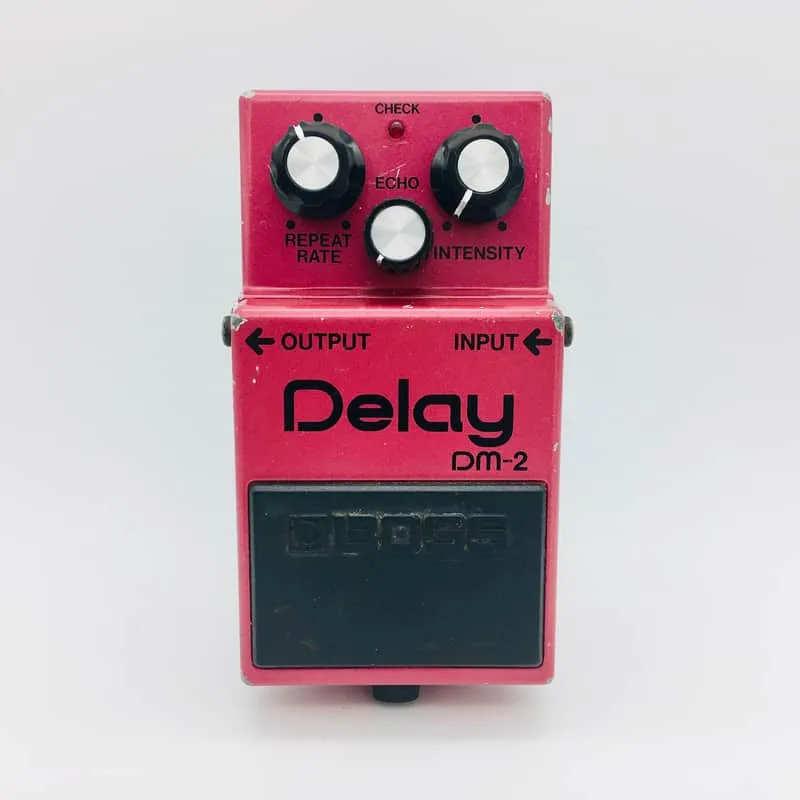
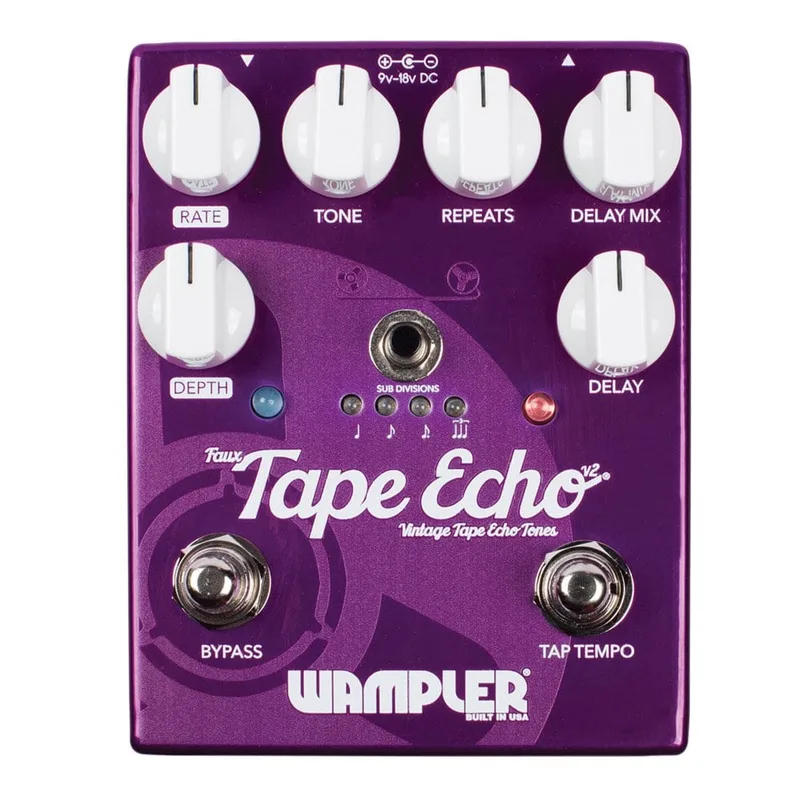
The ANLG program has a documented lineage: Premier Guitar reported that it "was inspired by Brian's love of the Boss DM-2 analog delay," and that it "gives you that kind of dark, smooth, analog delay that would have been found in the mid-1980's"2. MusicRadar carried the same description at the pedal's announcement5. The FTE program recreates the Wampler Faux Tape Echo, and ETH draws on the Wampler Ethereal reverb and delay pedal4.
The controls
The control surface follows the pattern Wampler established with the Terraform: five common parameter controls adjust the settings for each of the different algorithms, so the knobs do the same kind of job whichever program you select1. The primary rotary controller chooses the program itself1.
The pedal has two footswitches, one of which is dedicated to tap tempo3. The tap tempo switch supports selectable subdivisions and MIDI Clock sync6. An expression pedal input is assignable to any parameter2, and the manual documents MIDI CC 100 as emulating the expression pedal input, so a MIDI controller can sweep a parameter the same way a physical expression pedal would6.
Presets are handled with 8 onboard preset locations, with 128 total available via MIDI1. Wampler itself points out the advantage over its single-sound delay pedals: on the Faux Tape Echo v2 product page the maker notes "I wish it had presets, but the Metaverse does that"7.
Power, MIDI and connections
The Metaverse runs on 9V DC with a center pin negative plug, external supply only, drawing 130mA at 9V1. There is no battery option, and the 130mA draw is worth noting if you run a compact power supply.
External 9V DC supply only: the Metaverse cannot run on a battery, and its 130mA draw should be checked against your power supply's per-output rating1.
Connections are true stereo or mono1, with full MIDI control using CC and PC commands2. MIDI is implemented via mini-TRS jacks4. By default the pedal is set to Omni Channel mode, which means it will accept a MIDI command on any MIDI channel6.
Setting a specific MIDI channel is done through a hidden procedure documented in the manual6:
- Power off the device, press and hold the Preset Switch, and power the device on.
- After power up, release the switch: the Preset LEDs show the current MIDI channel, corresponding to 1 to 16, with no LEDs lit meaning Channel 1.
- Press the Preset Switch to increment through the channel options; all LEDs blinking is Omni mode.
- Hold the Preset Switch for one second to save the setting.
Designed by Brian Wampler as the delay counterpart to the Terraform
The Metaverse was designed by Brian Wampler, whose product page describes it as "comprising eleven of Brian Wampler's favorite delays"1. It follows on from the Terraform, Wampler's multi-modulation pedal, which also featured eleven custom designed effects4. Wampler's own page makes the lineage explicit: "Just like the Terraform that came before it, the Metaverse is an advanced, feature-packed pedal"1.
The pedal was announced around NAMM 2022, with guitar.com, MusicRadar, Gearnews and Guitar World all reporting it on 27 June 2022 at a retail price of $349.974853. Guitar World noted a street price of $/£3493. Delicious Audio later described it as Wampler's second digital multi-mode pedal, in a "pedalboard friendly enclosure with minimal footprint"9.
Videos
Pete Thorn
Sweetwater
AndyDemos
Questions
How many presets does the Wampler Metaverse have?
The Metaverse has 8 onboard preset locations for saving your favorite patches, and 128 total presets are available via MIDI. The onboard presets are selected with the Preset Switch, which also handles saving the MIDI channel when you hold it while powering the pedal on.
Is the Wampler Metaverse stereo?
Yes. The Metaverse offers true stereo or mono I/O, so you can run it in mono on a simple pedalboard or feed it stereo input and take stereo output for wider delay spreads. It also has full MIDI control and an expression input assignable to any parameter.
How do you set the MIDI channel on the Wampler Metaverse?
Power the pedal off, press and hold the Preset Switch, and power it on. After it powers up, release the switch: the Preset LEDs show the current MIDI channel, 1 to 16, with no LEDs lit meaning Channel 1. Press the Preset Switch to increment through channels, and hold it for one second to save. All LEDs blinking is Omni mode.
What is the maximum delay time on the Metaverse?
All programs use a continuous delay range of 25 to 2000 milliseconds, with the exception of the TAPE program, which starts at 40 ms. So the maximum delay time is 2 seconds on every program, and the TAPE multi-head tape program has a higher minimum.
How many delay types does the Wampler Metaverse have?
Eleven. The programs are ANLG, WET, BBD, JET, DOC, FTE, ETH, MOD, SPC, TAPE and DIGI, each a distinct delay algorithm hand picked by Brian Wampler. Several are based on existing Wampler pedals, including the Faux Tape Echo, the Doctor and the Ethereal.
How many presets can the Metaverse store?
It stores 8 presets onboard and 128 total via MIDI. That makes it usable as a simple stompbox with a handful of saved sounds, or as a fully MIDI-switched delay workstation on a larger rig.
Sources (9)
- Metaverse, Wampler Pedals, 2026-08-16
- Wampler Introduces the Metaverse Delay, Premier Guitar, 2022-06-27
- Welcome to Wampler's Metaverse, a programmable multi-delay pedal with a whopping 11 core sounds, Guitar World, 2022-06-27
- Wampler announces new multi-delay, The Metaverse, guitar.com, 2022-06-27
- The new Wampler Metaverse might be the only delay pedal you'll need, MusicRadar, 2022-06-27
- Voes | MIDI-CC, Voes, 2024
- Faux Tape Echo v2, Wampler Pedals, 2026-08-18
- Wampler Metaverse programmable multi-delay, gearnews.com, 2022-06-27
- Wampler Metaverse Multi-Delay, Delicious Audio, 2022-11-28