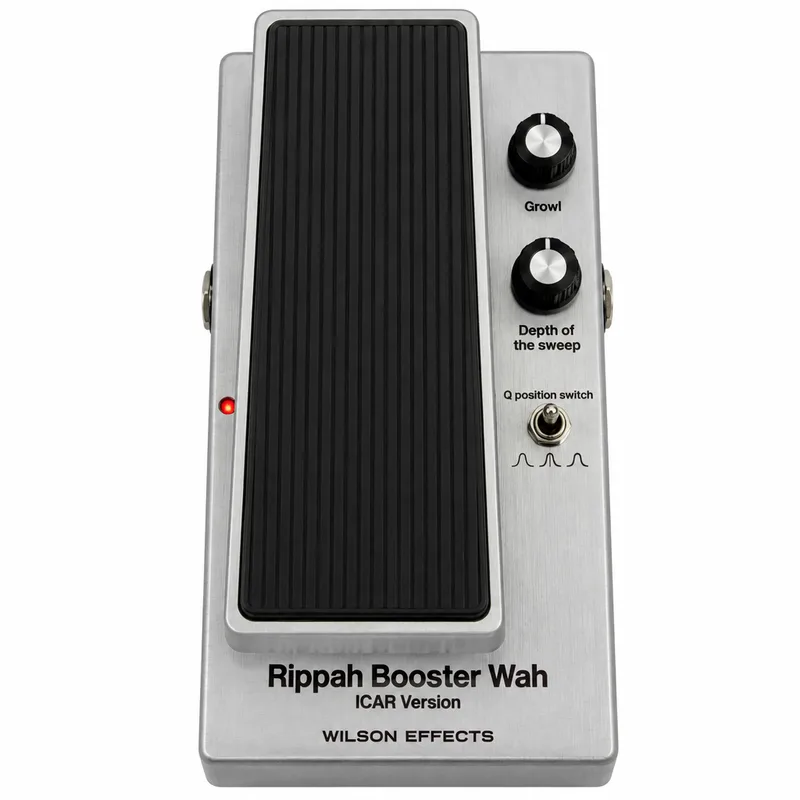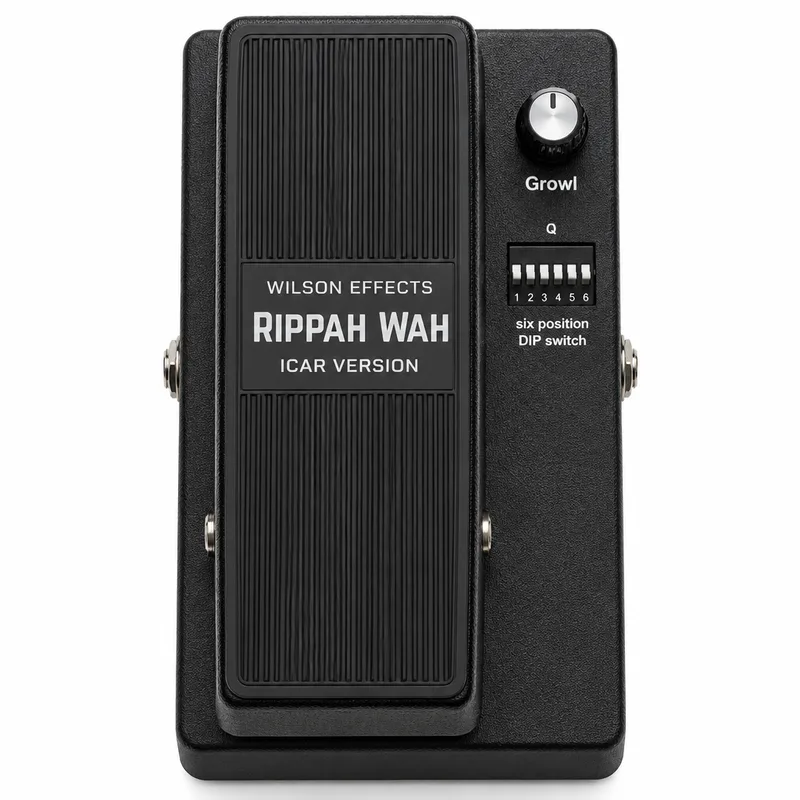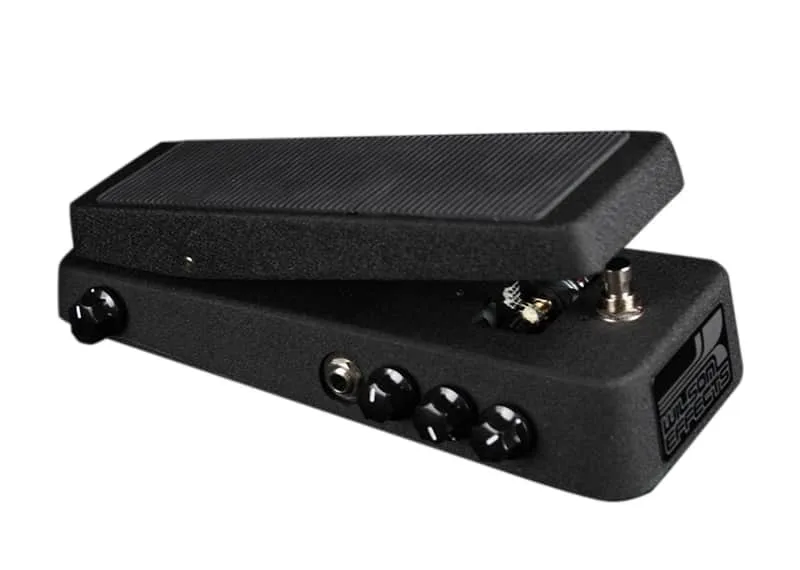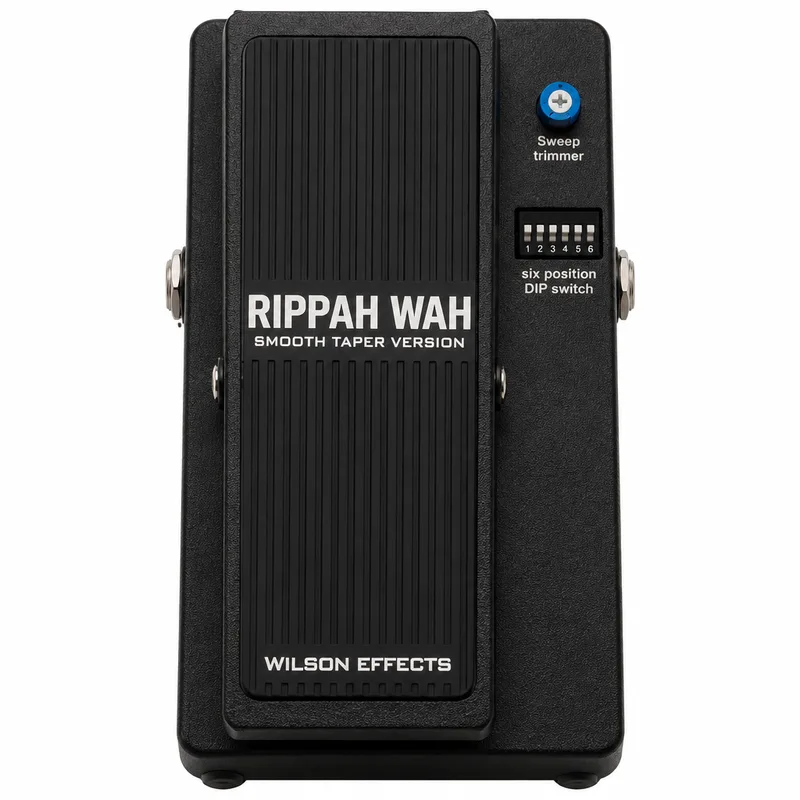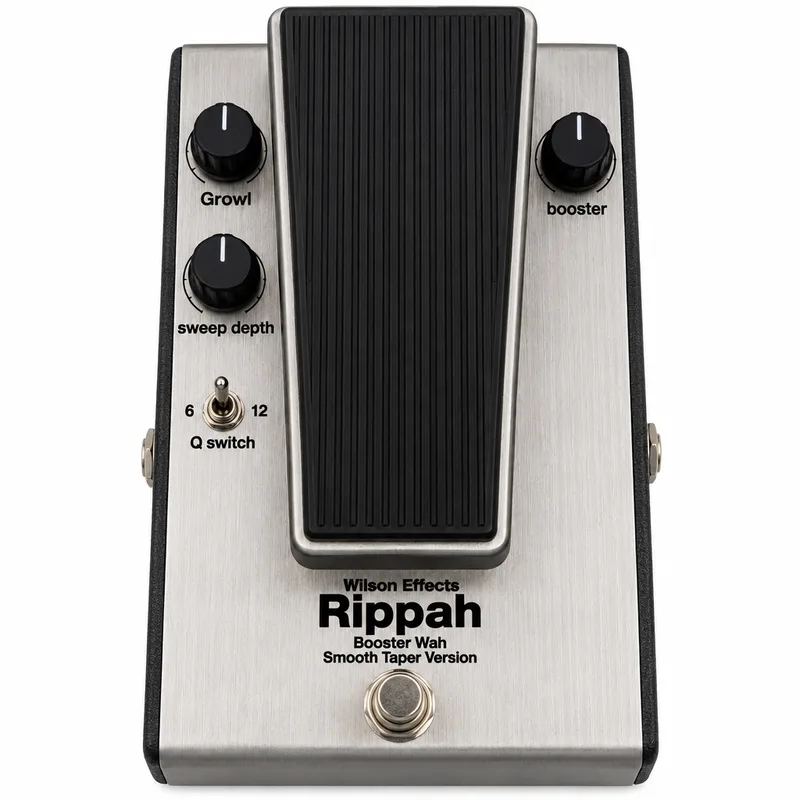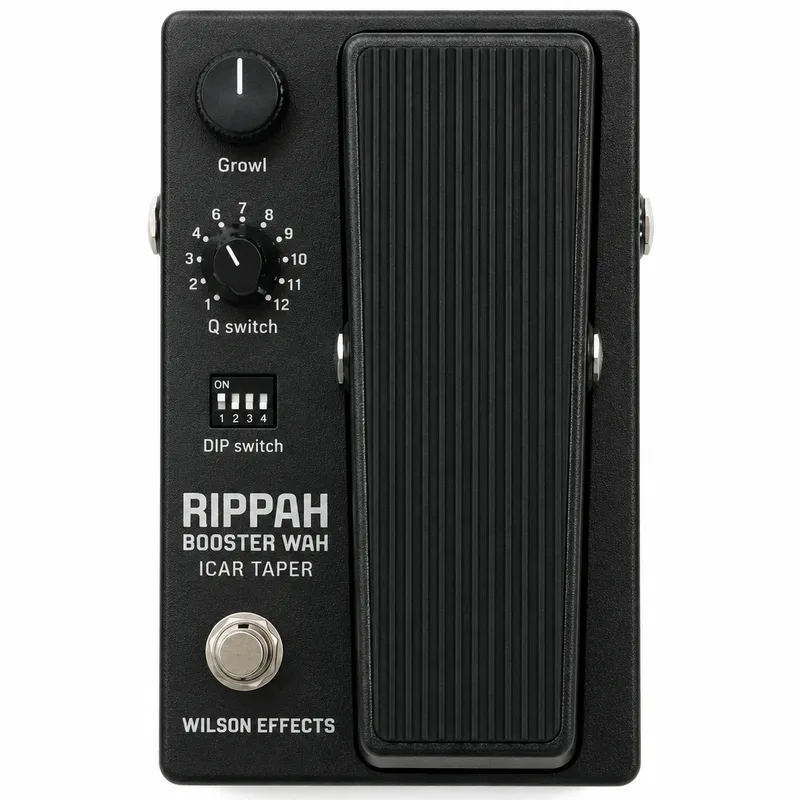


The Wilson Effects Rippah Booster Wah ICAR Taper is a wah pedal with a built-in booster, built around a faithful reproduction of the vintage Maestro Boomerang wah circuit with what Wilson Effects calls "tons of tuning options"1. What sets it apart from a standard wah is the low end: Wilson Effects says the Rippah Booster Wah has "a more pronounced throat and growl in the low end, making it ideal for cutting through a mix" where standard wah circuits do not1.
The ICAR Taper version gets its name from its potentiometer. It uses a Wilson Effects vintage taper wah pot "precisely modeled after a vintage ICAR taper pot" for what the maker describes as an authentic sweep and response1. ICAR was the brand of pot found in many classic vintage wahs, and the taper of that pot, the way its resistance changes as you rock the treadle, is a big part of how those wahs feel underfoot.
What it does to your sound
The core circuit is the vintage Maestro Boomerang wah, the same circuit behind the non-booster Rippah Wah. On top of that, the Booster Wah adds a volume boost and a wider set of tuning controls. Wilson Effects positions it for players who want a wah that pushes harder in the low register: the maker describes "a little more throat and growl in the low end which makes it ideal for the player that really wants to cut through the mix"4.
The pedal also carries a fuzz-friendly output buffer on the Smooth Taper side of the family, which Wilson Effects says "allows your wah to work seamlessly with most fuzz and overdrive pedals"3. That matters if you run a fuzz or overdrive after the wah, a pairing that many vintage-style wah circuits struggle with.
The controls
The Rippah Booster Wah puts most of its tuning inside the enclosure, in the form of trimmers and switches you set once and then play.
| Control | What it does |
|---|---|
| 12-Position Q Switch | Shapes the Q range, from deep, synth-like growls to sharp, envelope-filter-like tones1 |
| Sweep Control | At the front of the pedal; adjusts the depth of the wah sweep. Maxing it out adds throatiness, dialing it back softens the effect1 |
| Internal volume (boost) trimmer | A small blue trimmer inside the pedal; sets the output at unity gain or boosts it for leads14 |
| Six-position DIP switch | On the main board; adjusts the Q position of the wah5 |
The Q position switch is the headline control. Wilson Effects describes it as letting you "adjust the position of the Q in the sweep. You can adjust it to a deep synth like growl to a high almost envelope filter type of sound"4. In practice that means you can move the peak of the wah sweep low for a thick, vocal growl, or high for a sharper, more vocal-envelope cry.
The boost trimmer
Inside the pedal is a small blue trimmer that acts as the output volume control. Wilson Effects says you can set it at unity gain or boost it for searing lead levels1. The maker is specific about its purpose: the boost was incorporated "to allow the user to overcome any loss of volume that may occur at these settings," meaning extreme Growl settings, and to let you set the wah above unity gain so it cuts through the mix in live situations3.
The DIP switch and the 12 positions
The six-position DIP switch on the main board adjusts the Q position of the wah5. The Q position switch itself comes in six or twelve position versions depending on the model you choose46. The twelve-position version, sold as the 12 Position Rippah Booster Wah, gives you finer steps through the same range, from deep synth-like growl to a high, almost envelope-filter sound47.
Wilson Effects also fits three blue trimmers, or "trim pots," inside its Rippah wahs, adjustable with a small flathead or Phillips screwdriver, each tuning a different parameter of the wah5. One of these, the Sweep trimmer, controls the range or depth of the sweep: turning it broadens the spectrum and adds more throat, or thins it out for upper and midrange frequencies5.
Power and connections
The Rippah Booster Wah operates on a standard 2.1mm center-negative 9VDC power supply or a high-quality alkaline 9V battery13. That is the same connector and polarity as the vast majority of effects pedals, so it runs from a typical pedalboard power supply without an adapter. The battery option means it also works standalone.
Wilson Effects specifies a regulated 9VDC supply for the Rippah family3. As with any wah with internal trimmers, open the enclosure before you power it from a supply you have not used with it before, and check the polarity marking on the pedal.
ICAR and Smooth Taper versions and finishes
The Rippah Booster Wah is available in two pot options, each in two finishes1:
- ICAR taper pot: the Wilson Effects vintage taper pot, modeled after a vintage ICAR taper pot, for the classic sweep and response1
- Smooth Taper pot: maintains a smoother transition through the sweep of the Q range1
- Black Powder finish: the traditional finish1
- Brushed Aluminum finish: the newer alternative1
That gives four combinations: ICAR or Smooth Taper, in Black Powder or Brushed Aluminum. The Brushed Aluminum Rippah Booster Wah ICAR Taper lists at $240.00 USD as of 19 October 20262. The same choices exist across the Rippah family, including the non-booster Rippah Wah and its ICAR and Smooth Taper versions, and the Rippah Booster Wah Smooth Taper Version18.
The difference between the two pots comes down to feel. The ICAR taper reproduces the response of the pots in vintage wahs, with their characteristic jump in the sweep. The Smooth Taper pot, as the name suggests, keeps the transition through the Q range smoother and more even1. Players who want the vintage feel underfoot choose ICAR; players who want a more predictable, even sweep choose Smooth Taper.
Where it came from
The Rippah Booster Wah traces back to the Maestro Boomerang, a vintage wah circuit that Wilson Effects reproduces faithfully as the core of the Rippah line1. The Booster Wah takes that circuit and adds the low-end growl, the internal boost and the Q-switch tuning options on top of it1. Wilson Effects is a small maker that builds its wahs with the trimmer-and-switch approach seen across its range, from the Freaker Wah V2 to the Ten Spot II V.37.
Videos
Wilson Effects
Wilson Effects
Brett Kingman
Questions
What does the boost trimmer on the Rippah Booster Wah do?
It is an internal blue trimmer that sets the output volume. You can leave it at unity gain or turn it up to boost the pedal for lead parts. Wilson Effects says it was added to overcome any volume drop at extreme Growl settings and to help the wah cut through the mix live.
What does the DIP switch on the Rippah Wah change?
The six-position DIP switch on the main board adjusts the Q position of the wah. It ships with position one ON as the stock setting, and the other positions range from very subtle to very drastic changes to where the Q sits in the sweep.
Does the Rippah Booster Wah take a battery?
Yes. Wilson Effects says the pedal runs on a high-quality alkaline 9V battery as well as an external power supply, so it works on a pedalboard or standalone.
What power connector does the Rippah Booster Wah use?
A standard 2.1mm center-negative 9VDC power supply, the same connector most effects pedals use, so it fits a typical pedalboard power brick.
What finishes does the Rippah Booster Wah come in?
Two: the traditional Black Powder finish or a Brushed Aluminum finish. Each is available with either the ICAR taper pot or the Smooth Taper pot, giving four combinations in total.
Sources (8)
- Rippah Booster Wah, Wilson Effects
- Brushed Aluminum Rippah Booster Wah ICAR Taper, Wilson Effects, 2026-10-19
- Rippah Wah Smooth Taper Version, Wilson Effects
- Rippah Booster Wah ICAR Version, Wilson Effects
- Rippah Wah ICAR Version, Wilson Effects
- Rippah Booster Wah Smooth Taper Version, Wilson Effects
- 12 Position Rippah Booster Wah, Wilson Effects
- Rippah Wah, Wilson Effects