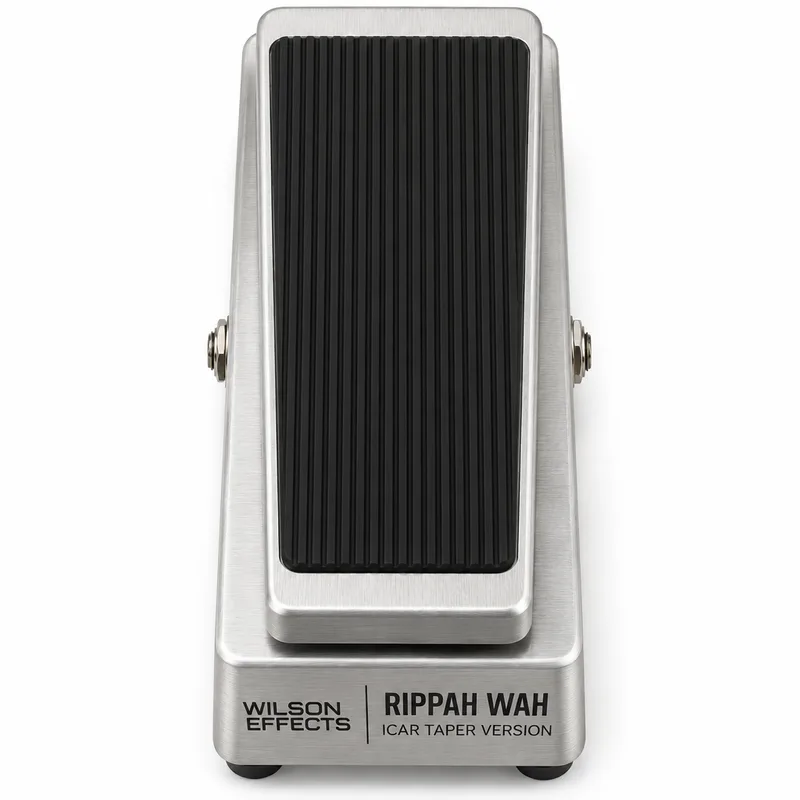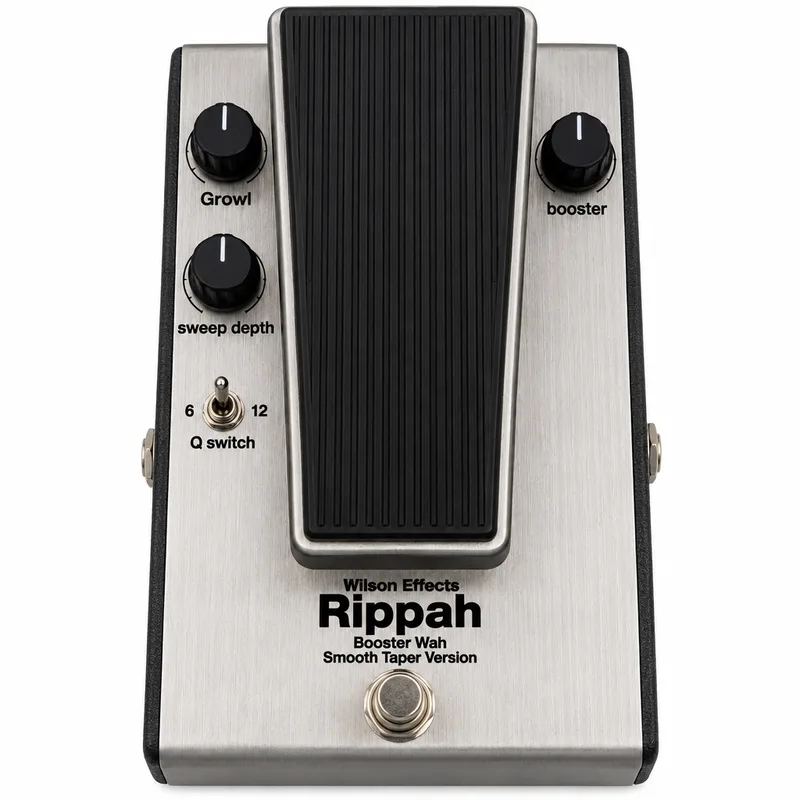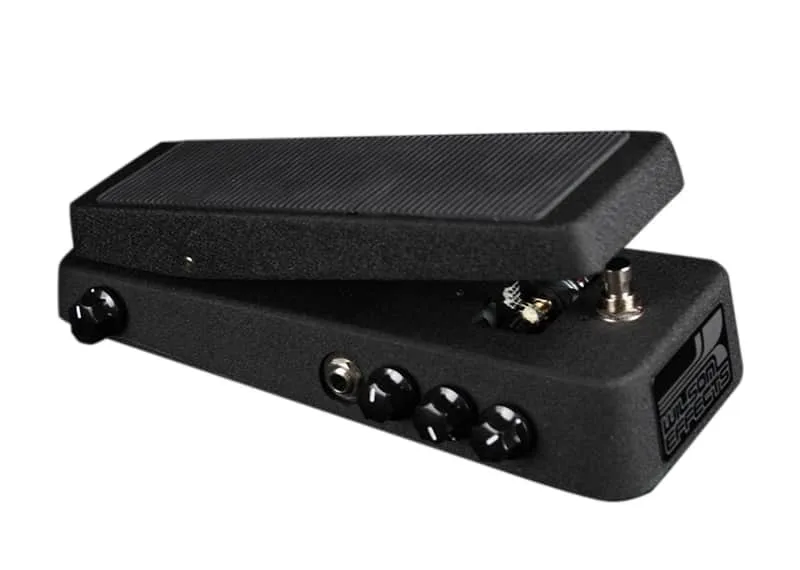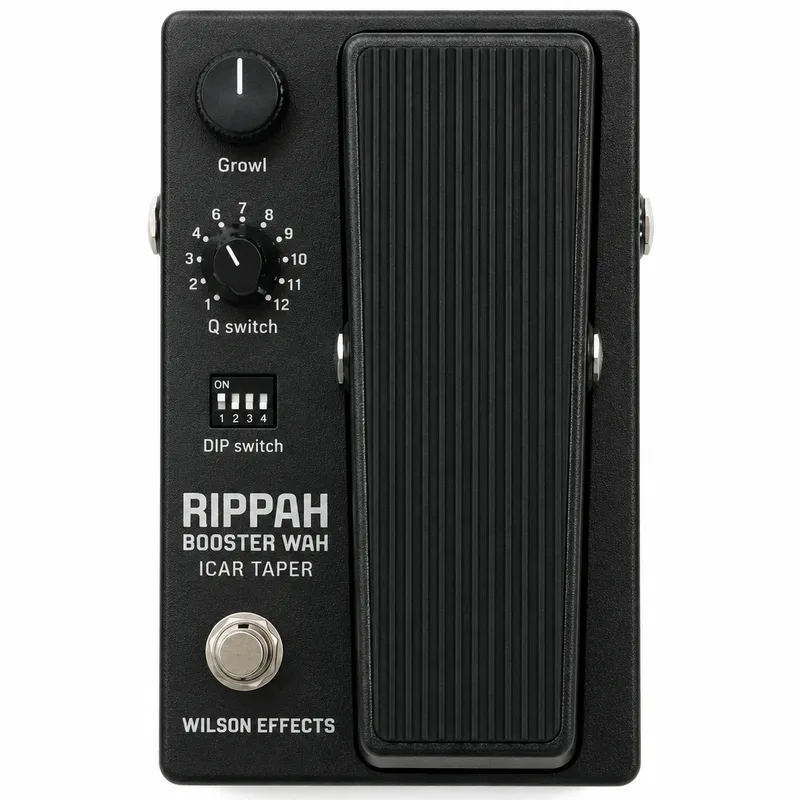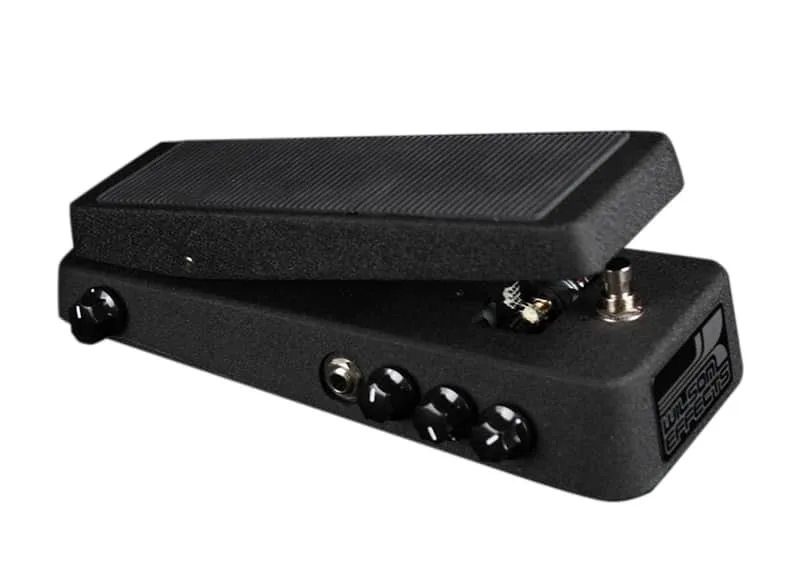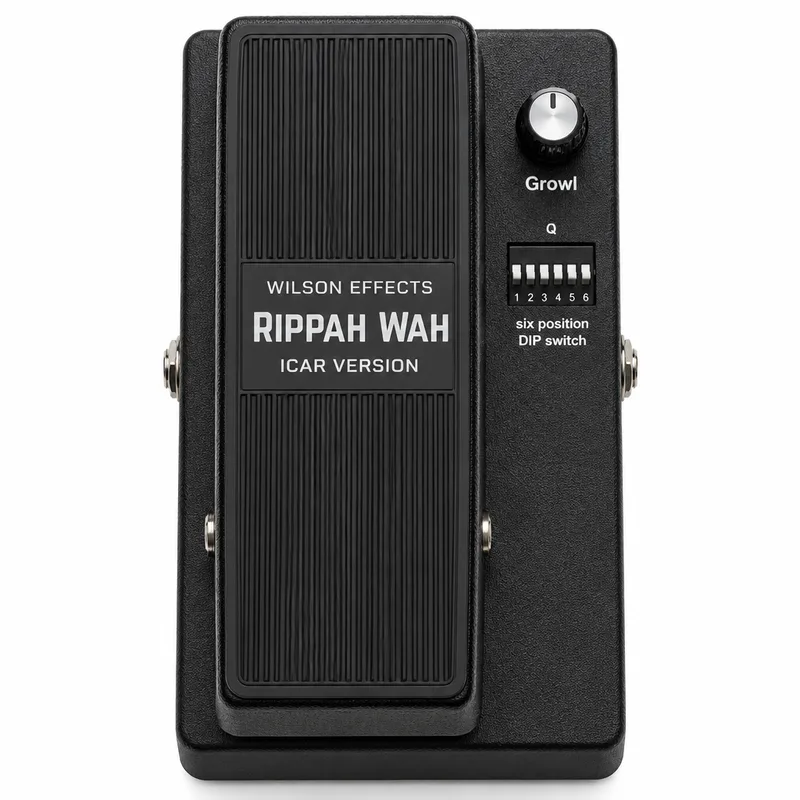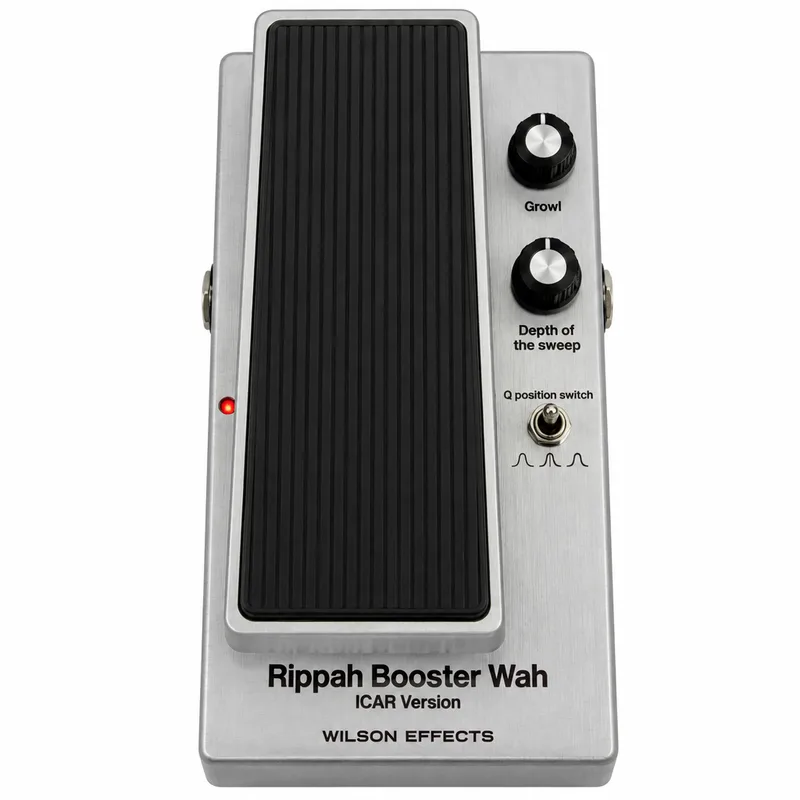


The Wilson Effects Rippah Booster Wah ICAR Version is a wah pedal with a booster, built in the U.S.A. by Wilson Effects. Its core circuit is a faithful reproduction of the vintage Maestro Boomerang wah, and Wilson Effects describes its voicing as having a little more throat and growl in the low end than an average wah circuit, which the maker says makes it ideal for a player who wants to cut through the mix12. The ICAR version carries a Wilson Effects vintage taper wah pot, precisely modeled after a vintage ICAR taper pot for an authentic sweep and response2.
Every Rippah Q-Wah also comes standard with a built-in fuzz buffer, so the pedal works just as well in front of a fuzz pedal as it does elsewhere in the chain1. The ICAR version lists at $240.00 USD1.
Controls and the built-in buffer
The Rippah Booster Wah is tuned through a mix of external knobs, a Q position switch, and internal trimmers. Wilson Effects describes the controls as follows1:
| Control | Location | What it does |
|---|---|---|
| Depth of the sweep | Front of the pedal | Dials in how deep the sweep goes; subtle from midpoint to max, adds more throat when maxed out1 |
| Growl knob | Heel of the pedal | Adjusts the amount of bass and gain in the circuit1 |
| Q position switch | On the pedal | Moves the position of the Q in the sweep, from a deep synth-like growl to a high, almost envelope-filter type of sound1 |
| Internal volume trimmer | Inside the pedal | A small blue trimmer that controls the output, settable at unity gain or boosted1 |
The volume control is not on the outside of the pedal. Wilson Effects describes the internal blue trimmer as a volume control for the output, allowing you to set it at unity gain or boost it for searing leads2. On the related Rippah Wah, the maker describes the boost trimmer's purpose in more detail:
"The Boost control was incorporated to allow the user to overcome any loss of volume that may occur at these settings6."
Wilson Effects product page6
The same page notes the boost can also push the front end of a tube amp for enhanced presence in a mix, though it is not intended to overdrive a clean amp6.
The built-in fuzz buffer is a standard feature of every Rippah Q-Wah. Wilson Effects says this means the pedal will work just as well in front of a fuzz pedal as it will after one7. On the Rippah Wah pages the maker describes it as a fuzz friendly output buffer that lets the wah work seamlessly with most fuzz and overdrive pedals, avoiding common impedance issues86. For players running fuzz or overdrive, this addresses the loading problem that can make a wah sound thin or choked in front of those pedals.
Power, bypass and connections
The Rippah Q-Wah operates off of a 2.1mm center negative power supply or a high quality alkaline battery1. All Wilson Effects pedals are true bypass1, and the Rippah Booster Wah line is equipped with true bypass switching and a bright side-mounted LED so the wah is not accidentally left engaged2.
The 2.1mm center negative connector is the standard barrel found on most pedalboard power supplies. A battery is an option, but the maker specifies a high quality alkaline1.
Wilson Effects ships all items via USPS Priority Mail1. The pedal carries a one year warranty on parts and labor, and returns are accepted within 7 days of receiving the new pedal; original shipping is not refunded and return shipping costs are the customer's responsibility1. For support, Wilson Effects asks players to email wilsoneffects@wilsoneffects.com or use the contact form on the website6.
Six-position, twelve-position and ICAR taper versions
The Rippah Booster Wah comes with either a six or twelve position Q position switch1. The switch adjusts the position of the Q in the sweep, from a deep synth-like growl to a high, almost envelope-filter type of sound1. On the Rippah Wah, the six-position version takes the form of a DIP switch on the main board, shipped with position one on as the stock setting, with the other positions allowing very subtle to very drastic adjustments6. Inside the Rippah Wah there are also three blue trimmers, adjustable with a small flathead or Phillips screwdriver, that tune three different parameters of the wah6.
The Booster Wah line is available in two pot options, ICAR and Smooth Taper, each in either the traditional Black Powder finish or a Brushed Aluminum finish2. The related versions include:
- The Rippah Booster Wah Smooth Taper Version, with the same booster circuit and a smooth taper pot7
- The 12 Position Rippah Booster Wah, with the twelve-position Q control5
- The Rippah Booster Wah ICAR Taper in a brushed aluminum enclosure, listed as available for purchase as of 2026-10-193
- The Rippah Wah and its ICAR and Smooth Taper versions, which share the same core circuit without the booster packaging86
What an ICAR taper pot is
The ICAR taper is a characteristic of the wah pot, the component the treadle moves to sweep the filter. Wilson Effects explains the history behind it:
"when ICAR pots were developed that the wah pedals that used these had a very limited physical sweep. This cause"28
Wilson Effects product page2
The maker says this limited physical sweep put a majority of the Q transition at the toe end of the pedal28. The ICAR version of the Rippah Booster Wah uses a Wilson Effects vintage taper wah pot, faithfully replicated from a vintage ICAR taper pot, which the maker says delivers that authentic sweep and response28. Players who prefer a longer, more even sweep across the treadle can instead choose the Smooth Taper pot option2.
Videos
Wilson Effects
Prymaxe
Questions
Where is the volume control on the Wilson Rippah Booster Wah?
There is no external volume knob. Inside the pedal is a small blue trimmer that controls the output level, settable at unity gain or boosted for leads. Wilson Effects also describes a boost trimmer that overcomes volume loss at extreme Growl settings and can push the front end of a tube amp for more presence in a mix.
Can the Rippah Booster Wah go in front of a fuzz pedal?
Yes. Every Rippah Q-Wah comes standard with a built-in fuzz buffer, which Wilson Effects says lets the wah work just as well in front of a fuzz pedal as after one. The buffer is described as fuzz friendly and designed to avoid the impedance issues that commonly arise when a wah feeds a fuzz or overdrive.
Is the Rippah Booster Wah true bypass?
Yes. Wilson Effects states that all of its pedals are true bypass, and the Rippah Booster Wah line is equipped with true bypass switching and a bright side-mounted LED so you do not accidentally leave the wah engaged.
What is an ICAR taper wah pot?
It is a wah potentiometer whose taper is modeled after vintage ICAR pots. Wilson Effects explains that wah pedals using ICAR pots had a very limited physical sweep, which put most of the Q transition at the toe end of the pedal. The company's vintage taper pot is faithfully replicated from a vintage ICAR taper pot for that sweep and response.
How do I contact Wilson Effects for support?
Wilson Effects asks customers with questions to email wilsoneffects@wilsoneffects.com or use the contact form on the company's website. The pedal carries a one year warranty on parts and labor, and returns are accepted within 7 days of receiving the pedal, with original shipping not refunded and return shipping paid by the customer.
Sources (8)
- Rippah Booster Wah ICAR Version, Wilson Effects
- Rippah Booster Wah, Wilson Effects
- Brushed Aluminum Rippah Booster Wah ICAR Taper, Wilson Effects, 2026-10-19
- Brushed Aluminum Rippah Booster Wah Smooth Taper, Wilson Effects
- 12 Position Rippah Booster Wah, Wilson Effects
- Rippah Wah ICAR Version, Wilson Effects
- Rippah Booster Wah Smooth Taper Version, Wilson Effects
- Rippah Wah, Wilson Effects