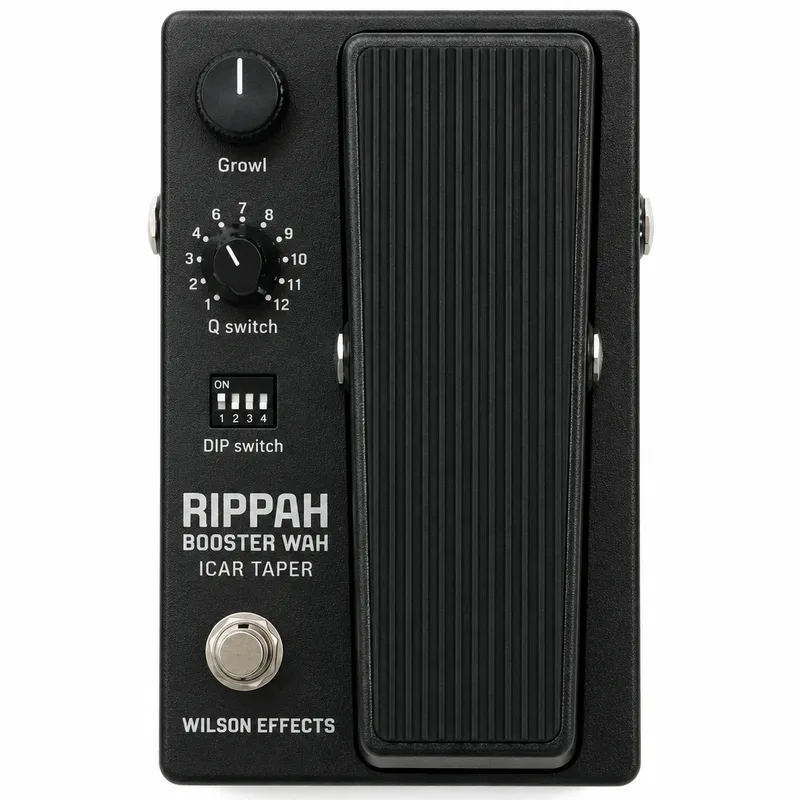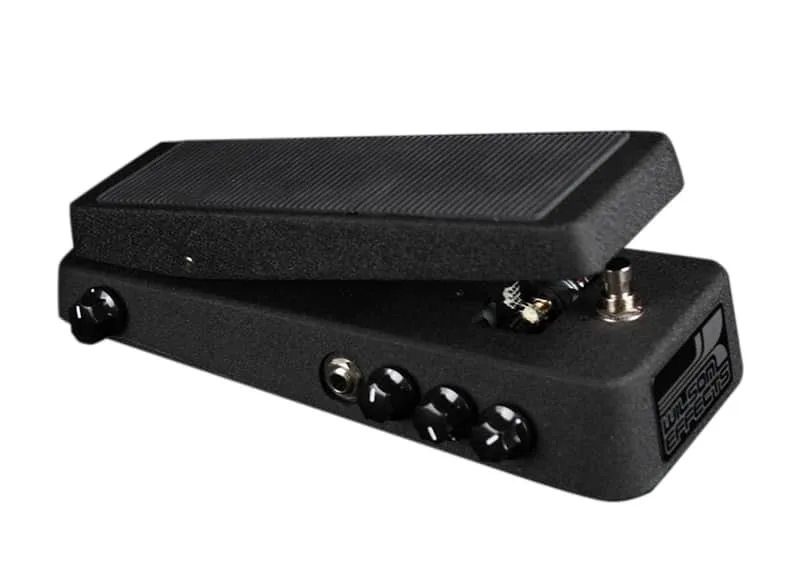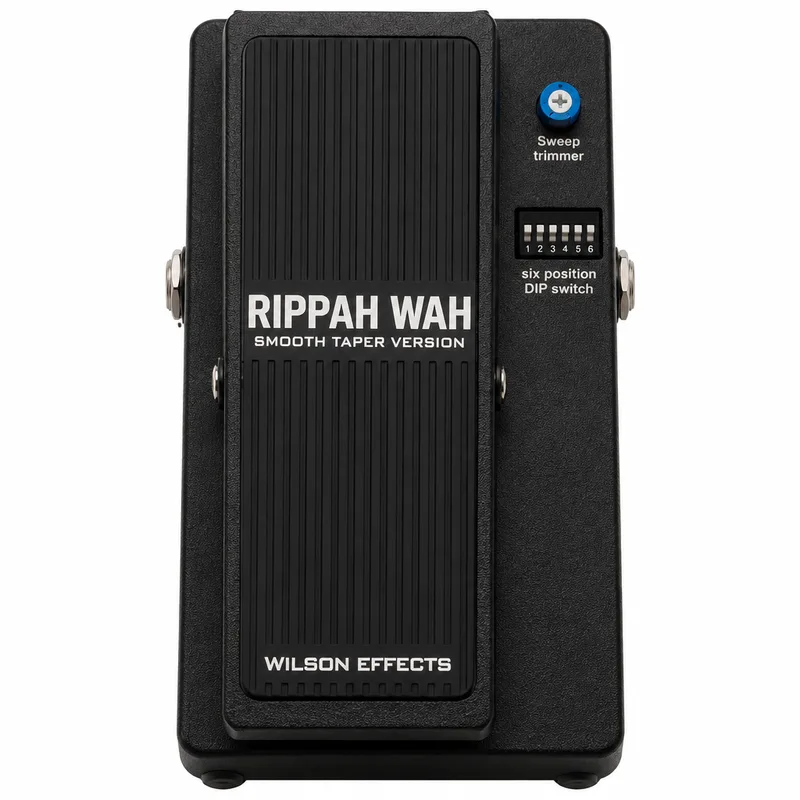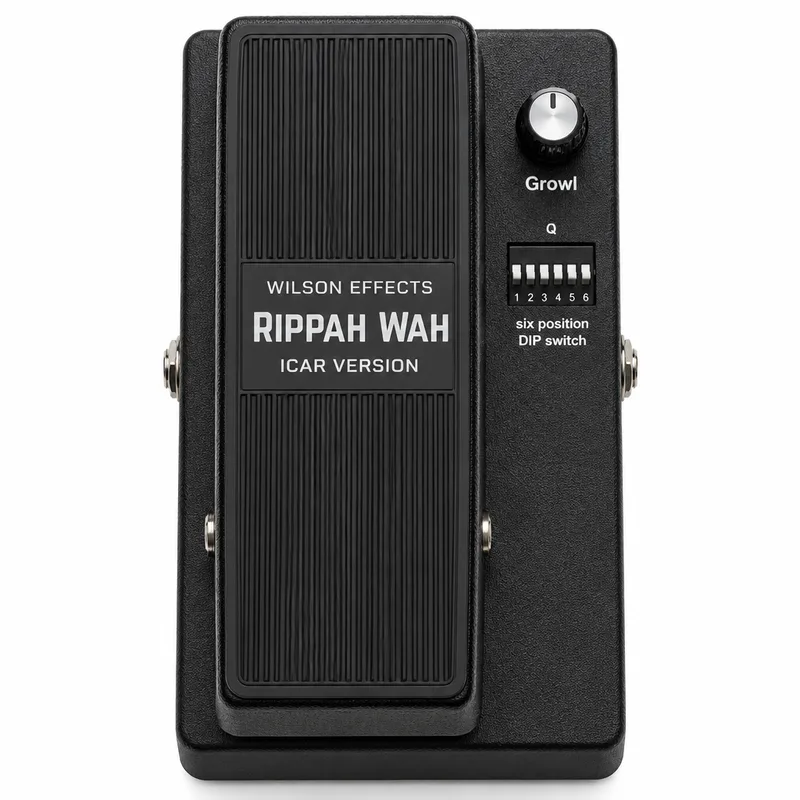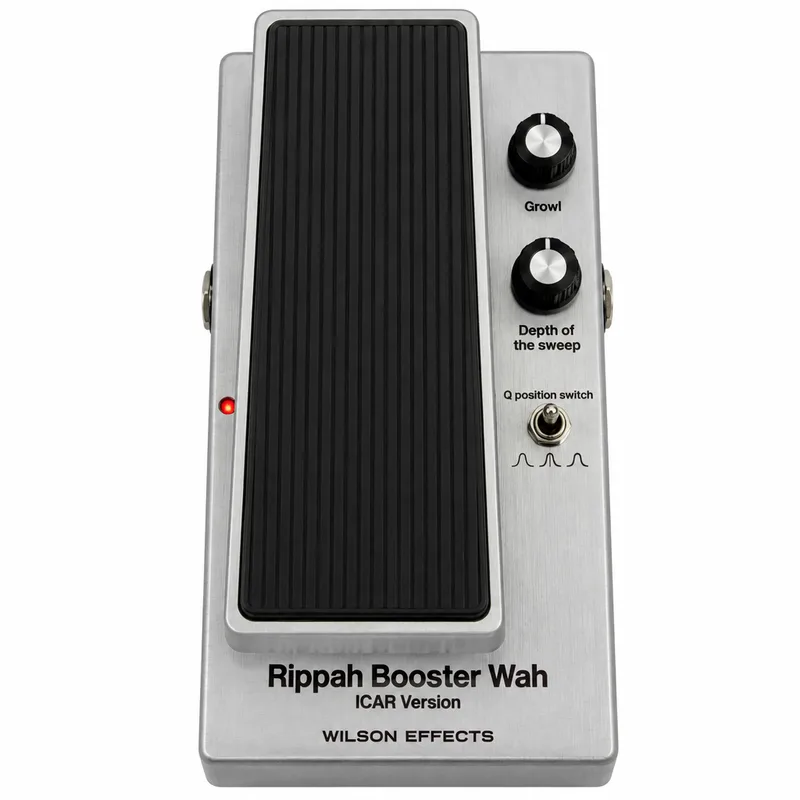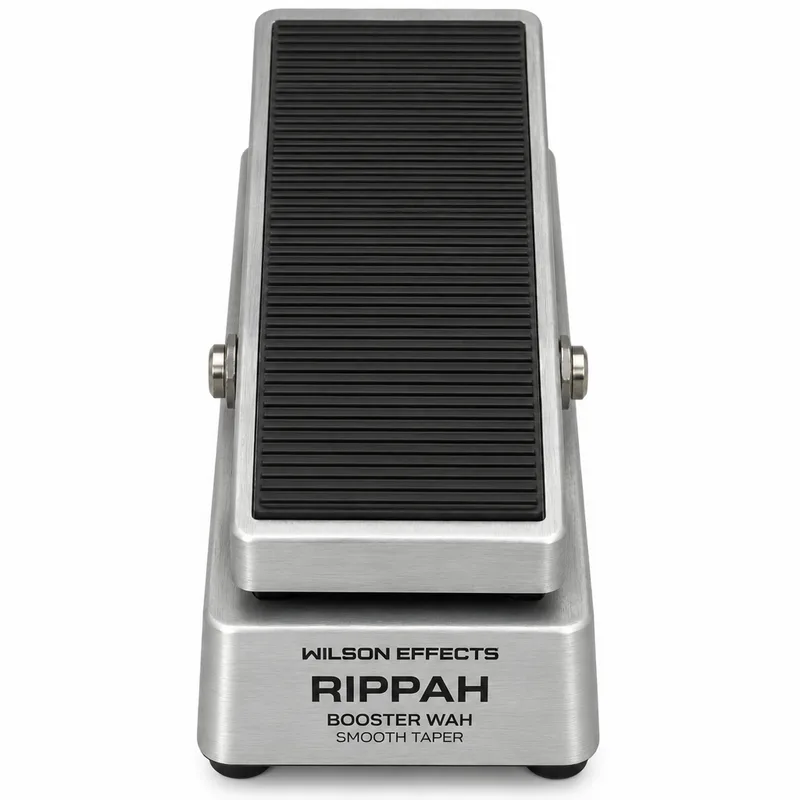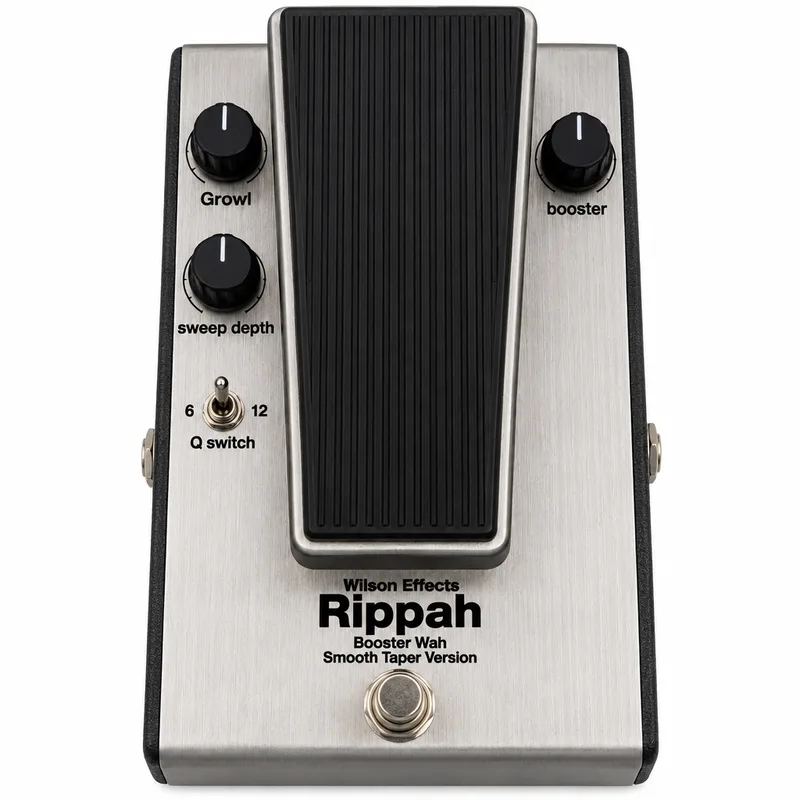

The Wilson Effects Rippah Booster Wah Smooth Taper Version is a wah pedal with a built-in booster, built around a faithful reproduction of the vintage Maestro Boomerang wah circuit with what Wilson Effects calls tons of tuning options1. The company positions it against standard wah circuits by giving it a more pronounced throat and growl in the low end, aimed at players who want to cut through a mix1.
The Smooth Taper Version is one of two pot options for the pedal. Its smooth taper pot maintains a smoother transition through the sweep of the Q range, while the alternative ICAR taper pot is precisely modeled after a vintage ICAR taper pot for a more traditional feel1. Both pots are available in either the traditional Black Powder finish or a Brushed Aluminum enclosure1.
A wah with a built-in booster and extra low-end growl
Wilson Effects describes the pedal's character plainly:
"There is a little more throat and growl in the low end which makes it ideal for the player that really wants to cut through the mix"
That low-end character comes from the Growl control, which adjusts the amount of bass and gain in the circuit. The pedal is hand-built in the U.S. with NOS Mullard Tropical Fish capacitors, carbon composition resistors, and BC109 transistors1.
The booster side of the pedal is handled by an internal volume trimmer rather than a foot-side knob. Inside, a small blue trimmer controls the output of the pedal, from unity gain to a boost, so you can set it flat for rhythm work or push it for leads2. Wilson Effects notes the Boost control was incorporated to overcome any loss of volume that can occur at extreme Growl settings, and that it lets you set the wah above unity gain to cut through the mix in live situations; it is not intended to overdrive a clean amp45.
Every Rippah also comes standard with a built-in fuzz buffer, which Wilson Effects says means the pedal will work just as well in front of a fuzz pedal as anywhere else in the chain2. The fuzz friendly output buffer lets the wah work seamlessly with most fuzz and overdrive pedals and deal with their higher input impedance, a common sticking point when a wah loads down a vintage-style fuzz6.
The controls: sweep depth, Q switch, Growl and internal trimmers
The Rippah Booster Wah puts its main controls on the outside of the enclosure, with finer tuning inside21.
| Control | Location | What it does |
|---|---|---|
| Depth of the sweep | Front of the pedal | Dials in how deep the sweep goes; subtle from the midpoint to the max, adds more throat when maxed out2 |
| Growl knob | Heel of the pedal | Adjusts the amount of bass and gain in the circuit2 |
| Q position switch | On the pedal | Moves the position of the Q in the sweep, from a deep synth-like growl to a high, almost envelope-filter type of sound2 |
| Volume trimmer | Inside (blue trimmer) | Sets the output from unity gain to a boost2 |
The Q position switch comes in six or twelve position versions depending on which model you choose2. The twelve position switch lets you shape the Q range from deep, synth-like growls to sharp, envelope filter-like tones1.
Inside the pedal you will find three blue trimmers, or trim pots, adjustable with a small flathead or Phillips screwdriver6. On the related Rippah Wah, Wilson Effects describes the three internal trim pots as:
- Sweep: alters the range and depth of the wah sweep; widen the spectrum for a throaty, full-bodied sound or thin it out to focus on upper and mid-range frequencies6
- Growl: adjusts the amount of bass and gain in the circuit; maxed out by default for the stock setting, but can be turned down for a smoother, funkier feel6
- Boost: compensates for any volume drop when adjusting the Growl control, and can push the front end of a tube amp for enhanced presence in a mix6
Power and connections
The Rippah Booster Wah operates off a 2.1mm center-negative power supply or a high-quality alkaline battery2. All Wilson Effects pedals are true bypass, and the Rippah Booster Wah line carries a bright side-mounted LED so you never accidentally leave the wah engaged1.
Wilson Effects specifies a high-quality alkaline battery rather than any battery. A cheap or partially drained battery may not deliver the headroom the booster side of the circuit wants.
Smooth Taper and ICAR versions
The Rippah Booster Wah is available in two pot options, each in a Black Powder or Brushed Aluminum finish1:
- Smooth Taper Pot: maintains a smoother transition through the sweep of the Q range1
- ICAR pot: a Wilson Effects vintage taper wah pot precisely modeled after a vintage ICAR taper pot for an authentic feel1
The same choice runs through the wider Rippah family. The Rippah Wah is the non-booster version of the circuit, offered in Smooth Taper and ICAR versions, and the Booster Wah itself comes in an ICAR Version alongside the Smooth Taper Version covered here. Brushed Aluminum finishes exist across the line, including the Brushed Aluminum Rippah Booster Wah Smooth Taper and the Brushed Aluminum Rippah Booster Wah ICAR Taper. There is also a 12 Position Rippah Booster Wah for players who want the full twelve-step Q switch167.
Videos
Prymaxe
Questions
Is the Rippah Booster Wah true bypass?
Yes. Wilson Effects states that all of its pedals are true bypass, and the Rippah Booster Wah line also carries a bright side-mounted LED so you do not accidentally leave the wah engaged. The LED sits on the side of the enclosure where it is easy to see mid-performance.
Does the Rippah Wah work in front of a fuzz pedal?
Yes. Every Rippah comes standard with a built-in fuzz friendly output buffer, which Wilson Effects says lets the wah work seamlessly with most fuzz and overdrive pedals and deal with their higher input impedance. That addresses the common problem of a wah loading down a fuzz and changing its tone.
What is the difference between the Smooth Taper and ICAR taper?
The Smooth Taper pot maintains a smoother transition through the sweep of the Q range, while the ICAR taper pot is modeled after a vintage ICAR taper pot for a more traditional feel. Wilson Effects offers the Rippah Booster Wah in both pot options, each in a Black Powder or Brushed Aluminum finish.
Is the Rippah six-position or twelve-position Q switch?
Both versions exist. The Rippah Booster Wah comes with either a six or twelve position Q position switch, depending on which model you choose. The switch moves the position of the Q in the sweep, from a deep synth-like growl to a high, almost envelope-filter type of sound.
Where is the Wilson Effects Rippah made?
Wilson Effects builds the Rippah right in the U.S.A. The company describes the pedal as hand-built, using NOS Mullard Tropical Fish capacitors, carbon composition resistors, and BC109 transistors in the circuit.
Can the Rippah Wah run on a battery?
Yes. The Rippah Booster Wah operates on a standard 2.1mm center-negative power supply or a high-quality alkaline battery. Wilson Effects specifically recommends a high-quality alkaline battery rather than any battery you have on hand.
Sources (7)
- Rippah Booster Wah, Wilson Effects
- Rippah Booster Wah Smooth Taper Version, Wilson Effects
- Brushed Aluminum Rippah Booster Wah Smooth Taper, Wilson Effects
- Rippah Wah Smooth Taper Version, Wilson Effects
- Rippah Wah ICAR Version, Wilson Effects
- Rippah Wah, Wilson Effects
- Rippah Booster Wah ICAR Version | Wilson Effects, Wilson Effects