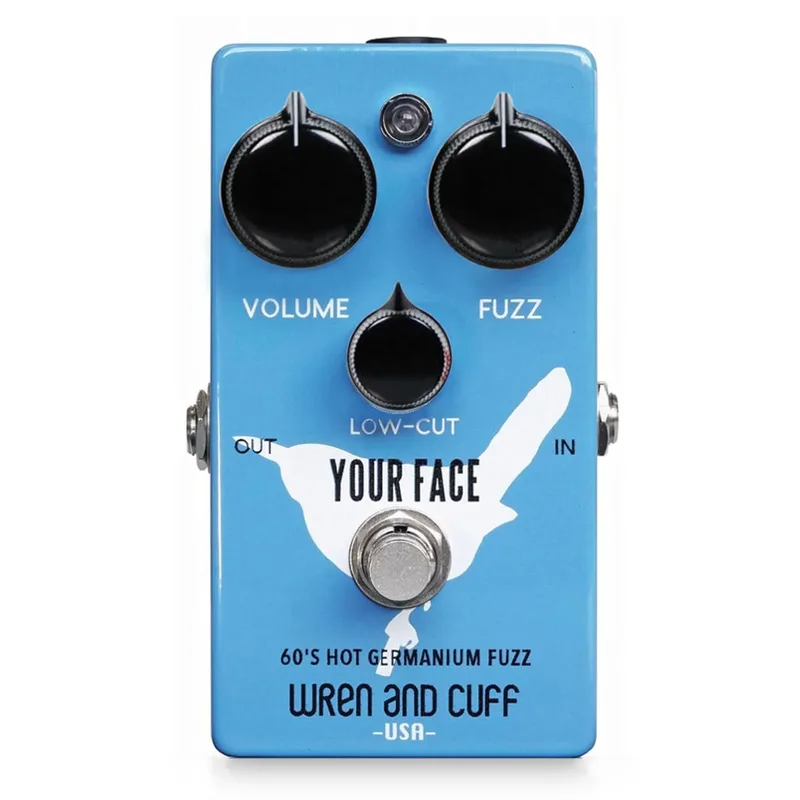


The Wren and Cuff Your Face 60's is a fuzz pedal built in the Fuzz Face tradition, the two-transistor germanium circuit that shaped fuzz in the 1960s. Wren and Cuff describes it as "dripping with fuzz, super dynamic, trim-pot adjustable bias, and more," and it uses hand matched NOS germanium transistors, the same transistor type as the originals it draws on1.
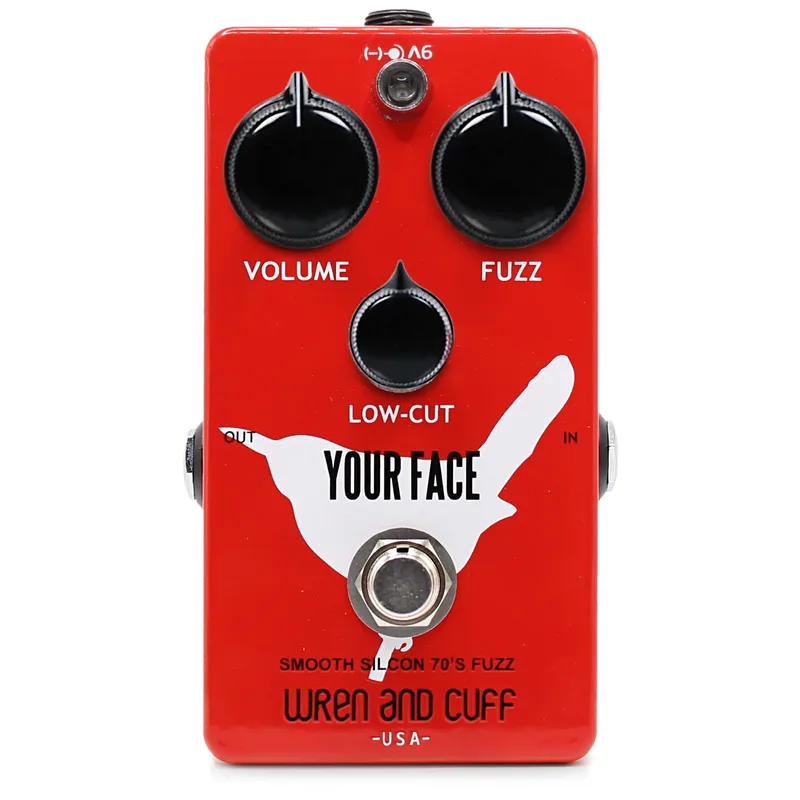
It is one of a pair: the Your Face 60's is the germanium version, while the companion Wren and Cuff Your Face 70's covers the later silicon Fuzz Face sound with hand matched NOS BC108C transistors21. Both are made in the USA and carry a lifetime warranty12.
A germanium fuzz in the Fuzz Face tradition
The circuit is based on the Fuzz Face, and Wren and Cuff has addressed some of the well-known quirks of the original design. On the traditional circuit's low output, the maker puts it plainly: "Don't like the low output on a traditional FF? Fixed it."1
Germanium transistors are the heart of the 60s Fuzz Face sound, and they are also what makes pedals like this fussier than silicon ones: their bias shifts with temperature. The Your Face 60's handles this with a trim-pot adjustable bias, so the transistors can be dialed back in without opening the pedal up and swapping parts1.
The transistors themselves are hand matched NOS germanium units, meaning new old stock parts selected in pairs, which matters in this circuit because the two stages need to work together for the fuzz to clean up the way a Fuzz Face does when you roll back your guitar's volume1.
Controls
| Control | What it does |
|---|---|
| Fuzz | Sets the fuzz amount, using a reverse-log potentiometer that widens the useful range so you can dial things in more precisely1 |
| "You" | A custom low-cut knob that reduces some of the low-end squash, letting you shape the pedal for your own setup1 |
| Bias trim pot | Internal adjustment for the germanium transistor bias1 |
The "You" knob is the pedal's own twist on the Fuzz Face formula. Fuzz Face circuits are known for a thick, squashed low end, and the low-cut lets you trim that back, whether you are on a bright single-coil guitar or a warmer humbucker rig1.
The fuzz knob's reverse-log potentiometer is a similar practical change: on a standard Fuzz Face, most of the usable sweep can crowd into one end of the knob. A reverse-log taper spreads that range out across the rotation1.
Power and bypass
The Your Face 60's runs on a 9V battery or a 9V DC center-negative adapter with a 2.1mm plug, drawing 5mA1. That draw is low enough that a battery is a realistic long-term option, and the pedal is light on a power supply if you run it from one.
Bypass is true hard-wire bypass, so with the pedal off your signal does not pass through the circuit1.
Germanium fuzz circuits are among the few pedal types where a battery is still common practice. If you power the Your Face 60's from a daisy-chained supply shared with digital pedals, be aware that germanium circuits can pick up noise; a clean isolated output or a battery is the safer route.
The 60's and the 70's side by side
Wren and Cuff makes two versions of the Your Face, and the choice between them is mostly the classic germanium versus silicon question21:
| Your Face 60's | Your Face 70's | |
|---|---|---|
| Transistors | Hand matched NOS germanium1 | Hand matched NOS BC108C (silicon)2 |
| Character | 60s Fuzz Face tradition1 | "Ultra-smooth high-gain silicon 70's style fuzzer"2 |
| Bypass | True hard-wire1 | True hard-wire2 |
| Power | 9V battery or 2.1mm adapter, 5mA1 | 9V battery or 2.1mm adapter, 5mA2 |
| Dimensions | 4.8" x 2.6" x 1.6"1 | 4.8" x 2.6" x 1.6"1 |
| Made in | USA1 | USA2 |
The 70's version adds its own touches, including a Mullard "tropical fish" out-cap with an increased value to allow more lows through, and custom filtering that Wren and Cuff says warms up the tight silicon edge2. Both pedals share the same enclosure size, power requirements, and "You" low-cut knob concept12.
Videos
The Philharmonic Orchestra
Pitbull Audio
Alec Houston
Questions
Does the Wren and Cuff Your Face 60's run on a battery?
Yes. The pedal runs on a 9V battery or a 9V DC center-negative adapter with a 2.1mm plug. Current draw is 5mA, so a battery lasts a long time at typical playing sessions.
Is the Your Face 60's true bypass?
Yes. Wren and Cuff specifies true hard-wire bypass, so the pedal keeps your clean signal out of the circuit when it is switched off.
What does the "You" knob do?
The custom "You" knob is a low-cut control. It reduces some of the low-end squash that Fuzz Face style circuits can produce, letting you shape the pedal around your own guitar and amp.
What transistors does the Your Face 60's use?
It uses hand matched NOS (new old stock) germanium transistors, the classic transistor type of 1960s Fuzz Face circuits. The bias is set by an internal trim pot, so the transistors can be dialed in without swapping parts.
Where is the Your Face 60's made?
Wren and Cuff builds the Your Face 60's in the USA, and it carries the company's lifetime warranty.
How big is the Your Face 60's?
The enclosure measures 4.8 by 2.6 by 1.6 inches and weighs 10 oz, roughly the footprint of a standard compact pedal.
Sources (2)
- Your Face 60's, Wren and Cuff
- Your Face 70's, Wren and Cuff