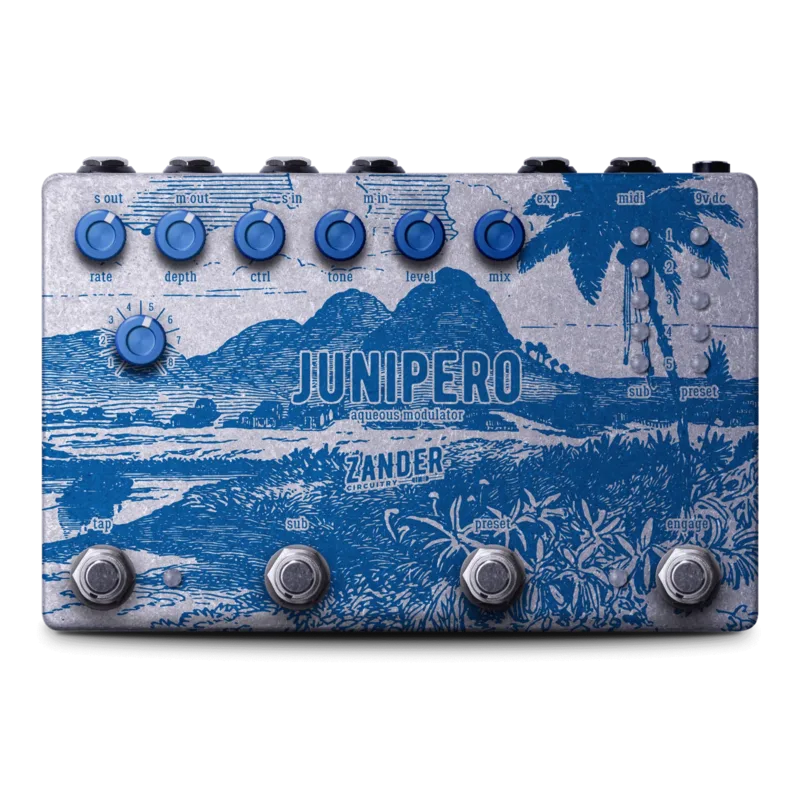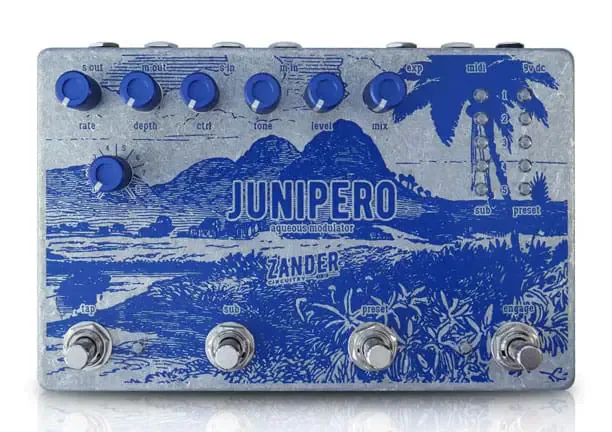


The Zander Circuitry Junipero Aqueous Modulator is a multi-modulation, stereo pedal aimed at what Delicious Audio called "the alternative and experimental guitarist"1. Built by the British company Zander Circuitry, it gathers eight modulation effects into one large enclosure, covering chorus, flanger, phaser, tremolo, vibrato and ring modulation territory, with presets, tap tempo, expression control and MIDI on board12.
Zander describes the pedal's inspiration plainly:
"Inspired by our love of post-punk, new wave and shoegaze; as well as an interest in classic modulation effects."
Pedal of the Day's 2020 review echoed the same influences, noting the pedal was "inspired by post-punk, new wave and shoegaze musical genres"2.
The modes and what the CTRL knob does
The Junipero's eight modes span most of the classic modulation families. Pedal of the Day listed them as chorus/vibrato with detune, multi-voice chorus, flanger, harmonic tremolo, vibrato and tremolo, and a ring modulator with an aliaser2. Delicious Audio's profile filled in what several of the modes do and how the CTRL knob behaves in each1.
| Mode | What it does | What CTRL does |
|---|---|---|
| Flanger | Multi-mode flanger with wide-ranging rate and depth controls | Blends between through-zero, vibrato and classic flange sounds |
| Phaser | Classic 10-stage phaser with wide-ranging rate and depth | Feedback control for more vocal phasing effects |
| Harmonic tremolo | Amp-style harmonic tremolo | A "Q" control to make the effect more vocal, like an auto-wah |
| Tremolo | Variable tremolo with wide-ranging rate and depth | Blends between classic sine-wave and a "repeat percussion" style effect |
| Vibrato and tremolo | Synchronized tremolo and vibrato, suited to faux rotating speaker effects | Sets the tremolo depth |
The CTRL knob is the pedal's most distinctive control. As Pedal of the Day put it, "CTRL is a secondary parameter, that works differently depending on what mode you're in, ranging from detune to blend to feedback to frequency control and more"2. In practice this means one knob takes on a different job in every mode, which keeps the front panel small while still giving each effect a voice-shaping control beyond rate and depth.
Players comparing single-effect pedals can read more about the individual types on the Chorus Pedals, Flanger Pedals, Phaser Pedals, Tremolo Pedals and Vibrato Pedals pages.
The controls and footswitches
The knob set is five deep, with CTRL doing double duty across modes12:
- Rate: modulation speed1
- Depth: modulation intensity1
- CTRL: a parameter that varies depending on the patch1
- Tone: shapes the wet signal1
- Level: output volume1
There are four footswitches: Engage (bypass), Sub, Preset, and Tap Tempo1. The pedal stores 5 presets, which Pedal of the Day described as "easily adjustable on the fly if need be"2. Beyond the front panel, it offers full assignable expression pedal control, so an expression pedal can drive parameters in real time1.
Power and connections
The Junipero runs on a 9V DC center negative power supply and draws 250mA1. That current draw is well above what a typical analog pedal uses, so it needs a proper power outlet on a supply rather than a shared low-current tap. Connections are top mounted jacks with full stereo input and output1.
At 250mA, the Junipero is a hungrier pedal than most single-effect stomps. Check your power supply's per-output rating before planning it into a compact board.
MIDI compatibility extends the preset count to as many as 128 via a MIDI controller1, which places it among the MIDI pedals useful for larger switched rigs. Tap tempo works with five subdivisions: quarter notes, eighth, dotted eighth, triplets and sixteenth notes1.
What reviewers said
Delicious Audio's take on the pedal was that "the Junipero offers incredible versatility that fits right in with anyone's rig"1. Pedal of the Day's review focused on the range within the classic sounds: "These classic sounds can sound as vintage or modern as you'd like, and there's a lot to cover here"2. The same review noted the pedal packs its eight effects into "a nice, big enclosure"2, so board space is part of the trade-off for the mode count.
Zander also offered the pedal for sale on its own or bundled with merchandise, including a t-shirt, hoodie or both, with a merch pack of pin badges, graphic prints, a key chain and stickers1.
Videos
Zander Circuitry
Zander Circuitry
Zander Circuitry
Questions
How many presets does the Junipero have?
It has 5 presets on the pedal itself, which Pedal of the Day described as easily adjustable on the fly. With a MIDI controller connected, you get access to up to 128 presets, so players running larger rigs can store far more sounds than the front panel alone offers.
Is the Zander Junipero true bypass?
It can be. The bypass is assignable per preset, so you can choose buffered or true bypass for each saved sound. That gives you the option of keeping a buffer in the chain for long cable runs, or switching to true bypass when you want the pedal fully out of the signal path.
Does the Junipero have tap tempo?
Yes. One of its four footswitches is a dedicated Tap Tempo switch, and it offers five subdivisions: quarter notes, eighth notes, dotted eighth, triplets and sixteenth notes. That makes it straightforward to sync modulation speed to a tempo you set with your foot.
Is the Junipero MIDI compatible?
Yes, it has MIDI compatibility, including access to up to 128 presets via a MIDI controller. This makes it a practical choice for players who want to recall sounds remotely or integrate it into a larger MIDI-switched pedalboard.
Can the Junipero run in stereo?
Yes. It has full stereo input and output through top mounted jacks, so it works in a stereo rig with two amps or a stereo effects setup. Stereo operation is especially useful for its chorus, flanger and tremolo modes, where the two channels can move independently.
Sources (2)
- Zander Circuitry Junipero Aqueous Modulator, Delicious Audio, 2020-07-21
- Zander Circuitry Junipero Aqueous Modulator, Pedal of the Day, 2020-09-19