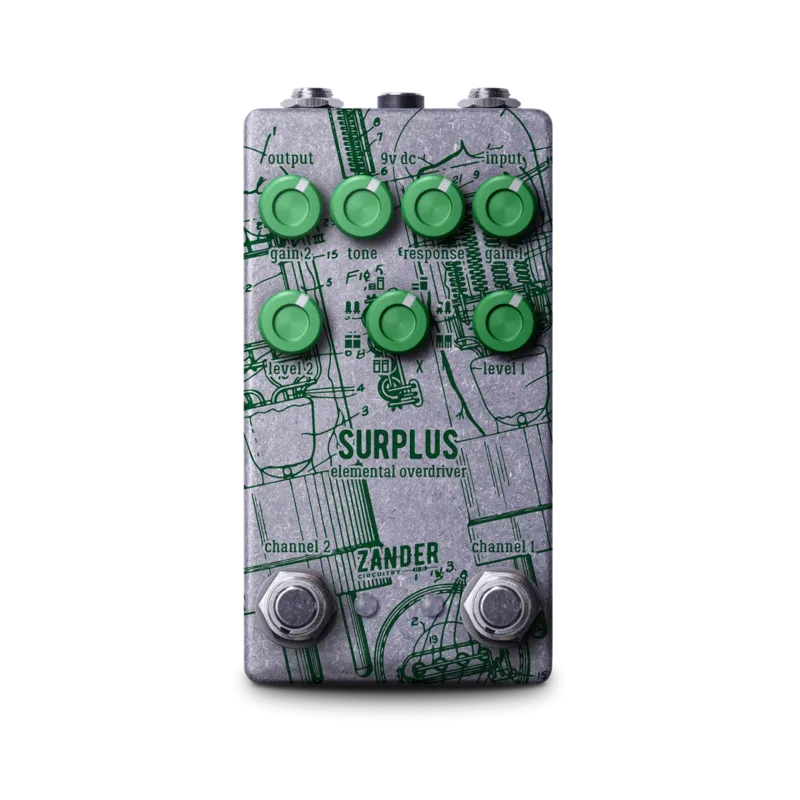



The Zander Circuitry Surplus, billed as the "Elemental Overdriver", is a dual-channel overdrive pedal from the UK maker. Zander describes it as their version of a classic boost/overdrive circuit, with the versatility to go from boost and subtle drive tones all the way through to full-throttle distortion and even fuzz1. Premier Guitar's press release described it as "a dual channel effect that covers everything from a sparkly clean boost through to o..."2.
The controls
The Surplus puts a lot on its panel: two channels, each with their own level and gain controls, plus a rotary clipping selector and a Response knob that reaches into the circuit itself1.
| Control | What it does |
|---|---|
| Gain 1 | Gain control for channel 11 |
| Level 1 | Output volume for channel 11 |
| Response | Alters the input capacitor value (low-end response and overall gain)1 |
| Rotary | Clipping diode selector1 |
| Channel 1 footswitch | Activates channel 1 and its controls1 |
| Channel 2 footswitch | Activates channel 2 and its controls1 |
Beyond the panel, Zander says the Surplus also offers the ability to tweak the input and output capacitor value1.
Two channels, two footswitches
"So the Surplus brings dual-channel flexibility to the party, each with their own level and gain controls," says the maker's product page1. Each channel has its own footswitch: the Channel 1 footswitch activates channel 1 and its controls, and the Channel 2 footswitch activates channel 2 and its controls1. Premier Guitar put it this way: "'Channel 2' footswitch swaps to another set of level and gain controls, allowing one to be set for low gain and the othe..."2. In practice, that means one channel can hold a clean boost or low-gain setting while the other carries a heavier drive, and you swap between them with a stomp.
Eight clipping types
The Surplus carries Zander's diode rotary switch, which lets you choose between eight different clipping types1. Clipping diodes are the parts of an overdrive circuit that shape how the signal distorts, and swapping them changes the character of the drive. The maker describes each setting this way1:
- Germanium: "Smooth, sweet, and classically 'amp-like'."
- Silicon: "Louder, brighter, and a little bit brittle."
- LED: "Louder again, with less saturation and more punch."
- Asymmetrical germanium, asymmetrical silicon, asymmetrical LED: asymmetric versions of the corresponding diode types1
- Transistor/MOSFET: "Similar to silicon, but sweeter and crunchier."
- No diodes: "Loads of output and much less gain."
That last setting is where the Surplus leans toward its boost side, while the diode settings take it into heavier overdrive and, per the maker, even fuzz territory1. For where the Surplus sits among drive pedals, see Overdrive Pedals, Boost Pedals, Distortion Pedals and Fuzz Pedals.
Power and specifications
The Surplus runs on a 9V DC center-negative supply and draws 100 mA1. Its enclosure measures (W) 67 mm x (L) 122 mm x (H) 60 mm1.
The 100 mA current draw is well above what many low-current daisy-chain outputs supply, so plan a dedicated or higher-current output on your pedalboard power supply1.
Price and availability
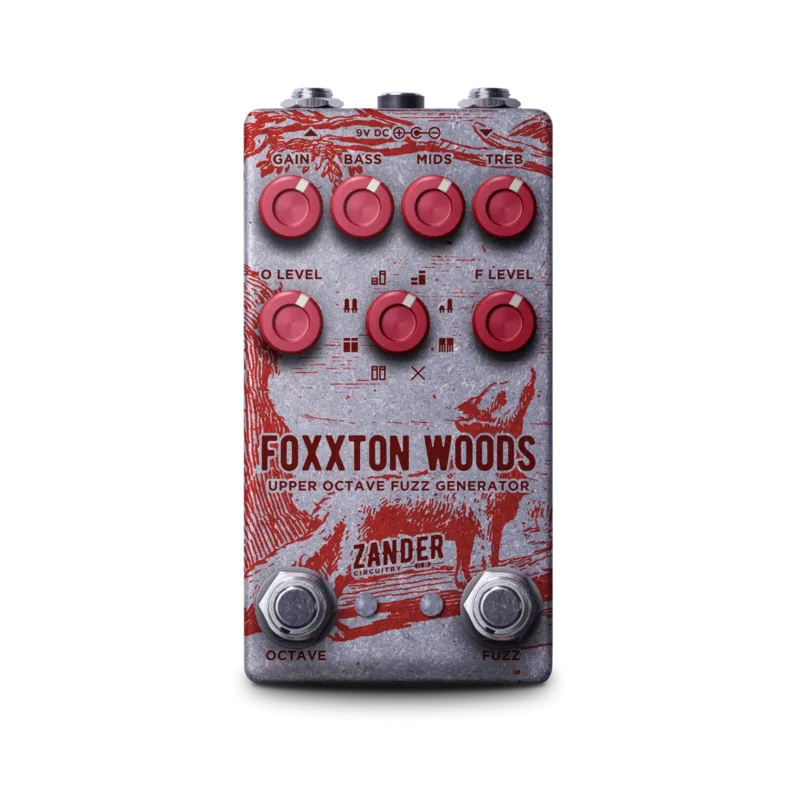
The maker's product page lists the Surplus at £149.00 GBP (as of 12 October 2024)1. Premier Guitar's 2018 press release reported the same figure at launch: "Both the Foxxton Woods and the Surplus retail for £149 (GBP)"2. The pedal was introduced in August 2018 alongside Zander's Foxxton Woods Upper Octave Fuzz Generator2.
Videos
Zander Circuitry
Zander Circuitry
Zander Circuitry
Questions
What does the Response knob do on the Zander Surplus?
The Response control alters the input capacitor value, which shapes the pedal's low-end response and overall gain. In practical terms, it changes how much bass the pedal passes into the clipping stage and how much drive character comes through, so you can tune the Surplus to sit right with different guitars and amps rather than working with a fixed input voicing.
Can the Zander Surplus get to fuzz tones?
Yes. Zander Circuitry describes the Surplus as covering everything from boost and subtle drive tones through to full-throttle distortion and even fuzz. The eight-position clipping rotary switch is a big part of that range: settings such as germanium or transistor/MOSFET clipping give softer, sweeter saturation, while the no-diodes setting delivers loads of output with much less gain for boost-style tones.
What power supply does the Zander Circuitry Surplus need?
The Surplus runs on a 9V DC center-negative supply and draws 100 mA. That current draw is high enough that a low-output daisy-chain output may not be the best choice, so plan your pedalboard power accordingly. Check the specifications of your power supply before adding it to a shared output.
How do the two channels on the Surplus switch?
The Surplus has two footswitches, one per channel. The Channel 1 footswitch activates channel 1 and its controls, and the Channel 2 footswitch activates channel 2 and its own set of level and gain controls. That lets you set one channel for low gain and the other for higher gain and swap between them while playing.
Sources (2)
- Surplus - Zander Circuitry, Zander Circuitry, 2018-07-15
- Zander Circuitry Launches Foxxton Woods Fuzz Pedal, Premier Guitar, 2018-08-14