

The JHS PG-14 is JHS Pedals' Paul Gilbert signature distortion pedal, released at NAMM in January 2020 and priced at $19912. At its heart is a FET-based distortion engine that JHS says emulates the touch, feel and response of a pushed tube amplifier, with an active mid-frequency preamp sitting in front of the FET circuitry1. The maker's pitch is that it gives a player the dynamics and tone of a loud, stadium-level amplifier at low or moderate volume, which is why JHS founder Josh Scott called it "the ultimate dirt channel box for a clean amp"3.
JHS itself describes the pedal's territory loosely: "Technically, you could call it an overdrive/distortion/fuzz"2. Press coverage has called it everything from a distortion pedal to a tube-like FET overdrive, which gives a sense of how wide its range runs34.
A FET distortion for a clean amp
The design idea is straightforward: instead of relying on your amp's dirt channel, the PG-14 puts a simulated cranked tube amp in a box in front of a clean amp. JHS describes the core as "a FET based distortion engine that emulates the touch, feel, and the response of a pushed tube amplifier," with the active mid-frequency preamp placed ahead of that engine1. In the Sweetwater demo video, the pedal was run through a 50 watt Marshall6.
The mid section is a big part of the character. MusicRadar quoted Josh Scott explaining that "the mid section of this pedal is very clean. It simply pushes really hard into that simulated tube FET thing," meaning the mid control drives the FET stage harder and distorts the midrange as you turn it up3. Paul Gilbert added his own take in the same piece: "And it's got knobs so you can adjust where the mid is"3.
GuitarPlayer's reviewer, Art Thompson, highlighted "how shapeable the FET-based preamp circuit is in response to EQ and gain settings"7, and Pedal of the Day called the result "a warm, hard-hitting effect that sounds great from the instant you plug it in"8.
The controls
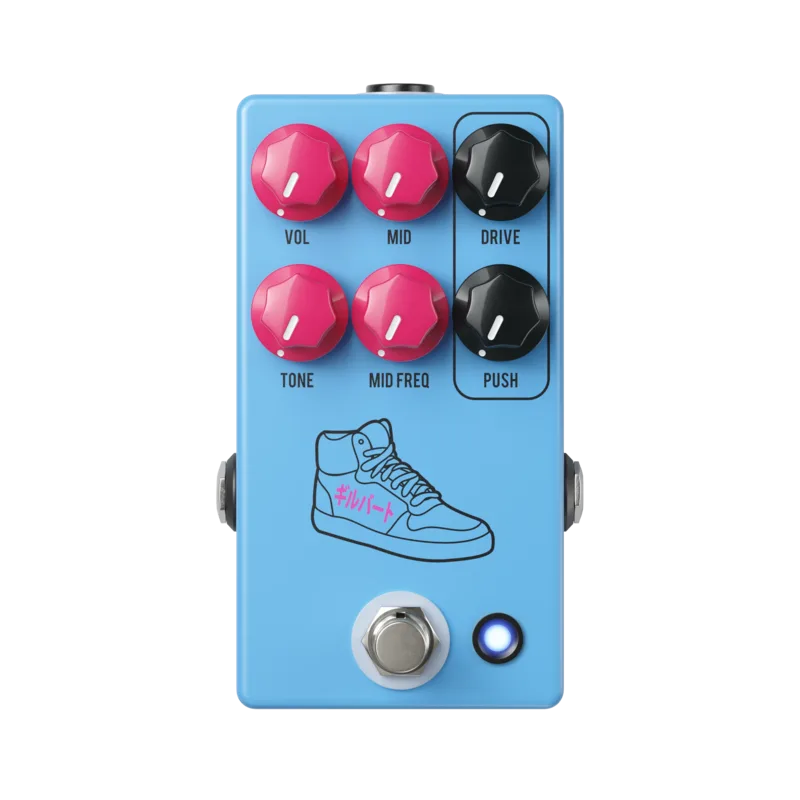
The PG-14 carries five knobs. Three are conventional, and two come from the Haunting Mids circuit borrowed for the mid section2.
| Control | What it does |
|---|---|
| Volume | Sets the output level5 |
| Drive | Sets the gain; as it is pushed, the FETs in the drive section "give up and sag just like a tube amp," per JHS's demo4 |
| Tone | Sets overall warmth5 |
| Mids | Controls the gain of the midrange frequencies, from the Haunting Mids section47 |
| Sweep | Sets the mid frequency the Mids control acts on, from the Haunting Mids section4 |
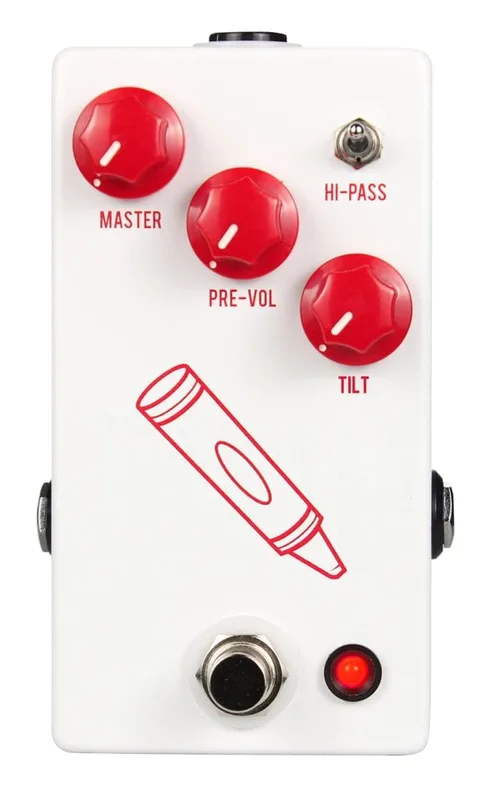
The Drive knob deserves a note for players who like tube-style touch response. In JHS's demo video, Josh Scott explains that the FETs in the drive section sag as they are pushed, the way a tube amp's output stage does when cranked4. He also describes the pedal's cleanup with the guitar's volume knob as "probably the best in the JHS line next to the Crayon"4.
The pedal's look matches its story: a light-blue housing with a Japanese-tennis-shoe graphic and pink knobs, the pink being a request from Gilbert himself79.
Power: 9V, 36mA
The PG-14 requires a standard 9V DC negative power supply through a 2.1mm center negative jack, and there is no battery operation option15. The maker lists its current draw as 36mA1, while Guitar World's review lists 67mA5. Either way, the draw is low enough for any ordinary isolated pedalboard supply.
No battery compartment means the PG-14 needs a power supply from day one. Any standard 9V DC center negative output from a pedalboard supply will run it.
Designed with Paul Gilbert
The PG-14 is a Paul Gilbert artist signature model, designed to his specifications in collaboration with JHS founder Josh Scott13. MusicRadar called it "the meeting of minds between Gilbert and JHS honcho Josh Scott"10.
The name comes from Gilbert's size 14 shoe, confirmed by Gilbert and Scott in the Sweetwater demo6. The pedal was nearly called the Dragon Suit, but that name was unavailable due to a trademark6.
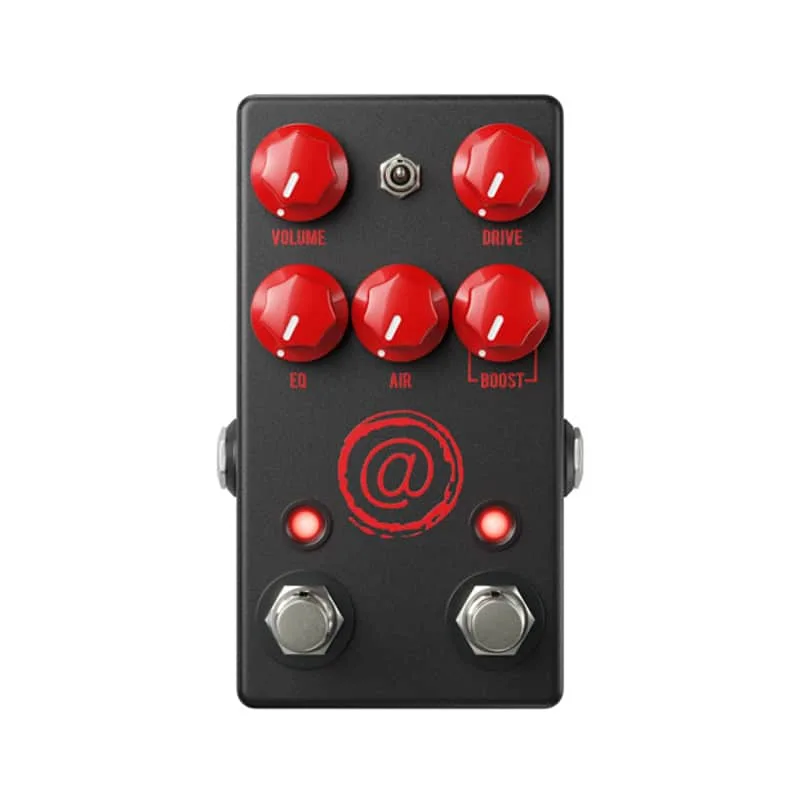
The circuit's origin is unusual. JHS says the specific design came about because of Paul Gilbert's tinnitus and hearing loss at certain frequencies, and the company ended up building the PG-14 from the circuitry of two existing JHS pedals: the Super Bolt, a FET simulation of a tube amp, and the Haunting Mids, whose mid circuit pushes the front of the PG-142. Gilbert's own verdict on the result: "it has more variety of how it sounds and how it feels than any distortion pedal I've ever played through"11.
What reviewers said
Published coverage was positive across the board:
- Guitar World's reviewer found the pedal "responds well to your picking dynamics"5.
- MusicRadar wrote that "the appeal is potentially huge here for a wide range of amps and styles with a huge sweep of tonal possibilities"3, and later that its "breadth and versatility with wide mid sweep could prove to be a mainstay on many 'boards"10.
- GuitarPlayer's Art Thompson praised how shapeable the FET-based preamp circuit is in response to EQ and gain settings7.
- Pedal of the Day called it "a unique distortion and overdrive pedal that adds the ultimate dirt channel to your amplifier"8.
- Premier Guitar listed the street price at $19912.
In JHS's own demo video, Josh Scott walks through the controls with Paul Gilbert joining by phone, covering the Drive sag, the Mids and Sweep interaction, and the pedal's cleanup with the guitar volume knob4.
The Sweetwater demo, with Gilbert and Scott playing the pedal through a 50 watt Marshall and telling the story of the name, is also worth a watch6.
Videos
JHS Pedals
Questions
Does the JHS PG-14 take a battery?
No. The PG-14 runs on a 9V DC center negative power supply through a 2.1mm jack, with no battery operation option. It needs a standard pedalboard power supply, and the maker lists its current draw as 36mA.
Is the JHS PG-14 true bypass?
Yes. Guitar World's review lists true-bypass switching among the pedal's features, so the signal passes untouched when the pedal is off.
Why is it called the PG-14?
The PG stands for Paul Gilbert, and the 14 comes from his size 14 shoe. In the Sweetwater demo video, Gilbert and Josh Scott confirm the name refers to his size 14 foot. The pedal was almost called the Dragon Suit, but that name was unavailable due to a trademark.
What pedals is the JHS PG-14 based on?
JHS developed the PG-14 using circuitry from two existing JHS pedals: the Super Bolt, a FET simulation of a tube amp, and the Haunting Mids, whose mid circuit pushes the front of the PG-14's distortion stage.
Does the PG-14 clean up with the guitar volume knob?
Yes. In JHS's demo video, Josh Scott describes the cleanup as incredible and says it is probably the best cleanup in the JHS line next to the Crayon. Guitar World's reviewer also notes the pedal responds well to picking dynamics.
Sources (12)
- PG-14 - JHS Pedals, JHS Pedals
- OUR MOST VERSATILE DISTORTION: PG-14, JHS Pedals
- NAMM 2020: The JHS Effects PG-14 Paul Gilbert signature distortion is here, MusicRadar, 2020-01-11
- Our Most Versatile Distortion: Paul Gilbert PG-14, JHS Pedals (YouTube), 2022-10-14
- JHS Pedals PG-14 review, Guitar World, 2020-08-28
- JHS PG-14 Paul Gilbert Signature Distortion Pedal Demo with Paul Gilbert and Josh Scott, Sweetwater, 2020-01-31
- JHS Pedals PG-14 Review, GuitarPlayer (www.guitarplayer.com), 2020-04-23
- JHS Pedals PG-14 Paul Gilbert Signature Distortion, Pedal of the Day, 2020-08-27
- Introducing the JHS Pedals PG-14... Paul Gilbert Artist Signature Pedal, JHS Pedals (YouTube), 2020-01-10
- The best new effects pedals of NAMM 2020, MusicRadar, 2020-01-24
- NAMM 2020: JHS finally releases the Paul Gilbert signature distortion pedal, guitar.com, 2020-01-14
- JHS PG-14 Review, Premier Guitar, 2020-06-22
 Paul Gilbert