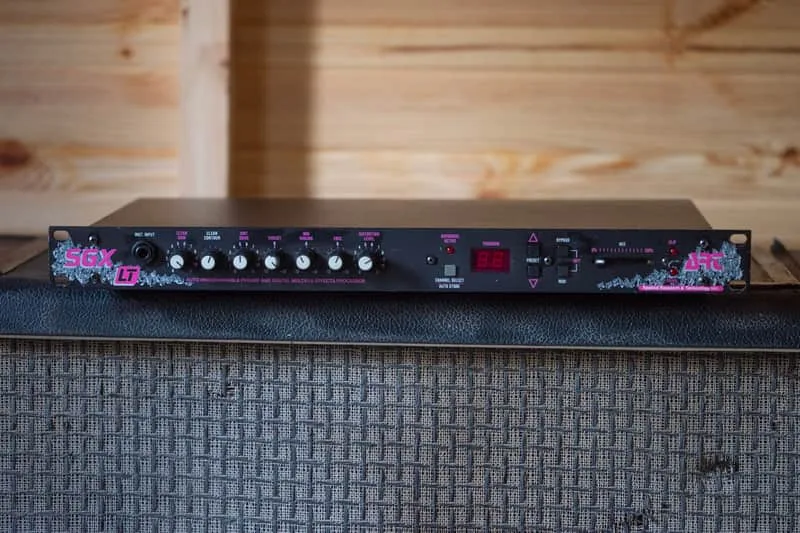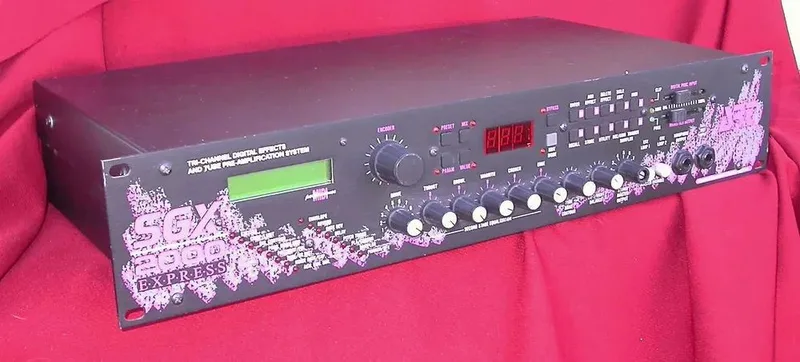


The ART SGX 2000 is a guitar preamp and multi-effects processor built into an all-steel, double-high 19-inch rack case, designed and manufactured in the United States by Applied Research & Technology (ART). ART describes it as a preamp, analog and digital effects processor that "combines the dazzling effects of ART's own digital VLSI technology with applied analog and tube technology"1. In practical terms, it puts a tube-driven analog front end and a bank of digital effects in one rack unit, aimed at continuous professional use.
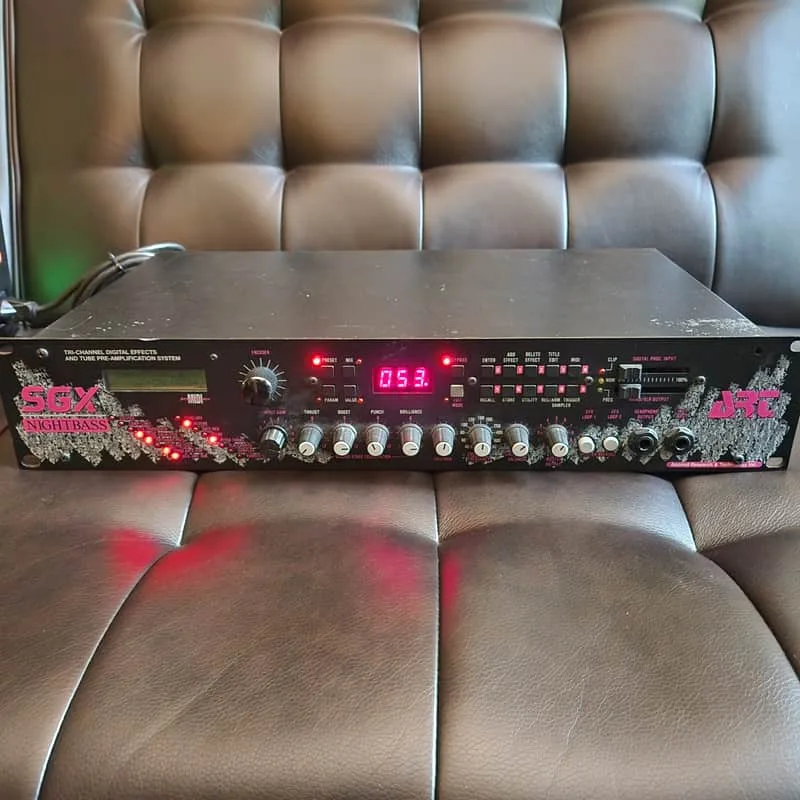
The unit is built around 24-bit digital architecture with a 12AX7 tube in the analog section, and it reproduces sound to 20KHz. It was released as model 500, with its MIDI implementation chart dated October 1991, version 1.01. It sits in ART's SGX line alongside the solid-state ART SGX LT, the bass-focused ART SGX NightBass, and the expanded ART SGX 2000 Express, which ART says increased the SGX 2000's power by 400% while keeping the ease of use unchanged1.
The analog section: compressor, distortion, exciter, filter and gate
The analog chain starts with a compressor (CMP) and distortion (DST) section and ends with a noise gate, which ART places last in the analog effects chain1.
The compressor offers slopes of 1:1, 2:1, 3:1, 4:1, 10:1, LIMIT, RVRS1 and RVRS2, with 4:1 as the default. Attack times run 2 to 50ms (default 4ms) and release times 200ms to 2 seconds (default 750ms). A useful trick from the manual: setting the slope to 1:1 turns the compressor into a programmable input level control, usable as variable distortion drive or a volume pedal effect1.
Distortion comes from four separate solid state circuits plus the tube, with eight algorithms to choose from1:
| Distortion algorithm | Character |
|---|---|
| TURBO TUBES (default) | Tube |
| PSYCHO TUBES | Tube |
| OVERDRV TUBE | Tube |
| JAZZ TUBES | Tube |
| TUBE CLEAN | Tube |
| TUBE STACK | Tube |
| SOLID SUPER | Solid state |
| SOLID WARM | Solid state |
The DRIVE parameter runs 0 to 100% in 2% increments (default 50%), and BITE runs 0 to 6 (default 3). Two things to know: the BITE parameter does nothing when a tube-only distortion is in the chain, and the front panel Tube Drive Contour control does nothing when no tube distortion is part of the effect chain1.
The harmonic exciter is integrated within the distortion section, sitting between the tube and solid state distortion circuits, with a RANGE parameter from OFF to 100% in 3% increments (default 34%)1.
The envelope filter offers ULTRA, SUPER, MEDIUM, NARROW, X15 SWP, RVRS LO, RVRS HI and OFF types, tunable from 120 to 3200Hz in 64 steps (default 1079 Hz), with a fixed 200ms release. If you use the X-15 Ultrafoot with it, ART says you must assign a Performance MIDI controller to the Threshold parameter1.
The expander/noise gate has a RANGE parameter from OFF to 100% in 3% increments (default 50%) and ratios from OFF to 1:5 (default 1:3)1.
A seven-band equalizer covers 40Hz, 100Hz, 250Hz, 640Hz, 1.6KHz, 4KHz and 10KHz, each band adjustable plus or minus 15dB in twelve steps1.
The digital effects: reverb, delay, pitch and modulation
ART groups the digital algorithms into categories: Analog Effects, Signal Frequency Shaping, Swept or Modulated Effect, Natural Reverberation, Gated Reverberation, Delay, and Utility/Level1.
Reverb. Natural reverb decay runs 0 to 25 seconds (default 2.4s), with HFDAMP 0 to 50 percent (default 14%) and diffusion 40 to 100 percent (default 100%). ART describes the size hierarchy as Plate being the smallest space, Room and Vocal next, and Hall types the largest. Gated reverbs offer decays up to 0.40 seconds, and ART calls GATE-VERB-3 the most complex and dense, recommending it for reverb-only programs. An Acoustic Environment Simulator adds room types from DEAD ROOM to OPEN AMBNCE1.
Delay. The tapped delays offer up to 1010ms (short) or 1150ms (long) of total delay with 1 to 7 taps, in Even, Shortened or Lengthened level patterns, mono or stereo. Regenerating delays run to 1100ms with REGEN 0 to 100%, and stereo delays reach 1350ms total, with regeneration derived from the left channel1.
Pitch. The pitch transposer shifts (-)12 to (+)12 half steps in whole steps, with FINE adjustment of (-)4.00 to (+)4.00 half steps in 0.06 (six cent) increments, and SMOOTH, NORMAL or QUICK modes1.
Modulation. The flanger and panner both sweep at .04Hz to 27.3Hz (defaults 0.84Hz and 2.16Hz), the chorus has a delay of 0 to 47ms (default 30), and the tremolo is an amplitude-modulating effect that cuts the signal level in and out at a set rate. MIDI pan position runs 0 to 127 (default 64)1.
Sampler. Three sampler algorithms record 0.02 to 1.58 seconds depending on the version, with AUTO, MANUAL or MIDI triggering and SINGLE, PUNCHIN, MIDI, REPEAT or AUDIO play modes. A low pass filter can roll off high frequencies before the signal is sampled. Note that an audio sample cannot be stored1.
The panner requires both Line outputs or both Headphone outputs to be in use. With one Line or Instrument output, the two outputs are summed, canceling the effect entirely1.
Controls, presets and MIDI
Editing is done through an Encoder, where each click changes a parameter value one step, and ART says it makes fast and accurate changes to presets, parameters and values. Utility parameters save automatically, with no STORE press needed1.
There are 200 memory locations: 115 factory presets and 90 user locations. The first 110 presets are protected from being overwritten, and ART suggests storing your own presets beginning with slot 200 and working down. Bank B holds 116 performance presets, including guitar sounds from recordings and artists, classic amplifier emulations, and keyboard and MIDI controller presets1.
MIDI is deep. The unit ships in OMNI mode, receiving program numbers on any MIDI channel, with the MIDI channel defaulting to 1 (range OFF to 16). Performance MIDI allows up to eight parameters per preset to be controlled simultaneously via MIDI, and the default controller is MC 4, the Left Foot Controller on the X-15. Default on/off controller assignments include BYPASS MC 84, EXCITER MC 70, COMPRESSOR MC 71, DISTORTION MC 72, EQUALIZER MC 73, EXPANDER/NOISE GATE MC 74, REVERB MC 75, DELAY MC 76, PITCH TRANSPOSER MC 77, FLANGE/CHORUS MC 78 and SPECIAL EFFECTS MC 791. The Express version's MIDI Enable parameters turn Performance MIDI (PM) and Program change (PROG) on or off independently, both defaulting to ON2.
You can dump a single preset, the entire MIDI Program Table, or all presets via MIDI to another SGX 2000 or a MIDI storage device, and MIDI programs may be assigned to any preset number. A monitoring mode displays MIDI events in plain or technical terms, decimal or hexadecimal. The unit accepts MIDI data at all times regardless of operating mode1.
The built-in tuner offers BASS and GUITAR types with accuracy better than .5 cents, responds to open string tuning only (no harmonics), and can detune the A 440 reference by up to 2 half steps, where 4 cents equals 1Hz. Factory Preset 113 [GUITAR TUNER X15] works instantly with an X-15, and Preset 005 [AUTO GUITAR TUNER] is for quick tuning on stage1.
The two REMOTE jacks can be programmed to Bypass the unit, increment or decrement presets, or re-arm or trigger the sampler. A footswitch with any two-conductor cable is intended; for non-X-15 uses, a momentary normally open switch. The X-15's Bypass Jack feature can control one of the SGX 2000's Remote Jacks1.
A factory reset, which eliminates presets, is performed by pressing and holding the PRESET, 0/ENTER, and 4/MIDI buttons simultaneously1.
Power, connections and hardware details
The SGX 2000 is AC powered via a standard 3-conductor grounded power cable, at 105-125 Volts AC, 60Hz, with an internal fuse, drawing 240mA at 117VAC and 28.1W. A rear-panel PWR Out jack supplies (+)9 Volts DC on a 2.1mm female connector, intended for powering external accessories1.
Connections on the rear panel include MIDI Out, MIDI In and MIDI Thru jacks, all standard 5 pin DIN connectors using standard MIDI connections1. The unit is self contained in an all steel double high 19" rack mount case1.
Other specifications from the manual1:
| Specification | Value |
|---|---|
| Dynamic range | >90dB typical |
| Equivalent input noise | -100dBv |
| Operating level | +16dBV max |
| Frequency response | To 20KHz |
| User memory | Approximately 5000 bytes (5.0 Kbytes) |
Memory is backed by an internal lithium battery with a life of approximately four years; an illuminated right decimal point indicates low battery voltage. Edited MIDI Program Table data, the last preset used and the MIDI channel are retained when powered off. The software lives in a socketed EPROM, with the version and date viewable through the Edit Mode Utility screen1.
Videos
JetFretz
Robert Baker
Bill Lau
Questions
What tube does the ART SGX 2000 use?
It uses a 12AX7, which ART describes as a twin pentode tube, effectively two tubes in one case. The tube sits in the analog distortion section, and the front panel Tube Drive Contour control shapes its character, though only when a tube distortion is actually in the effect chain.
How many presets does the ART SGX 2000 hold?
There are 200 memory locations in total: 115 factory presets and 90 user memory locations. The first 110 presets are protected from being overwritten, and ART suggests storing your own presets starting with slot 200 and working down.
Does the ART SGX 2000 work with the ART X-15 Ultrafoot?
Yes. All analog and digital effect parameters, including Mix Control parameters, are controllable from the X-15, and the X-15's Bypass Jack feature can drive one of the SGX 2000's Remote Jacks. Factory Preset 113, GUITAR TUNER X15, is set up to work instantly with an X-15 for tuning.
Why does the panner on the SGX 2000 have no effect with one output?
The panner needs both Line outputs or both Headphone outputs in use. With only one Line or Instrument output connected, the two outputs are summed, which cancels the panning effect entirely, so you get no effect at all.
Can the ART SGX 2000 store samples?
No. The sampler algorithms can record short passages, from 0.02 seconds up to 1.58 seconds depending on the algorithm, but an audio sample cannot be stored. It is a performance tool, not a sample library.
Can the ART SGX 2000 tune a bass?
Yes. The built-in tuner has BASS and GUITAR types, with GUITAR as the default, and accuracy better than .5 cents. It responds to open string tuning only, no harmonics, and Factory Preset 005, AUTO GUITAR TUNER, is intended for quick tuning on stage.
Sources (2)
- 500MAN.PDF, ART, 2025
- Voes | MIDI-CC, Voes, 2024