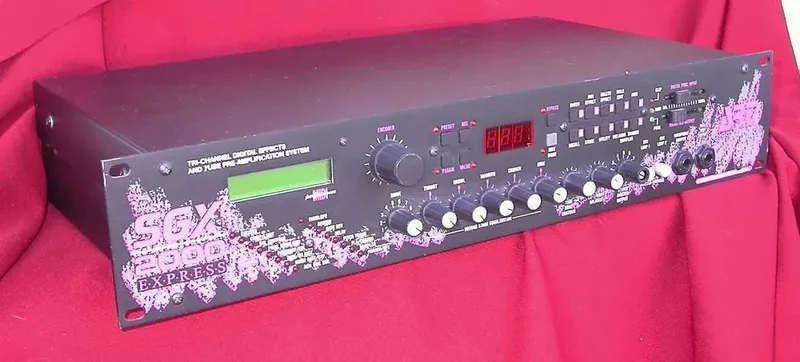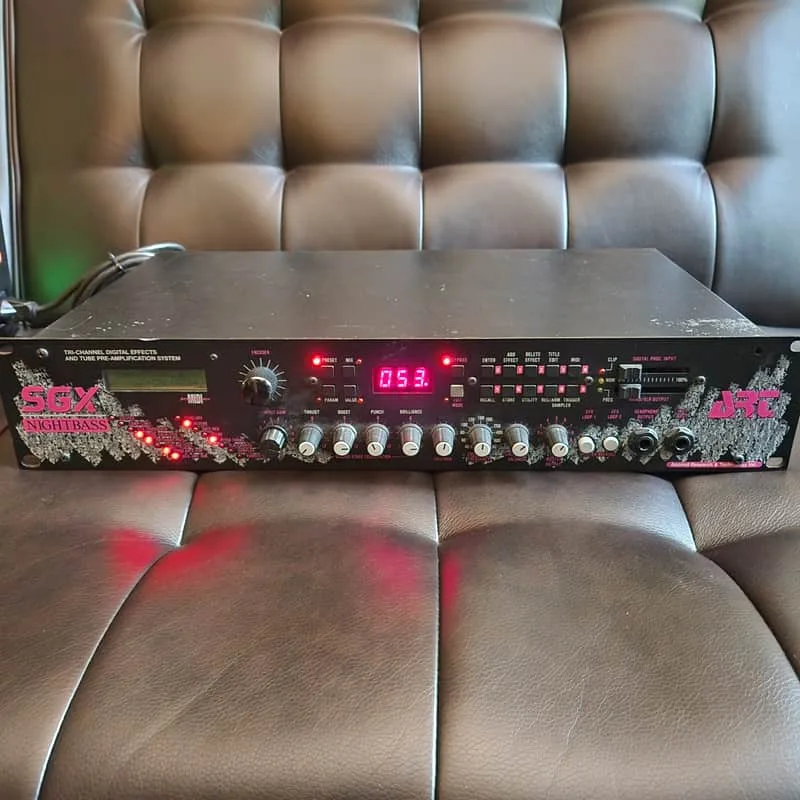



The ART SGX Nightbass is a rack-mount preamp, analog and digital effects processor built for bass. ART describes it as combining "the dazzling effects of ART's own digital VLSI technology with applied analog and tube technology," with 24-bit architecture and classic tube circuitry in the preamp section1. It sits in an all-steel double-high 19-inch rack case designed for continuous professional use1.
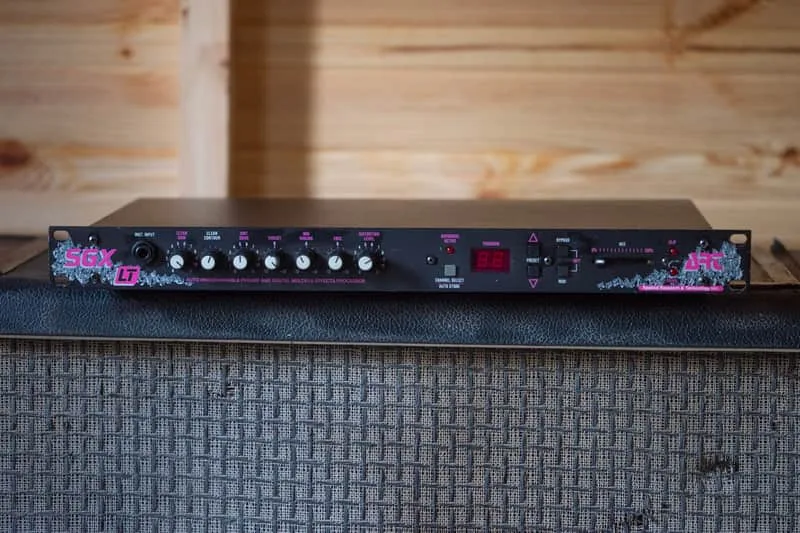
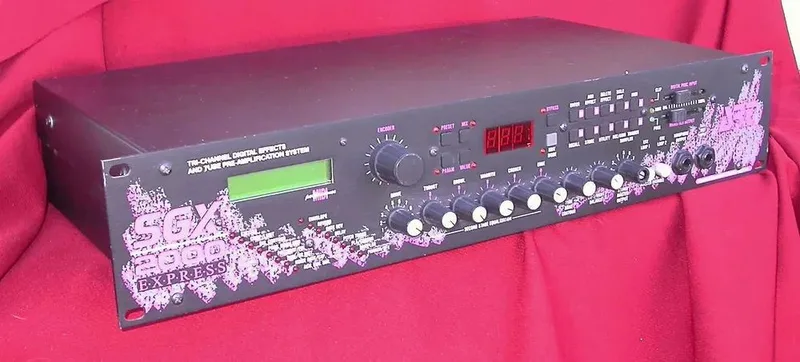
For a bass player, the Nightbass covers the jobs of a preamp, an equalizer and a multi-effects unit in one chassis: you plug straight into the front panel, shape your tone, and send the result to an amp, a mixer or a bi-amped rig. It belongs to the same ART family as the SGX 2000, the SGX LT and the SGX 2000 Express, all of which share the hybrid tube-and-digital approach123.
Input gain and the four-band equalizer
The Input Gain control on the front panel sets the input level feeding the preamp section. Its range runs from 1 to 11, and at 0 no signal is sent to the effects at all1. That makes it both a level match for different basses and pickups and a quick mute for the effect path.
The Nightbass carries a programmable equalizer as part of its signal chain. The related SGX 2000 documents its seven-band programmable EQ in detail: bands at 40Hz, 100Hz, 250Hz, 640Hz, 1.6KHz, 4KHz and 10KHz, each adjustable plus or minus 15dB in twelve steps, with 0 as the default2. The Nightbass shares the programmable EQ concept, and its EQ sits in the chain after the analog section, just before the point where Effect Loop 1 inserts1.
A Crossover Frequency control sets the split point from 40Hz to 800Hz for bi-amping, feeding separate High and Low crossover outputs on the rear panel1. That is the feature that separates the Nightbass from most guitar-oriented multi-effects units: a bass player running two power amps or a bi-amped cab setup can send low and high bands to different destinations directly from the rack.
Inputs, outputs and effect loops
Connections are split between the front and rear panels.
| Connection | Location | What it does |
|---|---|---|
| Instrument input, 1/4" | Front panel | Plug a bass in directly with a standard cable1 |
| Line inputs, Left/Mono and Right | Rear panel | Stereo line-level input1 |
| Two 1/4" line outputs | Rear panel | Final signal to amplifiers, mixers or recorders1 |
| Male balanced XLR outputs | Rear panel | Balanced line feeds, pin 2 hot1 |
| Headphone output | Front panel | Monitoring1 |
| High and Low crossover outputs | Rear panel | Bi-amp feeds from the crossover1 |
The XLR outputs are wired with pin 2 hot (+), pin 3 negative (-) and pin 1 ground, and their level is set by the Mains/XLR slider rather than the Stereo Master Output control, so the two output paths are level-matched independently1.
Two effect loops let you insert outboard gear into a preset. Effect Loop 1 is a mono send and return located at the end of the analog section and before the programmable seven-band equalizer, which makes it the natural home for outboard overdrive, compressor or EQ units that you want ahead of the digital processing1. Effect Loop 2 provides a second insertion point. Both loops are switched in and out with front panel push switches, and the loop must be switched in and the Patch Bay algorithm used for the outboard gear to appear in a stored preset1.
The Panner algorithm requires both outputs to be used in stereo. With only one output connected, the effect signals cancel and there is no effect at all1.
Presets and MIDI
The Nightbass holds 200 memory locations with 115 factory presets1. Presets 116 through 200 are null when the unit arrives or after a factory reset, so those slots are where your own sounds live, and Factory Preset 100 is programmed blank so it can be used to delete stored presets1.
Factory presets 1 through 115 are locked. You can change their parameters, but the new values cannot be stored unless the presets are unlocked through the Utility section1.
Preset selection works by encoder scanning or by keypad entry of preset numbers using digits 0 through 9. Entering only one digit will not recall a preset, so preset numbers are always multi-digit entries1. Preset 002 is set up as an automatic tuner: select it and tune1. Each preset can be named in TITLE EDIT, which offers sixteen spaces with the complete ASCII character set1. The backlit LCD shows two sixteen-character lines, with the preset title on the upper line and the preset number plus an abbreviated effect description on the lower line, and the backlighting is intended for low-light stage use1.
On the MIDI side, the Nightbass offers full MIDI system exclusive codes, a MIDI data monitor, and direct interface capability with the ART X-15 Ultrafoot controller1. The related SGX 2000 shows what the family's MIDI implementation can do: MIDI programs may be assigned to any preset number, Performance MIDI allows up to eight parameters per preset to be controlled simultaneously, and you can dump a single preset, the entire MIDI program table, or all presets via MIDI to another unit or a MIDI storage device2. The SGX 2000 Express variant dropped the +9V power out jack that the Nightbass and SGX 2000 carry2.
Power and the PWR OUT jack
The Nightbass is AC powered through a standard 3-conductor grounded power cable, with the power supply contained inside the unit, so there is no external wall wart to lose1. That internal supply is worth noting next to the SGX LT, the solid-state preamp member of the family, which runs as a digital unit with an analog solid-state preamp rather than the Nightbass's tube front end3.
The rear panel PWR OUT jack provides a +9V DC output for external devices such as the ART X-11 and X-15 foot controllers, and it accepts a 2.1mm female connector1. That means one rack unit can power its own floor controller from the same supply, which saves an outlet and a power adapter in a stage rig.
Videos
Mathias Bronnes
Eric Lesniewski
Eric Lesniewski
Questions
Is the ART SGX Nightbass a tube or digital unit?
It is a hybrid. ART describes it as combining digital VLSI effects processing with applied analog and tube technology, built on 24-bit architecture with classic tube circuitry in the preamp section. So the front end is tube and analog, while the effects are digital.
How many presets does the SGX Nightbass have?
The unit has 200 memory locations, of which 115 are factory presets. Presets 116 through 200 are null when the unit is received or after a factory reset, so those 85 slots are where your own sounds go. Preset 002 is set up as an automatic tuner.
Can I overwrite the factory presets on the SGX Nightbass?
Not as shipped. Presets 1 through 115 are locked; you can change their parameters but you cannot store the new values unless you unlock them through the Utility section. Your own sounds go in presets 116 through 200, and Factory Preset 100 is programmed blank so it can be used to delete stored presets.
Does the SGX Nightbass have a built-in tuner?
There is no dedicated tuner section, but Preset 002 is set up as an automatic tuner: select it and tune. The related SGX 2000 has a full digital tuner with BASS and GUITAR modes, including 12-fret variants.
What are the XLR output pinouts on the SGX Nightbass?
Pin 2 is hot (positive), pin 3 is negative, and pin 1 is ground. The XLR output level is set by the Mains/XLR slider, not by the Stereo Master Output control, so adjusting the master output will not change the XLR level.
Sources (3)
- 490MAN.PDF, ART, 2025
- 500MAN.PDF, ART, 2025
- TABLE of CONTENTS, Applied Research & Technology, Inc. (ART), 1992-02