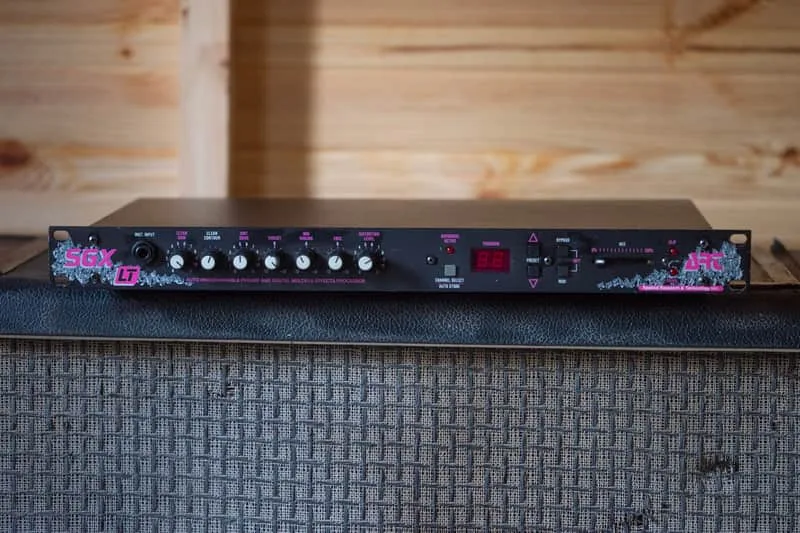


For a player, it works as a rack mounted multi-effects unit: the preamp shapes the guitar signal going in, and the digital section supplies effects that can be recalled as presets. It carries 250 studio effect presets, with up to three studio effects combinations available per preset1.
What it is and how it is built
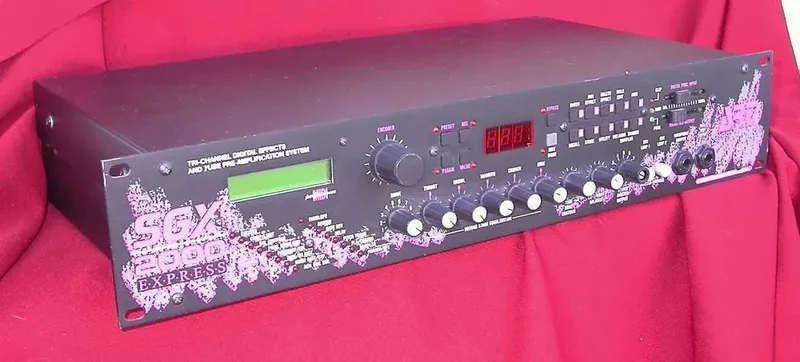
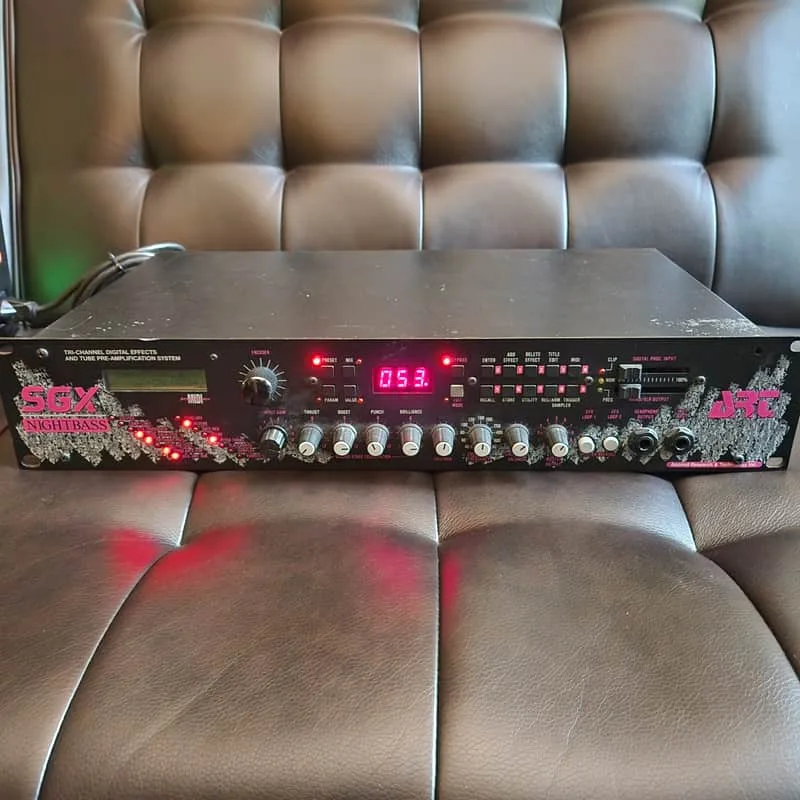
The SGX LT sits in ART's SGX family of rack units. It is the compact sibling of the ART SGX 2000, a guitar preamp and multi-effects processor with tube and analog preamp circuitry in a double high 19-inch rack case2, and of the ART SGX NIGHTBASS, the bass preamp equivalent, also in a double high case3. The SGX LT takes a single rack space instead of two, and where the SGX 2000 and NIGHTBASS pair digital VLSI effects with tube technology23, the SGX LT's preamp is analog solid state1.
Its published specifications from the maker's manual:
| Specification | Value |
|---|---|
| Dynamic range | >85dB typical1 |
| Equivalent input noise | -107dBv1 |
| Input impedance | 47K ohm1 |
| Output impedance | 1.5K ohm1 |
| Operating level | 0BV max1 |
The outputs are single ended (unbalanced) at 1.5K ohms impedance and can provide a stereo or mono signal1. The Clean Gain control adjusts the input gain of the clean channel, with a control range of 0 to 111.
The presets: 250 effects, up to three at once
The unit holds 250 studio effect presets, and each preset can combine up to three studio effects at once1. The manual's program tables list the program number, preset number, whether distortion is enabled, and the effect's settings: the slapback delay table gives delay time left and right, the reverb with long predelay table gives decay time and predelay in ms, and the echo table gives delay time left and right plus regen in percent1. Individual programs show the range of combinations available, such as preset 155 (F5), a reverse effect with slapback, and presets 161 (G1) and 164 (G4), slope and flat settings with regen ddl1.
Each table lists the program number, preset number, whether distortion is enabled, and the effect's timing parameters. For example, the slapback delay table lists program number, preset number, distortion enable and delay time left/right, while the echo table adds regen percentage, and the reverb with long predelay table lists decay time and predelay in milliseconds1. A few named programs give a sense of what the groups contain:
| Program | Preset | Distortion | Description |
|---|---|---|---|
| 155 (F5) | 0.1 | Enabled | reverse (w/SLAP), hf decay varies1 |
| 161 (G1) | 0.2 | Enabled | slope w/regen ddl1 |
| 164 (G4) | 0.2 | Off | flat w/regen ddl1 |
| 167 (G7) | 0.2 | Enabled | reverse w/regen ddl1 |
| 170 (H0) | Enabled | inverted mono flange1 | |
| 171 (H1) | Off | inverted mono flange no distortion1 |
Inputs, outputs and MIDI
There are two mono inputs: an Instrument Input on the front panel and a Line Input on the rear panel, both 1/4" phone jacks1. A guitar can be plugged directly into the front panel jack, while the rear input handles line level sources.
On the output side, the SGX LT has LEFT and RIGHT 1/4" phone outputs plus a headphone output on the rear panel, which is a standard 1/4" stereo jack1. Using both main outputs produces a stereo image; a single output gives mono1.
MIDI is a five pin DIN jack on the rear panel, and the unit receives program change messages, so presets can be switched from a MIDI controller1. This is a simpler MIDI implementation than the SGX 2000, which carries MIDI IN, OUT and THRU jacks and accepts MIDI data at all times regardless of operating mode2, and the ART SGX 2000 Express, which adds an editable MIDI Program Table4.
The SGX LT is AC powered through a standard 3 conductor grounded power cable, drawing mains voltage directly (105-125 Volts AC, 60Hz) rather than a 9V pedal-style supply1. It is a rack unit, not a stompbox, so it belongs in a rack or on a shelf rather than on a pedalboard.
Videos
TechWith Todd
G.A.M. Productions (Gambina Audio & Media)
Tone Works
Questions
Does the ART SGX LT have a headphone output?
Yes. A headphone output is located on the rear panel, and it is a standard 1/4 inch stereo jack, so ordinary stereo headphones can be plugged straight in for silent practice or monitoring.
Can I plug a guitar straight into the ART SGX LT?
Yes. There is an Instrument Input on the front panel, a 1/4 inch phone jack, so a guitar can be connected directly with a standard instrument cable. A rear panel Line Input is also available for line level sources.
Does the ART SGX LT accept MIDI program changes?
Yes. The MIDI connection is a five pin DIN jack on the rear panel, and the unit receives program change messages, so presets can be switched remotely from a MIDI controller or footswitch.
Is the ART SGX LT stereo?
Yes. It has LEFT and RIGHT 1/4 inch outputs, and a stereo image is produced when both outputs are used. A single output can be used for mono operation.
Sources (4)
- TABLE of CONTENTS, Applied Research & Technology, Inc. (ART), 1992-02
- 500MAN.PDF, ART, 2025
- 490MAN.PDF, ART, 2025
- Voes | MIDI-CC, Voes, 2024