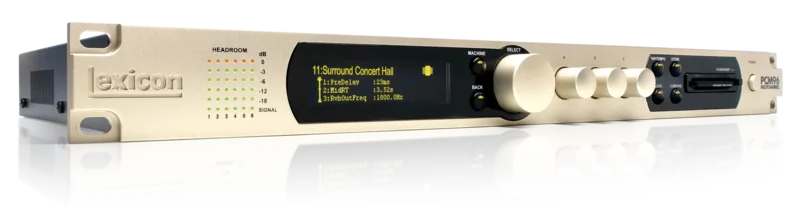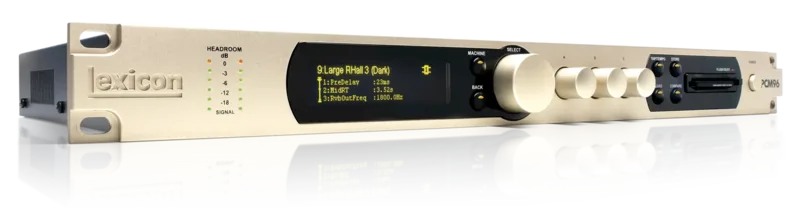


The Lexicon PCM96 is a stereo reverb and effects processor from Lexicon Pro that occupies a single rack space. Lexicon describes it as delivering 28 new and legendary Lexicon reverbs, delays and modulation effects, with over 1200 factory presets, 32-bit floating point processing and sample rates up to 96 kHz1. For a player, it is the rack-mount route to the Lexicon reverb sound: a unit that can sit in a studio insert loop or at the end of a pedalboard chain, fed from an amp loop or a mixer, and controlled from its front panel or over MIDI.
What it does to a signal
The PCM96 is a stereo processor, so it takes a left and right input and returns a left and right output, whether those connections are analog XLR or digital AES/EBU. In standalone mode, Lexicon says the unit can process up to two physical inputs and two outputs in analog and digital configurations1. In practice that covers the two ways most players and engineers use it: patched into a mixing console's insert or aux loop with XLR cables, or inserted digitally in a recording setup through its AES/EBU connections.
The effect set spans the categories a rack reverb unit is expected to carry: reverbs, delays and modulation effects, 28 of them by Lexicon's count1. Lexicon artist Tim Jones described the character of the reverb algorithms this way:
"I love the dense, complex reverbs in the PCM96."
Controls and connectivity
The front panel is built around knobs rather than a deep menu system, and that is one of the points players who use the unit bring up. Alan Parsons, on his Lexicon artist page, said4:
"The front panel knobs are intuitive and instantly functional and the device is refreshingly free of lengthy menus"
Parsons also called the unit affordable and easy to use4. For control from outside the rack, the PCM96 includes MIDI I/O alongside its audio connections1, so preset changes can be sent from a MIDI controller or pedalboard.
The connections are:
The PCM96 family
Lexicon builds a larger sibling around the same name. The PCM96 Surround is described by Lexicon as a parallel stereo and surround reverb and effects processor with digital I/O, built on the success of the PCM96 with more presets, more configuration options and more inputs and outputs5. It comes in two hardware versions: one with 6 XLR stereo AES inputs and outputs, and one with 2 DB25 6-channel analog I/O and 1 DB25 6-channel digital I/O5. The Surround version adds MIDI in, out and thru, an external BNC wordclock input, and 768 user presets6. For a stereo rig, the standard PCM96 is the unit in this family with the smaller footprint and the two-channel analog and digital I/O.
Who uses it
Lexicon's artist pages name the PCM96 among the gear of recording engineers and producers. George Massenburg is listed on his Lexicon Pro artist page as using the PCM967. Graham Pattison's page describes the unit as "two machine's of famed Lexicon reverbs and effects in a 1u package"2, a framing that speaks to how much of the company's reverb heritage Lexicon packed into the single rack space.
Availability
Lexicon's product page lists the PCM96 as a current product, with retailer purchase links and worldwide distributors shown on the page1. The PCM96 Surround is likewise listed as current with retailer availability and worldwide distributors5.
Videos
gearwire
gearwire
SK Creation
Questions
How many rack spaces does the Lexicon PCM96 take?
The PCM96 is a 1U rack unit. Lexicon artist Graham Pattison describes it as two machines' worth of famed Lexicon reverbs and effects in a 1U package, so it fits a single space in a standard rack while carrying the full stereo reverb and effects engine.
Does the Lexicon PCM96 have MIDI?
Yes. The PCM96 includes MIDI I/O alongside its two channels of XLR analog and two channels of XLR AES/EBU digital connections, so it can be controlled from a MIDI pedalboard, controller or sequencer in a rig or studio setup.
What sample rate does the Lexicon PCM96 run at?
The PCM96 runs at sample rates up to 96 kHz and uses 32-bit floating point processing, according to Lexicon's product page. That places it comfortably within the range of modern studio recording and mixing setups.
How many presets does the Lexicon PCM96 have?
Lexicon lists over 1200 factory presets on the PCM96, described on the product page as 'over 1200 and growing'. The related PCM96 Surround model adds 768 user presets on top of its factory bank.
Does the Lexicon PCM96 have digital inputs and outputs?
Yes. The PCM96 carries two channels of XLR analog I/O and two channels of XLR digital AES/EBU I/O, plus MIDI. That means it can sit in an analog insert loop or take a digital feed directly from an interface or console.
Is the Lexicon PCM96 still made?
Lexicon's product page lists the PCM96 as a current product, with retailer purchase links and worldwide distributors shown on the page as of the date verified here. The PCM96 Surround variant is likewise listed as current.
Sources (7)
- PCM96 | Lexicon Pro - Legendary Reverb and Effects | English, Lexicon Pro
- Graham Pattison, Lexicon Pro
- Tim Jones, Lexicon Pro
- Alan Parsons, Lexicon Pro
- PCM96 Surround, Lexicon Pro (lexiconpro.com)
- PCM96 Surround (digital), Lexicon Pro
- George Massenburg, Lexicon Pro