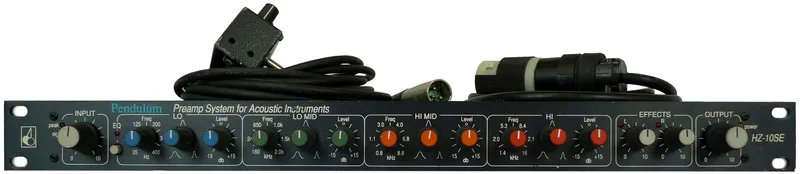
The Pendulum Audio HZ-10SE is a preamp system for acoustic instruments with stereo effects, which Pendulum Audio describes as "the first professional-quality preamp system designed specifically for acoustic instrument pickups"1. Rather than a single box, it is a three-part system: a small "front-end" instrument preamp called the Preamp Module, a rack-mountable Main Preamp Unit containing a four-band parametric equalizer and a stereo effects interface, and a dual foot switch1.
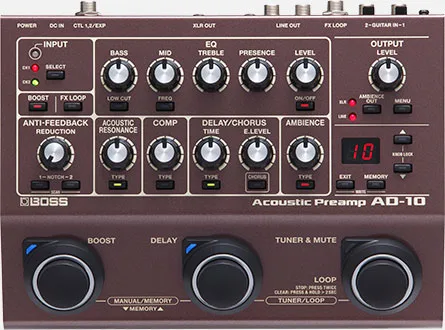
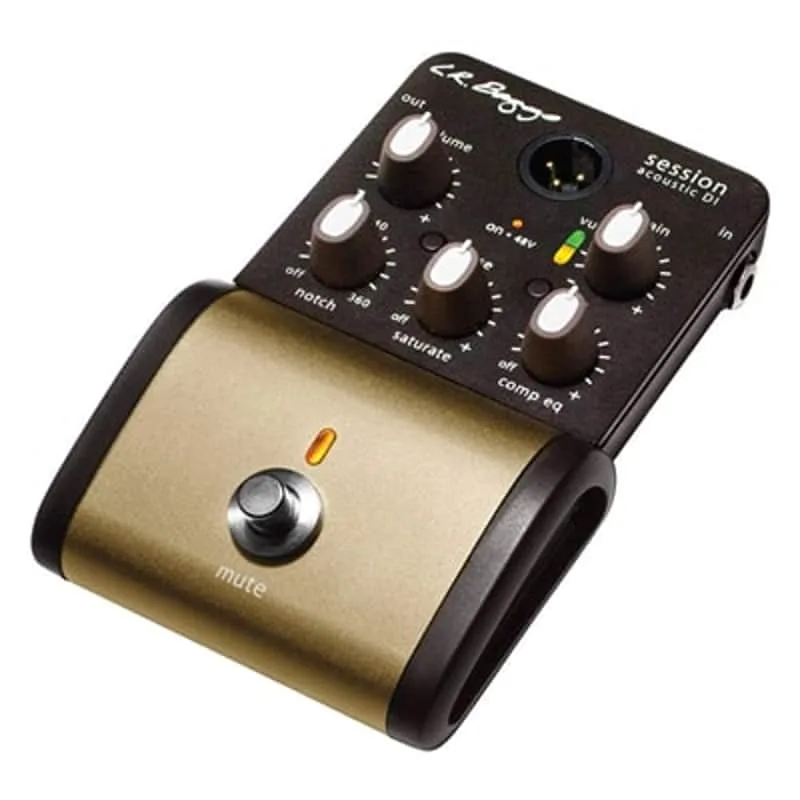
The idea is that the pickup signal gets a clean, high-headroom gain stage close to the instrument, then travels down a balanced line to the rack unit where EQ and effects are applied. Because the system is modular, it adapts to any type of pickup system simply by changing Preamp Modules1. For players comparing acoustic preamps, it sits at the professional rack end of the spectrum rather than the floor-pedal end occupied by units like the Boss AD-10 Acoustic Preamp or the LR Baggs Session DI.
What the HZ-10SE does
The signal flow starts at the Preamp Module, a compact box measuring 1.1" x 2.2" x 1.0" excluding its input plug, with an adjustable gain control of 0 to +20 dB1. It feeds the Main Preamp Unit through a balanced, phantom-powered line, which Pendulum Audio says allows operation with greater headroom and dynamic range than battery-powered units1.
Inside the rack unit, the four-band fully parametric EQ offers ±15 dB of boost or cut per band, with each band's frequency and bandwidth adjustable1:
| Band | Frequency range | Bandwidth | Q |
|---|---|---|---|
| Lo | 35 to 400 Hz | 0.10 to 1.0 octave | 10 to 1 |
| Lo-Mid | 180 to 2000 Hz | 0.33 to 1.0 octave | 3 to 1 |
| Hi-Mid | 800 to 8800 Hz | 0.33 to 1.0 octave | 3 to 1 |
| Hi | 1.5 to 16 kHz | 0.33 to 1.0 octave | 3 to 1 |
The stereo effects interface has two modes set by a rear-panel MIX/REPLACE switch. MIX mode blends effects with the unprocessed "dry" guitar sound, suited to effects like reverb and delay. REPLACE mode is for effects meant to replace the dry sound, such as a compressor or limiter, or for effects units with their own mix control1. A separate MONO switch reconfigures the interface as two mono effects loops in parallel with the instrument signal, which the manual notes can be used to obtain a split output feed for driving a stage amp and a sound reinforcement system at the same time without a splitter box1.
The dual foot switch turns the instrument on and activates the stereo effects loop from the playing position; the effects loop is only active when the Instrument ON switch is also depressed1. Switching inside the unit uses FETs in a shunt switching mode, which the manual says effectively takes them out of the signal path when activated, for silent switching without FET-induced distortion1.
Preamp Module versions
The Preamp Module comes in several versions, and the system adapts to different pickups by swapping modules1:
- Endpin Jack version
- Belt-clip version
- HZ-10(I) implant
- HZ-10(D) dual pickup module
- Mini-Mic Preamp Modules
The Mini-Mic modules are designed to work with all currently available 3-wire mini-mics in a 2-wire hookup, and they supply power to the mini-mic so internal batteries in the mic are eliminated1. Input impedances are specified at 10 MΩ, unbalanced, for the piezo or magnetic pickup input and 47 kΩ, unbalanced, for the mini-mic input1.
Power and connections
The Main Preamp Unit runs on 120 VAC mains power at 10 Watts1. It supplies +48 Vdc phantom power to the Preamp Module through the rear-panel 3-pin XLR Preamp Module input, and the manual warns this input should only be used with the Preamp Module or other sources equipped to use the phantom voltage1.
| Connection | Type | Notes |
|---|---|---|
| Preamp Module input | 3-pin XLR, phantom powered | +48 Vdc on pins 2 and 31 |
| Line in | 1/4" phone jack, unbalanced | Accepts unbalanced or TRS balanced line signals1 |
| Effect returns (L and R) | 1/4" phone jack, unbalanced | Accept low and high level signals1 |
| L/R outputs | 1/4" TRS balanced (XLR optional) | Interfaces with unbalanced and balanced line systems1 |
| Effects sends | 1/4" phone jack, unbalanced | Post-equalizer signal for effects or a tuner1 |
| Foot switch | 1/4" TRS phone jack | 10 mA current loop1 |
The Line input is an accessory input that lets the Main Preamp Unit work as a stand-alone parametric equalizer, or serve as the input for a wireless receiver1. The rear-panel SEND LEVEL control matches the send output to the effects being used: full level for +4 dBu professional inputs, halfway for -10 dBV semi-pro equipment, and below halfway for instrument-level effects1.
The main and effects send outputs are muted for about 3 seconds at power-on while internal voltages stabilize, minimizing turn-on transients1. The manual elsewhere describes the outputs as muted for 5 seconds when the power is turned on, so expect a few seconds of silence before sound appears.
Specifications
| Specification | Value |
|---|---|
| Frequency response | +0/-1 dB, 20 to 20,000 Hz |
| Maximum input level | +15.5 dBu (4.6 Vrms) |
| Maximum output | +21 dBu unbalanced, +27 dBu balanced |
| Gain | 0 to +20 dB, adjustable |
| Input noise | EIN less than -113 dBu, input shorted |
| Output noise | Less than -93 dBu (EQ out, unity gain); less than -88 dBu (EQ in, flat) |
| Distortion | THD less than 0.01% at 0 dBu |
| Metering | Signal green LED at -20 dBu, Peak red LED at +14 dBu |
All noise measurements are unweighted over a 20 to 20,000 Hz bandwidth1.
Warranty
Pendulum Audio, Inc. warrants to the first purchaser of a new HZ-10SE that the unit is free of manufacturing defects in materials and workmanship for one year from the date of purchase, and will provide parts and labor without charge for defects appearing within that period1. The warranty does not cover damage due to misuse, abuse, modification, accident or negligence1. Warranty repair requires return authorization from Pendulum Audio before shipment, and the owner pays two-way shipping, with the manual recommending UPS and suggesting the shipment be insured1.
Questions
Does the HZ-10SE Preamp Module need phantom power?
Yes. The Preamp Module is powered by +48 Vdc phantom power supplied from the Main Preamp Unit through its 3-pin XLR input, applied to pins 2 and 3. Pendulum Audio says this gives the module greater headroom and dynamic range than battery-powered units, and the module has no internal battery to replace.
Will the HZ-10SE work with a magnetic pickup or mini-mic?
Yes. The system is modular and adapts to different pickup systems by changing Preamp Modules. Versions include an Endpin Jack version, a Belt-clip version, the HZ-10(I) implant, the HZ-10(D) dual pickup module, and Mini-Mic Preamp Modules. Pickup inputs are specified at 10 MOhm unbalanced and mini-mic inputs at 47 kOhm unbalanced.
How many rack spaces does the HZ-10SE take?
One. The Main Preamp Unit measures 1.75 x 19 x 6 inches, which is a single standard rack space. The Preamp Module is a small outboard box at 1.1 x 2.2 x 1.0 inches excluding its input plug, and the foot switch is 4.3 x 2.3 x 1.2 inches.
What does the HZ-10SE warranty cover?
Pendulum Audio warrants the unit to the first purchaser to be free of manufacturing defects in materials and workmanship for one year from the date of purchase, and will provide parts and labor without charge for defects appearing within that period. It does not cover misuse, abuse, modification, accident or negligence, and you pay two-way shipping.
Why are the HZ-10SE outputs muted at power-on?
The main and effects send outputs are muted for about 3 seconds when the unit is turned on, letting the voltages inside the unit stabilize and minimizing turn-on transients. The manual also describes the outputs as muted for 5 seconds at power-on for the same purpose, so the exact interval varies by description.
Sources (1)
- Microsoft Word, Pendulum Audio, Inc.