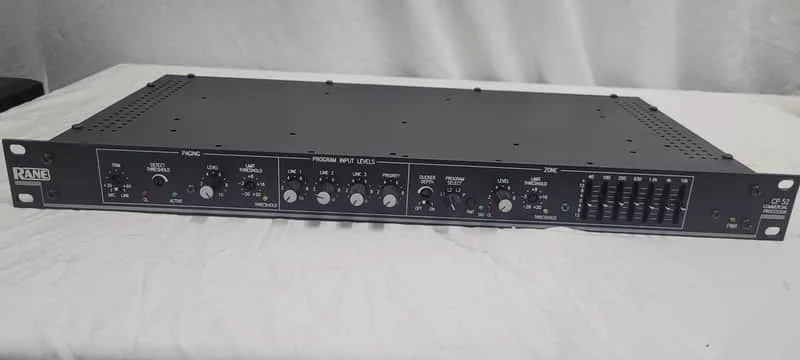
The Rane CP 52 is a page and zone processor: a rack unit for commercial sound systems that takes program inputs, a page input, and a ducker, and feeds zone outputs through EQ filters1. It is not a guitar effect. Rane built it for installed sound, where a paging microphone has to duck background music across one or more zones, and the EQ on each zone output shapes the sound for the room rather than for an amp.
For a guitarist arriving here, the honest answer is that this unit has no place on a pedalboard. It runs on AC power, uses terminal-block connectors, and its controls are about paging priorities and zone levels, not tone shaping for an instrument. Players looking for tone shaping should look at equalization pedals instead. What follows is what Rane's own schematic documents show about how the CP 52 is built and what it does12.
What the CP 52 does
The unit's job is commercial audio distribution. It accepts four program inputs, and the schematic designates program input 4 as the priority input1. A separate page input handles a paging microphone, with a Mic/Line switch offering a 10 to 40 dB range and phantom power2. A ducker sits in the signal path so that a page announcement drops the program level in the zones2.
Each zone output, left and right, passes through a seven-band EQ. The 1997 schematic set lists the filter frequencies for both zone channels2:
| Filter | Zone Left and Zone Right |
|---|---|
| Filter 1 | 40 Hz boost |
| Filter 2 | 100 Hz boost |
| Filter 3 | 250 Hz |
| Filter 4 | 630 Hz boost |
| Filter 5 | 1.6 kHz |
| Filter 6 | 4 kHz boost |
| Filter 7 | 10 kHz21 |
The EQ slider board uses 100K sliders for the seven filter bands on each channel2. The 2004 schematic also identifies Filter 1 at 40 Hz and Filter 7 at 10 kHz on the zone left and zone right paths2.
Controls shown in the schematics
The schematic documents name the controls a service technician would find on the unit21:
- Page Trim2
- Page Level2
- Zone Level2
- Threshold, in dB, for the gate section2
- Priority Threshold2
- Program 3 Level2
The ducker and priority circuits use LM339 comparators for gate, detect and priority functions, while the page and zone signal paths run through SSM2164 voltage-controlled amplifiers12. The Zone Level control tracks the zone signal path, and the priority threshold sets where the priority program input takes over.
How it is powered
The CP 52 runs from an 18 V AC supply1, connected through European-style screw terminals: a EURO 3-STA connector on the page input section and a EURO 5-STA connector on the zone section1.
This is AC power at a terminal block, not the DC supply a pedalboard uses. The CP 52 runs on 18 V AC2, so it cannot run from a typical pedal power supply, and it is not a battery or daisy-chain device.
Where it came from
The CP 52's schematic history is documented in two Rane drawing sets. The 1997 set, document 100477, was drawn by SKH and checked by RJ on 26 November 1997, issued as a new document number for the CP 52 with no change to the drawing1. A later revision, drawing 107859, runs to five sheets and carries a schematic date of 5 August 2004, with designer initials RWJ2. That revision records a connection change between points Q4-3 and Q5-3, made by RWJ on 7 April 2004, while sheets 2, 4 and 5 carry the note "NO CHG TO THIS PAGE"2.
Why a guitarist would not use one
Everything about the CP 52 points away from the pedalboard. Its inputs are line and mic level with terminal connectors, its EQ bands are fixed boost filters on zone outputs rather than a player-adjustable tone curve in front of an amp, and its ducker and priority circuits exist to manage paging over background music. A player who wants to shape their tone with sliders has a range of equalization pedals built for exactly that, at instrument level and pedal power21.
Questions
Can the Rane CP 52 be used with a guitar?
Not as intended. The CP 52 is a page and zone processor for commercial sound distribution, built around program inputs, a page input with a ducker, and zone outputs with EQ. It has no instrument-level input or guitar-oriented controls, so a player looking for EQ on their board is better served by an equalisation pedal.
What power does the Rane CP 52 need?
The schematic shows an 18 V AC power input, delivered through European-style terminal connectors on the page input and zone sections. This is mains-adjacent AC power, not the 9V DC center negative supply a typical pedalboard runs on, so it cannot share a pedal power supply.
Does the Rane CP 52 have phantom power?
Yes. The schematic shows a Mic/Line switch with a 10 to 40 dB range and phantom power on the page input section, which suits the paging microphones this unit was designed to manage in a commercial installation.
Sources (2)
- CP 52 SCHEMATIC, Rane Corporation, 1997-11-26
- CP 52 SCHEMATIC, Rane Corporation, 2004-08-05