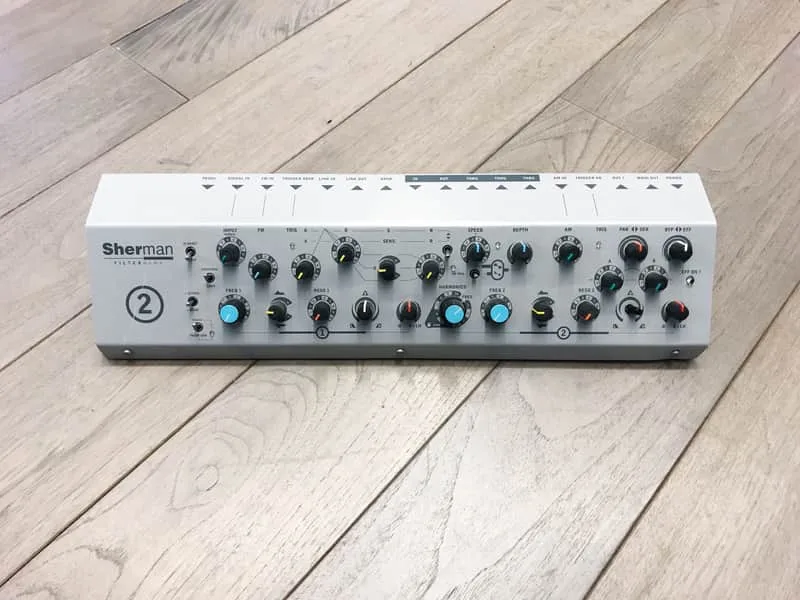


The Sherman Filterbank 2 is a stand-alone analog filter and distortion unit in a 19 inch rack case, built by Sherman Productions, a small Belgian manufacturer. It is the successor to the original Sherman Filterbank, and it takes the same idea further: a 12 or 24 dB/octave, 4-pole dual filter module with one signal input and two audio outputs, driven by LFO, ADSR and AR modulation, with tube-style overdrive behavior and a huge frequency range12. Where a filter pedal shapes one sound one way, the Filterbank 2 is a filter instrument in its own right.
The reviews collected on Sherman's own site call it "one of the most complex, flexible and great sounding stand-alone filters on the market"1, and Vintage Synth Explorer notes it "shines when it comes to producing the famous sound of filtered loops"2. It was produced from 20012 and listed at $799 in August 20011.
A stand-alone analog filter in a rack case
The Filterbank 2 lives in an aluminum case with a metallic gray finish and an angled control surface, replacing the original's white front panel1. It just about fits into a 2U rack space, but Sherman's reviewers note it looks equally at home on a tabletop with its industrial look1. The filters can run dual mono or linked, with crossfading from hi-pass to low-pass filtering under LFO and ADSR modulation2.
The original Filterbank lived in a white (light gray) 19" rack unit about 10 centimetres thick, with one sloping corner cut into its front panel1. The Filterbank 2 replaced that white finish with a metallic gray, housed in an aluminum case with an angled control surface, and carried a list price of $7991. It was produced from 20011.
A compact variant also exists: MusicRadar's 2017 group test of hardware filters describes the Filterbank 2 Compact as flattening the original angled case and bringing the I/O array to the front, which works well with Eurorack and modular setups5. MusicRadar called the Filterbank 2 "ear-meltingly awesome, capable of lush filtering as well as flying off into wild worlds of wobbly weirdness, usually at the flick of a switch"5.
The controls and switches
The front panel offers 24 knobs and six switches, with the knobs color coded by function1. Vintage Synth Explorer lists ADSR and AR controls for the VCA among what the Filterbank 2 added over the original2.
| Control or switch | What it does |
|---|---|
| 24 knobs, six switches | Full front panel, color coded by function1 |
| Sensitrig/Limit 3-way switch | Sensitrig makes triggering twice as sensitive, for example on clean string pad filtering; Limit leaves the filters more breathing room for self-oscillation when the input stage is extremely overdriven6 |
| Tracking 3-way switch | A monophonic pitch follower that tunes filter 2 to the incoming pitch and makes filter 1 a slave of filter 2 via the harmonics switch, with a normal or deep "track low" position6 |
| LFO section 3-way switch | Selects sawtooth wave shape or AR retrig, forcing an LFO restart from the AR trig, with pumping grooves as the result6 |
| ADSR switch, middle position | The ADSR trigger "freezes" in the red zone of the LFO, the LFO randomly influences the ADSR and can softly retrigger it in some ADSR settings67 |
| Second filter 6 octave switch | Synchronizes the second filter with the first6 |
Two of the Filterbank 2's behaviors came about by accident or by batch. The middle position of the ADSR switch was incorporated after a batch of Filterbanks accidentally received 3-position switches7. And from serial number 8280 onward, a range extension function works in Harmonic mode (blue LED on) while the Freq2 and ADSR amount knobs are not at zero: it transposes both center frequencies, gradually downscales harmonic ratios, cuts away low on LP and BP, boosts low in HP, and creates cross modulation interference distortion via all possible Freq2 modulations, including the Freq2 knob, ADSR, LFO, FM and the MIDI mod wheel7. Prior to that serial number, in Harmonic mode the Freq2 knob and ADSR amount knob were not used6.
From serial number 7786 and higher, all Filterbank 2 models include a noise generator and feedback circuit with 4 different modes, activated when no jack is plugged at the input. With both outs plugged, the input delivers pure noise74.
Outputs, pedal input and MIDI
The rear panel carries one signal input, two audio outputs (OUT1 and MAIN OUT), a pedal input jack, and MIDI IN/OUT/THRU324. The pedal input allows foot control of the frequency of filter 1 and bypass or effect switching71, which reviewers called "dead handy live"1. Sherman's technical pages describe the input as suitable for a DIY pedal circuit3, so a player can build a pedal to suit.
When the bypass switch is open, the Filterbank 2 switches OUT1 and MAIN OUT to bypass, no matter the position of the bypass-effect pot3. On the MIDI side, Sherman provides a MIDI mixer map for Steinberg's Cubase sequencer, plus an Instrument Definition and Studioware Panel for Cakewalk3.
Filterbank 2 versus the original Filterbank
Sherman describes the Filterbank 2 as "the next evolutionary step of the hugely successful Sherman Filterbank"1. Against the original Filterbank, the version 2 adds:
- 5 extra new switches7
- 1 extra input for a footpedal7
- 2 extra new LEDs7
- A new silver-gray color with an improved long-lasting varnish layer7
Vintage Synth Explorer counts five three-way toggle switches added to the front panel as the core of what is new in the Filterbank 22. The original's white finish gave way to the metallic gray aluminum case with its changed front-panel layout1.
What reviewers said
The press response Sherman collects on its site centers on the unit's flexibility. Sonic State's review called it "one of the most complex, flexible and great sounding stand-alone filters on the market"1.
"The Sherman has to be one of the most complex, flexible and great sounding stand-alone filters on the market."
MusicRadar's 2017 hardware filter group test placed the Filterbank 2 Compact among five all-analog filter-centric effects units representing distinct points across a wide range of designs5.
Videos
shaft9000 DaveRosGerry
Mururoar
znshn
Questions
How many rack spaces does the Sherman Filterbank 2 take?
It just about fits into a 2U rack space, though its angled control surface and roughly 10 centimetre depth mean it also looks at home sitting on a tabletop. The original Filterbank shared the same 19 inch rack format with a sloping front panel.
What is different between the Filterbank 2 and the original Filterbank?
The Filterbank 2 adds five extra switches, one extra input for a footpedal, two extra LEDs, and a new silver-grey finish with an improved long-lasting varnish layer. The original's white finish is gone, and the front panel layout changed. Later units also gained a noise generator and feedback circuit.
Can a footpedal control the Sherman Filterbank 2?
Yes. A pedal input jack on the back panel allows foot control of the frequency of filter 1 and bypass or effect switching. Sherman's support pages describe it as suitable for a DIY pedal circuit, so a player can build or adapt a pedal for live use.
Is the Sherman Filterbank 2 analog or digital?
It is an analog processor. The filter is genuine analog circuitry with overdrive built in, but the unit adds MIDI I/O for control, so you get analog sound with digital remote control of parameters.
Sources (7)
- Reviews, Sherman (www.sherman.be), 2001
- Sherman Electronics FilterBank 2, Vintage Synth Explorer, 2026
- Technical Corner, Sherman
- History, Sherman (www.sherman.be)
- Tech group test: Hardware Filters, MusicRadar, 2017-07-14
- Filterbank, Sherman
- Features, Sherman