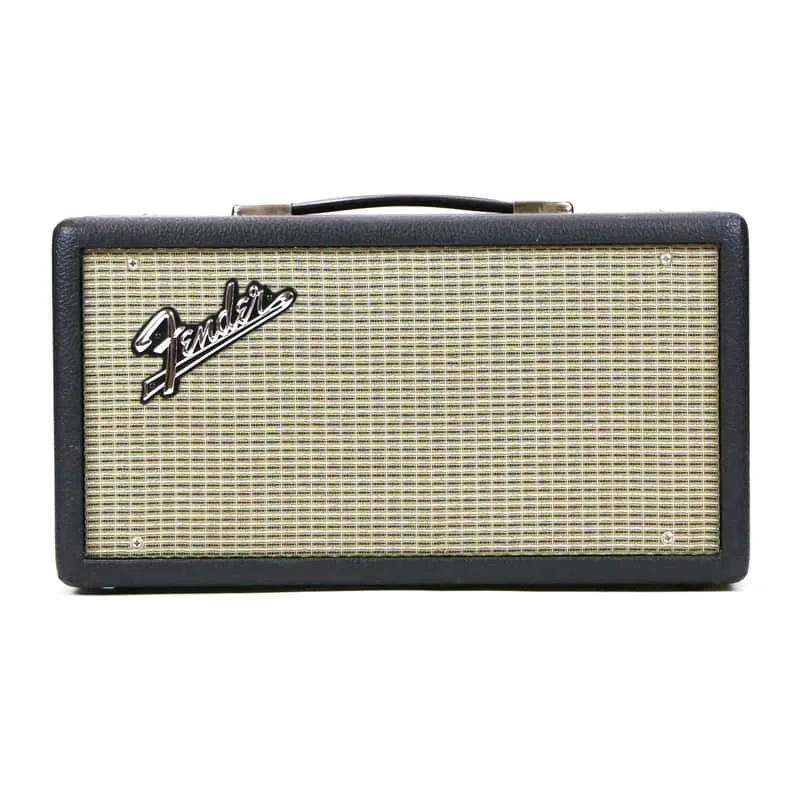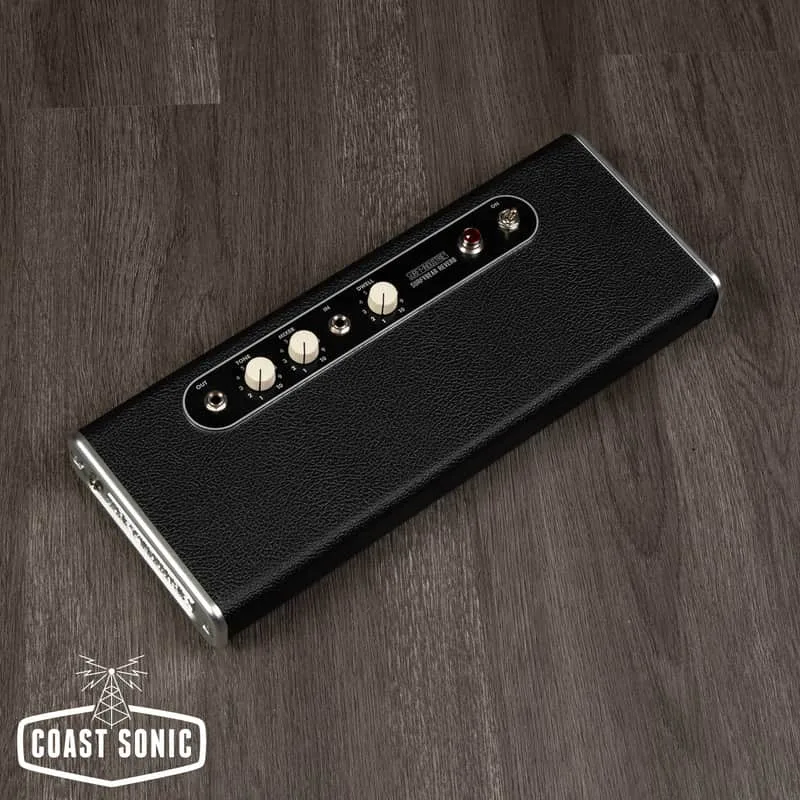


The SurfyBear Studio Edition is a rack-mounted spring reverb unit from Surfy Industries, built on the circuits of the Fender 6G15 standalone reverb, including its Class A driver and the frequency response of its recovery stage1. Where the original 6G15 was a tube-driven outboard box, the Studio Edition recreates that signal path with Class-A JFET/MOSFET technology, and it is a 100% analog design: the reverb you hear comes from a real spring pan, not a digital emulation1.
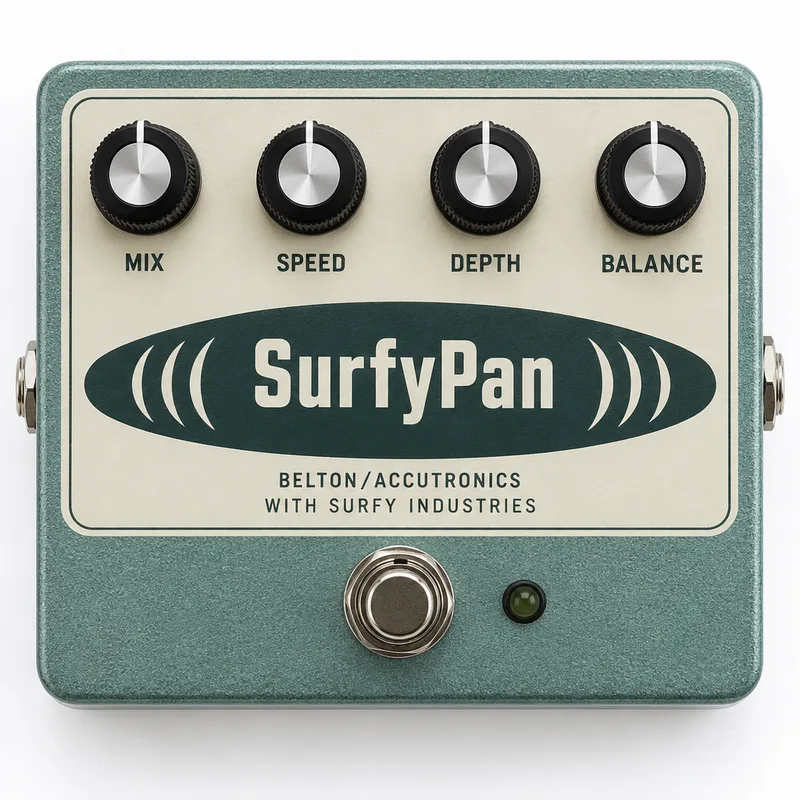
Surfy Industries positions it as the version of their SurfyBear reverb "dedicated to professional users and recording applications," with modern functionality for handling line-level signals alongside the instrument-level connections a guitar player expects2. It carries the SurfyPan type-4 spring reverb pan, made by Accutronics to Surfy Industries' custom specifications for decay and materials2.
The 6G15 lineage
The Fender 6G15 was one of the first reverb units available for electric guitars3. Press coverage has long tied it to a specific sound: Delicious Audio calls the outboard 6G15 "the sound of Surf guitar, Spaghetti Western and many other great guitar sounds from the sixties"4. The Studio Edition follows the same circuit approach, with the driver and recovery stage frequency response carried over from the original design, but implemented in solid-state Class-A form rather than with tubes1.
Controls
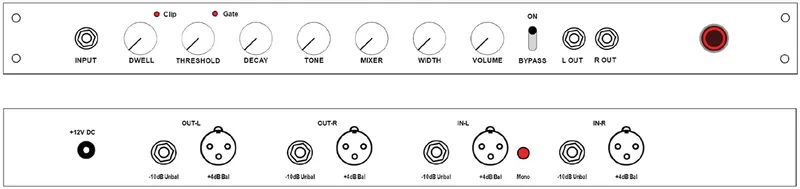
The front panel carries the controls familiar from the 6G15 tradition, plus gate controls for the decay tail1.
| Control | What it does |
|---|---|
| Dwell | Sets the level of the signal sent to the transducer of the reverb pan; a Clip LED lights when the reverb driver is overloaded1 |
| Threshold | Sets the threshold of the soft-knee gate circuit shaping the decay tail; at 0 the gate is disabled1 |
| Decay | Shapes the decay tail together with Threshold1 |
| Width | Generates a pseudo-stereo image on the wet signal2 |
The unit is built on the same circuits as the Fender 6G15, including the Class A driver and the frequency response of the recovery stage, realized with Class-A JFET/MOSFET technology1. Its input impedance is 1 MΩ at the front TS jack and its output impedance is under 600 Ω1.
Inputs, outputs and levels
The Studio Edition is built to sit between instrument-level gear and studio equipment, so it offers both kinds of connection21.
- Front panel: guitar input at -20 dBv (mono), and a guitar output at -20 dBv (stereo/mono)1
- Back panel line level: unbalanced TR jacks for IN-L / IN-R and OUT-L / OUT-R, plus balanced XLR inputs and outputs1
- Balanced outputs: electronically balanced output stage, no transformer1
- Maximum input and output level: +14 dBu at the rear XLR connections1
- Input impedance: 1 MΩ at the front TS jack; output impedance under 600 Ω1
A Mono switch on the back panel, when pressed in, makes the IN-L jacks serve as a mono input feeding both left and right channels, so stereo reverb effects can be created from both stereo and mono input signals1. The Width control then generates the pseudo-stereo effect on the wet signal2.
The power polarity is center positive, the opposite of the center-negative standard on most guitar pedals. The unit needs its own 12V DC 1A supply and cannot run from a typical pedalboard daisy chain1.
Specifications
| Specification | Value |
|---|---|
| Circuit topology | Class-A JFET/MOSFET1 |
| Input impedance | 1 MΩ TS front1 |
| Output impedance | < 600 Ω1 |
| Dimensions | 19", 1 HE, depth about 25 cm1 |
| Weight | 3 kg1 |
Videos
Guitar IQ - Play Smarter
Guitar IQ - Play Smarter
Questions
Is the SurfyBear Studio Edition a real spring reverb or a digital emulation?
It is a real, 100% analog spring reverb. The signal drives the transducer of a physical spring pan, an Accutronics-built SurfyPan with custom Surfy Industries specifications for decay and materials, and the circuitry around it uses Class-A JFET/MOSFET technology rather than digital processing.
How many rack spaces does the SurfyBear Studio Edition take?
It takes a single 19-inch rack unit, one rack space high, with a depth of about 25 cm measured from the rear of the front panel. It weighs 3 kg, so a lightweight rack shelf or standard rack ears setup is enough to hold it.
What power supply does the SurfyBear Studio Edition need?
It runs on an external 12V DC power supply rated at 1A, with center positive polarity, and the unit itself draws 700mA. The center positive polarity is the opposite of most guitar pedals, so it cannot share a typical pedalboard daisy chain supply.
Can the SurfyBear Studio Edition be used in mono?
Yes. A Mono switch on the back panel, when pressed in, uses the IN-L jacks as a mono input feeding both left and right channels, so stereo reverb effects can be created from a mono signal source. The front panel guitar input is mono as well.
Does the SurfyBear Studio Edition have a noise gate?
Yes. It has a studio grade soft-knee gate circuit used to shape the decay tail through the Threshold and Decay controls. Surfy Industries notes it works best for single instrument material, and setting Threshold to 0 disables it entirely.
What warranty comes with the SurfyBear Studio Edition?
Surfy Industries covers the whole unit with a 90 day full warranty that applies to both proprietary and non-proprietary parts, including reverb pans and power adapters.
Sources (4)
- SurfyBear Studio Manual, Surfy Industries, 2026
- Surfy Industries, Surfy Industries
- Surfy Industries, Surfy Industries
- Catalinbread Topanga Spring Reverb, Delicious Audio, 2018-03-04